
Category Archives: Walden

Leaving “Walden” Behind

By Corinne H. Smith

“How many a man has dated a new era in his life from the reading of a book. The book exists for us perchance which will explain our miracles and reveal new ones.” ~ Henry Thoreau, “Reading,” Walden

On Friday morning, I zipped over to an adjacent town just before 9 a.m. I wanted to hit a public library book sale in its first minutes, before I had to go to work.

I don’t “need” more books, mind you. My bedside stack of to-be-reads stands more than two feet tall. I buy one or two more from online sources at least once a month. And I work part-time at a used bookstore, for heavens sakes. Still, I had to go to this sale to make sure that I wasn’t missing out on some other crucial titles. I knew I had only 15 or 20 minutes to waste – uh, I mean spend — there.

I pulled into the parking lot just as the doors opened. A few dozen early birds hurried in ahead of me. As I walked into the large room, I saw that the volunteers had marked the tables well. The LITERATURE and NONFICTION signs caught my eye first, and I decided to save these sections for last. I started instead with FICTION and MYSTERY. I began the usual cock-headed zombie walk of the experienced book sale customer.

This was an average-sized sale, with many more hardbacks than paperbacks. I soon saw familiar books. Ones I managed and distributed as a long-time librarian. Ones I once owned and have since given up. Others – both read and unread — that still sit on my shelves at home. It’s like Old Home Week when I go to one of these sales. I had to smile at some of the titles I saw, remembering. I couldn’t dawdle, though. And I kept bumping into people going the other way.

I used to devour mysteries like potato chips. But I’m not always in the mood for them. More often I move toward books about nature, writing, nature writing, and personal motivation. I made short work of MYSTERY here.

I picked up James Michener’s “The Novel” and carried it along as I kept looking. I soon realized that I didn’t want to own this book; and if I wanted to read a copy, I could always borrow it. Had I read it before? I thought I had. I may have even owned a paperback copy of it, once. After a few minutes, I returned Mr. Michener to an open slot on the FICTION table.

I headed toward LITERATURE. This was the smallest section of the sale, and the pickings here were slim. Nearly every book was recognizable as a classic: American, English, even some from old Greek storytellers, like Homer. Not many selections appealed to me. I rounded the corner to scrutinize the other side of the table. Well, what do you know? Here was a copy of Walden. Hello, old friend. Hello, Henry. I may have even gasped when the one-word title caught my eye.

It was the Great Illustrated Classics edition, first printed in 1946. I’ve seen it on many library shelves over the years. Now here this one sat, right next to Catcher in the Rye, The Heart is a Lonely Hunter, The Great Gatsby, and biographies of Shakespeare and Mark Twain.

It wasn’t a library discard. It was fresh and unscathed. The hinges held perfectly, almost as if they were brand new. I opened it up and looked for a past owner’s name. I didn’t see one. I did see the price mark of four dollars. I put it back. I stared at it for at least a minute. Should I, or shouldn’t I?

waldenatsale

I didn’t “need” this “Walden.” I already have a few key editions that I like. And of course, this wasn’t my favorite version of all time. That’s the 1970s paperback that I read in my senior year of high school (See my blog post, “MY Walden,” https://thoreaufarm.org/2013/08/my-walden/, for this story.) After a minute of contemplation, I sighed and turned away, empty handed.

Running out of time, I speed-sauntered around the rest of NONFICTION and BIOGRAPHY. I glanced quickly through SELF-HELP. In the end, I took three books to the checkout clerks: A River Runs Through It, by Norman Maclean (which I read in the 1980s but never owned); In Defense of Food, by Michael Pollan (which I hadn’t gotten to yet, though I’ve read a few of Pollan’s other books); and an original hardcover of Blink, by Malcolm Gladwell. I’ve read all of Gladwell’s books by borrowing them from libraries. I knew I had since bought a used paperback of one of them, and I couldn’t remember which one it was. I decided to take the risk on this Blink. It was in excellent condition.

And what of that “Walden”? I decided to leave it behind. I hoped it would find another home with another devoted reader. Perhaps it was fated to make a difference in someone else’s life. How could I stand in its way?

[Many thanks to Jeannette Weitzel, who served as photographer, by request and at the spur of the moment. And FYI: I now own two copies of Blink.]
Spring Words

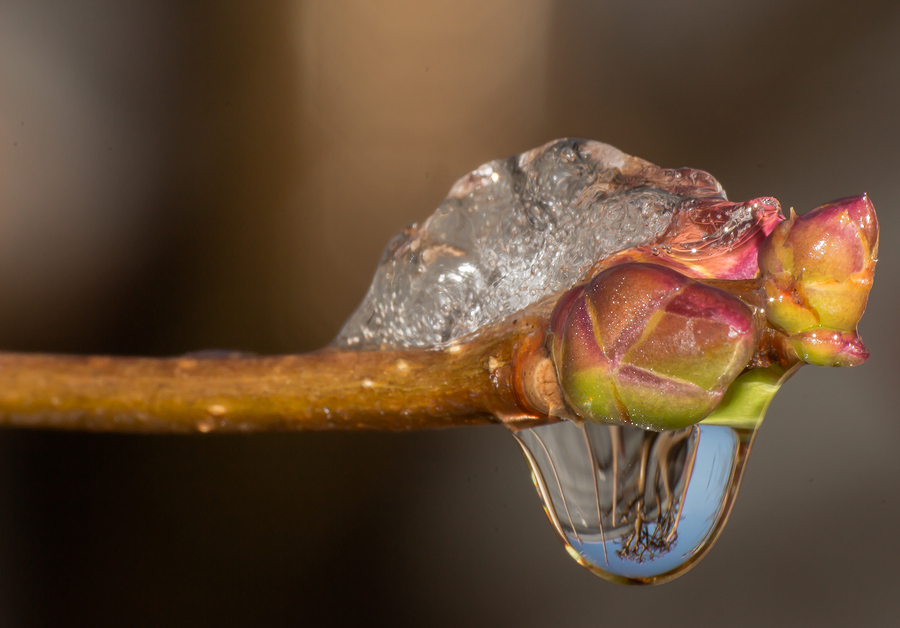
There is, this morning, the long-running voice of water on tin as the snowmelt falls from the gutter through its metal pipe to ground. Our intense winter gives up its ice grudgingly, but the morning sun says it must, and even ice can’t sass the sun on this 50-degree day.

Photo Credit: Bigstock

Photo Credit: Bigstock

Ice and water are on my mind because I’ve been thinking back to the work of teaching. The catalyst is an essay written by a former student, now in college, and sent on at my request. Scott recently reread Walden as part of his studies, and I had wondered in a note what struck him on this pass through. My experience has been that Walden is that rare book that bears rereadings across time and human ages.

So, this morning, as the water ran, I settled into a chair and read Scott’s essay. It was – no surprise to me – insightful and clearly written, but beyond that I was taken by its range. Here was writing that suggested that, for Scott, Walden had become a world in which he was free to wander, that the knottiness of its sentences and propositions had given way to a sort of landscape to be sauntered, known and drawn upon easily.

My experience reading Scott’s work made water of another sort of ice – a teacher’s sense of what happens when his students read a long-studied work freezes at the moment of teaching, in the memory of class. But, of course, students move on, flow on; in truth, there is no ice, no fixed sense, at all in their readings. And I have been reminded of this by the morning work of Scott’s words. A paragraph that makes good sense of Thoreau’s “spring work,” his house-building at Walden Pond follows.

May each of you find the flow of spring in your own mornings these days; it seems, as Thoreau knew, just the right time to construct another year.

“The remade origin-myth of Walden Pond runs parallel to the autobiographical account of how Thoreau set up housekeeping there. The communicative closeness with divinity that Thoreau feels so intently during his recorded year is an outgrowth of the etiology that he forms for his “experiment.” It is not incidental that he begins to build a house “near the end of March,” at a time when the “torpid state” of wintertime transforms into a “higher and more ethereal life”; here begins the narrative of seasonality at Walden, which will conclude itself by coming into the same springtime which nurtures Thoreau’s optimistic impulse. As springtime is the morning of the year, it shares the sanctity of the antemeridian hours. “What should be man’s morning work in the world?” Thoreau asks, fervently, in “Economy.” “Morning work” is both sanctified and sanctifying, and what Thoreau chooses to do in the morning – to build a house and thus found his experiment – gains an equally spiritual dimension. Emerson posits, “The knowledge of man is an evening knowledge, vespertina cognitio, but that of God is a morning knowledge, matutina cognitio.” To work in the morning is hence a higher calling which begets a superior form of understanding. House-building, a seemingly human activity, nevertheless has the potential to make Thoreau conversant with the higher truths of divinity. Long after the house is finished, in “The Pond in Winter,” Thoreau recounts that after a turbulent sleep, “I awoke to an answered question, to Nature and daylight.” This is the “morning knowledge” which he has gained, and for which the pond has acted as an intermediary between his human, questioning state and the godly answer.”                     – Scott Berkley

Roadentia

As noted in a prior posting, we’ve been on the road lately, and the miles of wheeling south have made me think about, well, roads. Always, as we drive, I am aware of bisecting some landscape, of riding right through it at a speed that outpaces perception. Some of that thinking crystallized this morning when I read a posting – What Have Roads Wrought – on the New Yorker’s website.

As often happens when I read studies of ecological observation and effect, I thought of Henry Thoreau and the roads – both highway and railway – that passed by and, at times, animated his stay at Walden Pond. The pond’s east end is skirted by Route 126, and, famously, its west end has 1844’s Fitchburg Line as a tangent.

In the “Sounds” chapter, one of my favorite sections of Walden, Thoreau considers the complicated realities and possibilities of the train: it is both fearsome and expansive: “We have constructed a fate, an Atropos, that never turns aside (Let that be the name of your engine)…I am refreshed and expanded when the freight train rattles by me…I feel more like a citizen of the world [at the sight of the passing freight from around that world.]” The railroad is tireless and relentless and not subject to Nature, but it carries with it a broader sense of the world.

So too these other roads, the highways on which we drive.

Michelle Nijhuis’s New Yorker post – http://www.newyorker.com/tech/elements/roads-habitat-fragmentation?intcid=mod-latest – summarizes decades of some of the Manaus [Brazil] project’s research on habitat fragmentation brought on by our development of roads on which we drive our own “iron horses.” Chief among its findings are precipitous declines in species – flora and fauna – that arrive with roads; that seems especially true along the edges that line our roads. And, of course, the more roads we build the more edges we create.

What caught my eye (and returned me to Henry Thoreau) was the following statement from professor Nick Haddad of North Carolina State University:

The study also demonstrates, using a high-resolution map of global tree cover, that more than seventy per cent of the world’s forest now lies within one kilometer of such a [roadside] edge. “There are really only two big patches of intact forest left on Earth—the Amazon and the Congo—and they shine out like eyes from the center of the map,” Haddad said.

Two thoughts floated up from memory. The first took me back to Estabrook Woods, in my mind Thoreau’s north pole of Concord. In the early 1960s Concord businessman Tom Flint was flying back into Boston and doing what we all do when given a window seat – he was watching the strings and blobs of lights that show where we live. He noticed a large dark patch. “Where’s that undeveloped forest/land?” he wondered to himself. Flint discovered that it was Estabrook Woods, which turned out to be the largest contiguous patch of undeveloped land within the Rte 495 belt. Flint’s discovery launched a 30-year effort to keep Estabrook Woods intact, which, despite a Middlesex School intrusion for athletic fields, it mostly is today.

In Estabrook’s deepness, back from the roads that ring it, a walker can find goshawks, pileated woodpeckers, and Thoreau’s favorite bird, the wood thrush, all species that require uninterrupted forest.

Far (or not so) from the Madding Road

Far (or not so) from the Madding Road

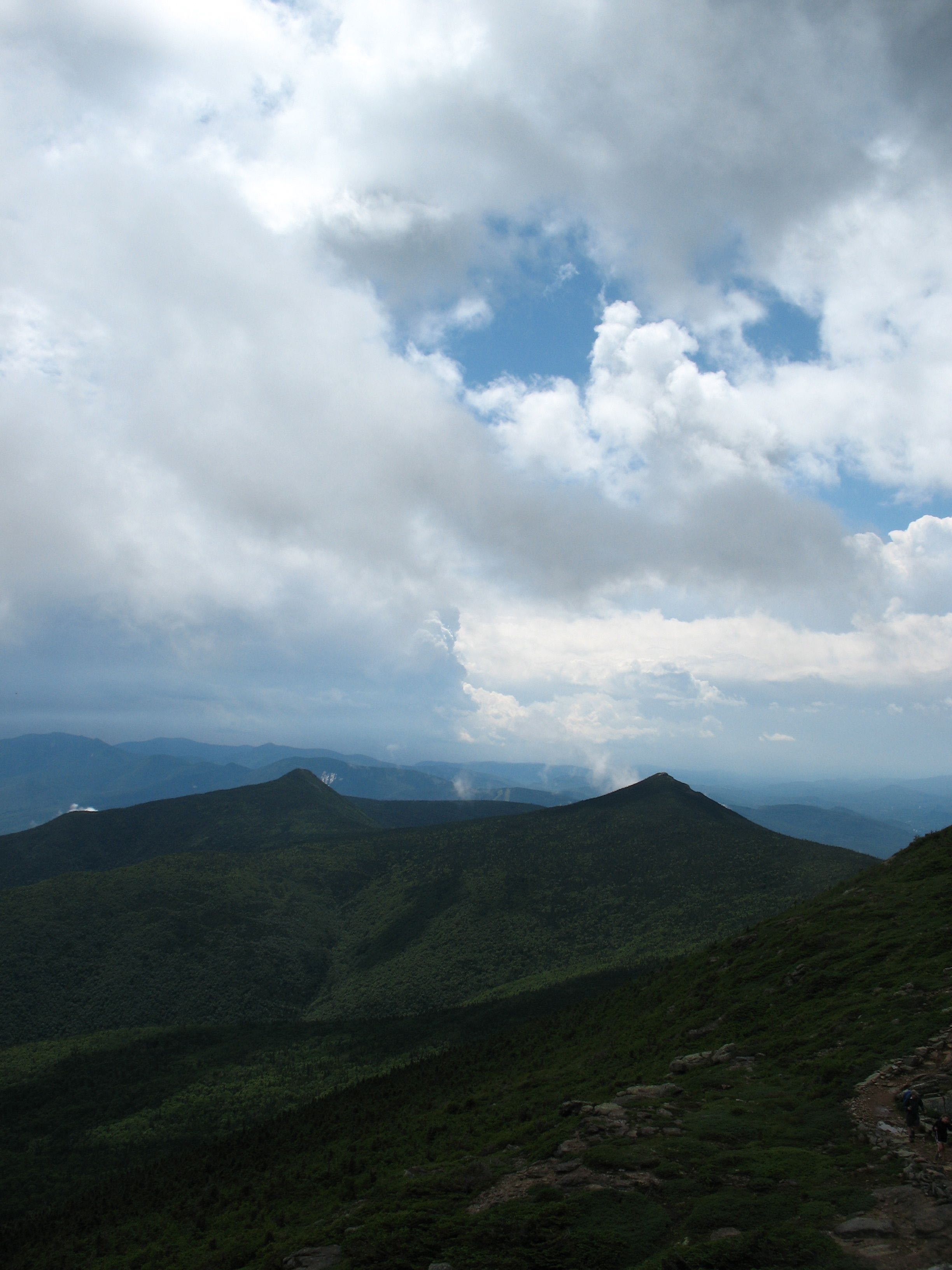
The other thought is a common “game” for wilderness walkers – how far from a road are we? Or, put differently, what’s the most remote spot we can walk to (remote being defined as farthest from a road). It is – surprisingly or unsurprisingly – hard to get many miles away. In the lower 48 states, for example, the point of greatest remove from a road was tracked by Backpacker writer Mark Jenkins in 2008: “Astonishingly, in the entire continental U.S., coast to coast, Mexico to Canada, there is only one place left where you can get more than 20 miles from a road: in the greater Yellowstone region.” (See more at: http://www.backpacker.com/trips/wyoming/yellowstone-national-park/destination-nowhere/2/#bp=0/img1)

In “Sounds” the train goes by, and throughout the night Thoreau rides his most expansive vehicle, that of his imagination. The chapter ends decisively with an image of unfragmented Nature: “Instead of no path to the front yard gate in the Great Snow, – no gate,-no front yard,- and no path to the civilized world.”

IMG_0903

Back on the asphalt paths, I’m thinking again of Nijhuis’s post and this note: “Roads scare the hell out of ecologists,” William Laurance, a professor at James Cook University, in Australia, said. “You can’t be in my line of business and not be struck by their transformative power.”