The Farm Next Door

Getting to know Thoreau Farm’s neighbor, Gaining Ground

“I came to love my rows, my beans, though so many more than I wanted. They attached me to the earth, and so I got strength like Antaeus. But why should I raise them? … What shall I learn of beans or beans of me?”
-Henry David Thoreau, “The Bean-Field,” Walden

Writing there in Walden of his (successful) experiment in the bean-patch, Henry Thoreau got down to basics (as he had a tendency to do). Down to the fundamental questions: Why should I raise them? What shall I learn? And learn not only about the beans but about himself.

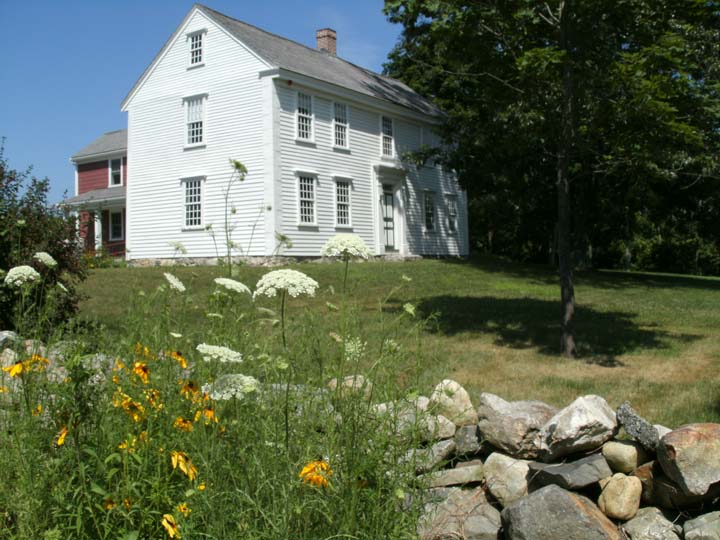
At the outset of my very first post on this blog, back in February, I mentioned that the Thoreau Farm property (the parcel owned by Thoreau Farm Trust on which the birthplace house sits) is adjacent to — in fact seamlessly connects with — a community farm and food project called Gaining Ground, dedicated to hunger-relief in the Boston area.  Situated on 17 acres leased from the Town of Concord — on some of the oldest continually cultivated land in America (farmed for more than 350 years) — all of the farm’s organically-grown produce , more than 20,000 pounds per year, is donated to food pantries and meal programs, consumed within 20 miles of the farm and within 24 hours of harvesting. Community volunteers provide roughly two-thirds of the labor. Continue reading

As I said in that first post, it’s hard to imagine a better neighbor to Henry’s birthplace: an organic farm with a social conscience. Somewhere in that combination, I think, lies an answer to those basic questions Henry asked of himself and all of us. Because for Henry Thoreau, naturalist and abolitionist, living in harmony with nature meant acting in solidarity with his fellow human beings.

I’ve been wanting to write a post on Gaining Ground since the moment I saw it last winter. Not because I’m any sort of a farmer (though I’m only one generation removed from a small, hardscrabble farm in northeast Texas) or even much of a gardener. Sadly, I’m neither. Rather, it was because I immediately felt the pull of the place’s idealism mixed with pragmatism. There’s nothing abstract about the place or the project. Its mission, stated simply, is to “grow food and give it away to people who need it. For free.”

The farm’s philosophy and “model” is spelled out lucidly (and enjoyably) in “Gaining Ground: A Model of Hunger Relief and Meaningful Volunteerism” (pdf). The document tells a bit about the project’s history — founded by Concord resident Jamie Bemis in 1994 as simply a small garden on private land, later moving to the current location in 1999, expanding the operation — and suggests what makes it different:

There are other models for what we do. Community supported agriculture (CSAs) grow food with the financial support of community shareholders. Community gardens bring together gardeners on communal plots of land. And some progressive commercial farms devote space to growing food for hunger relief. We’re something different — a unique combination of hunger relief and community volunteerism. All of the food we grow is given away to people who need it — for free. This refreshingly simple approach lets us focus on meeting the needs of our volunteers and recipients, rather than on sales. It lets us provide healthy produce to people who need it most, while offering new volunteer opportunities to a wide range of people. These two aspects of our work are closely intertwined — one wouldn’t work without the other.

The document goes on to elaborate on the Gaining Ground “values,” including “Experience — we nurture joy and wonder in our garden,” “Scale — we respect the power of small,” and “Sustainability — we grow in a careful, considered fashion.”  Another value seems to be a healthy sense of humor. Under “How to Have Fun”:  “If you don’t know how by now, you can always learn…. Keep it light. Avoid phrases like ‘sustainable food systems’ and ‘teen empowerment.’ … Don’t think of it as saving the planet.”

And as they point out, it’s a model that appears to work. They’ve been thriving now for nearly two decades. Just think how many tons of food has been given away.

(A side note for Thoreau buffs: Gaining Ground also operates the kitchen garden at the Old Manse in Concord, based on the heirloom vegetable garden Henry created as a wedding present for Nathaniel and Sophia Hawthorne in 1842.)

Gaining Ground farm managers Michelle De Lima, left, and Kayleigh Boyle. (Photo: Gaining Ground)

This past Saturday I volunteered at the farm for the first time (something I plan to do a lot more of), helping farm manager Michelle De Lima and two other volunteers — teachers at the Carroll School in neighboring Lincoln — plant beds of flowers, which will be given away along with the produce. Next time, Michelle promised, I’ll get to help grow some food! (If you want to volunteer, either by yourself or as a group, check out this useful section on the website.)

Last week, leading up to my first volunteer visit, I sent Michelle and her co-manager, Kayleigh Boyle, a few questions by email, which they generously took time to answer (see below). Michelle, 29, is a graduate of Brown University, where she majored in Latin American studies, and Kayleigh, 25, is a graduate of Emerson College, where she (impressively!) created her own major: non-profit marketing.  They’ve been farming at Gaining Ground for several years now, and have been the farm managers since January 2011. They also, as of this season, oversee the kitchen garden at the Thoreau Farm birthplace house next door.

Just to get a quick sense of the operation, I asked Michelle what crops are currently in the ground, and what’s just about to be planted. She replied:

In the ground: peas, radishes, turnips, tat soi (an Asian green), Napa cabbage, red and green cabbages, broccoli, kale, collards, baby bok choi, fennel, lettuce, beets, carrots, potatoes, onions, leeks, parsnips, summer squash, zucchini, and flowers. Plus perennials: strawberries, raspberries, asparagus, rhubarb, herbs, fruit trees, blueberries.  Going in this week or next: tomatoes, eggplant, sweet & hot peppers, basil, green beans, more beets, carrots, and lettuce. Waiting in the wings (a.k.a the greenhouse): winter squash, pumpkins, musk melon, water melon, cucumbers.

That’s a lot of food. All of it going where it’s really needed.

My email exchange with Michelle and Kayleigh follows. We hope you’ll join the conversation.

(P.S. I should note: Thoreau Farm needs your support as well. If you care about the legacy of Henry David Thoreau, and putting his ideas into action today, please consider making a donation and becoming a member. Many thanks.)

-Wen Stephenson

*     *     *

WS: What’s happening at the farm right now? What are your days like at this point in the growing season?

KAYLEIGH BOYLE: This week things are a little stagnant because of the continuation of last week’s wet weather.  Weeding and tilling are tougher when the land is wet, and we don’t really have anything urgent to go in the ground right now. We’re teetering on the time when frost-sensitive plants go out, but we’re biding our time until we’re absolutely sure no hard frosts will surprise us.

On this week’s agenda is our first round of weeding in our spring field (crops include cabbage, kale, broccoli, lettuce, and fennel).  We will also be tilling and prepping the land for next week’s planting of  tomatoes.  Little things include orchard care, the trapping of a woodchuck by way of overripe cantaloupe, and trapping of slugs by way of PBR.

WS: PBR?

DE LIMA: PBR as in Pabst Blue Ribbon — not some sophisticated organic pest management system.  We used little cups of beer set in the asparagus patch to attract and drown slugs.

Kayleigh covered the basics, so I’ll just add a little.  I find this time of year both exciting and a bit daunting.  It’s exciting because we’re finally getting to do the things — preparing fields and planting — that we’ve been planning over the winter, but it’s also intimidating because there’s no telling what the season will bring in terms of weather, pests, and diseases.

WS: How does this season — this spring — compare with previous seasons? What did the warm/dry winter, early spring, and hard frosts mean for the farm?

DE LIMA: At this point, I hardly feel like there is a baseline to which I can compare this spring’s weather.  The last few years have been all over the place in terms of temperature and precipitation, but this one certainly seems extreme in its variability.

The warm winter made sugaring more difficult, because low sugar concentrations meant that we had to use a lot more time and firewood to convert sap to syrup.  The warm, dry early spring made it harder to get cool weather crops like peas, cabbage, broccoli, and kale established.  We had to irrigate in April, which is a scary first.

Most of the crops have recovered and seem to be enjoying the cool, wet weather we’ve been having.  The hard frost after all of that warmth damaged some of our fruit tree blossoms, which luckily won’t matter much this year as the trees are too young to bear fruit anyway.  We, and other farmers, are seeing early and strong emergence of some pests due to the warm winter and early spring, and I imagine that will continue as the season progresses.

BOYLE: This is my fourth season at Gaining Ground, and not one spring season has been the same — though I can say this spring was drier than any I have experienced in the past.  The dry early spring made for easy tillage of the land, no worries about getting stuck in the mud with our new tractor.  The downside was the desperate need for our drip irrigation system as soon as our first spring field was planted.  It was definitely strange to be running irrigation in April.

WS:  Is the changing climate a concern for you as a farmer? If so, how does it affect your work, on a practical level and in terms of your overall outlook? (If you read my interview with Amy Seidl, who talked about farmers in Vermont, you’ll know that this is something I’ve been thinking about lately.)

DE LIMA: The changing climate is a huge concern for me as a farmer and human being.  It’s something I’ve been thinking and worrying about for ten years, but this year’s freaky weather, including an April hail storm, and the experience of running irrigation two months before we usually do, really brought home to me the fact that climate change is happening here and now.  The extreme variability of precipitation, alternating between periods of no rain and periods of frequent storms, is the thing that concerns me most.  Farming in New England has never been easy or predictable, but I think it is becoming even harder to plan for, making observation and flexibility even more important.  It is all pretty unsettling, but, despite the challenges, I am still happy to spend my days growing food.

BOYLE: I feel like our seasons have become more unpredictable – for example, this past year’s warm winter,  this year’s dry spring, and multiple days last summer with temperatures of 100+ degrees. These are weather patterns I wouldn’t expect for New England. The thing is, certain crops thrive in all of those conditions, but we don’t know what the conditions will be until they are on top of us.  As a farmer you are ordering seeds in January for what you are going to be planting in April; you cannot change crops at the last minute according to the weather.

It seems like Eastern Mass. has already started to adapt to the warming weather. People don’t wait until Memorial Day to put out their tomatoes anymore.  That could be looked at positively, since that means more tomatoes in a longer season, but I also think of the effects it has on something like maple sugaring.  Sugaring is entirely dependent on cold winters and the steady warming of temperatures in the spring, so a changing climate could make it impossible to produce in this area.  It is such a special product that is made in such a small part of the world, that would be a huge loss.

WS: I’m curious whether you know many others roughly your age who are working in local/sustainable agriculture? How do you see GG in relation to the wider culture and society in which you grew up and came of age? Is there something a little bit “counterculture” about small-scale organic farming as a career or line of work? (Do you think of it as a career?)

DE LIMA: I’m 29, and I do know lots of people my age who are farming, mostly women.  And I think there is something “counterculture” about it, in that a lot of growers do not fit in, or want to fit in, with the prevailing consumer culture.  That’s not to say that we are cut off entirely from the mainstream, like the “back to the land” folks were — many of us live and/or work in cities and work with the public in various ways.  However, I do think a lot of us are turned off by the materialism, inequality and environmental degradation that consumer culture is built on, and have come to farming because it is tangible, satisfying work that we can feel good about doing.

BOYLE: I am going to be 26 this June, and when attending Eastern Mass. CRAFT meetings, weekly educational farm visits during the season, I see a lot of people my age who work on farms in the area.  My childhood best friend is working on a farm in Western Mass. Both of us got into farming at the same time even though it wasn’t our initial plan.

I grew up in a rural Vermont town where farming was the lifestyle for a lot of the native Vermonters.  It was also the career of a lot of back-to-the-landers, who decided to move to the area to start farming for the first time.  But growing up it was a line of work you didn’t want to get into because you saw how people struggled and had to close down their farms when they could no longer support themselves.  For me, I look at farming differently now, not just as a career but as being part of a great movement.  Since it is a hard way to make a living it has to be something you care deeply about.  Farming is the best sort of direct action — it involves a lot of doing, versus a lot of sitting around and talking. It makes for a literal ”working from the ground up” to make a change.

WS: I’m interested in what drives you personally. What led you here? What motivates you?  There must be a healthy amount of idealism under-girding a project like Gaining Ground, but it’s obviously anchored or rooted in real pragmatism as well. That mix of the idealistic and the pragmatic is really potent (and of course has a long and rich tradition in social-justice movements).  But maybe you don’t think of it in those terms — those are just my terms, looking in from the outside. So, tell me, what it is that really drives you to do what you’re doing?

BOYLE: I found Gaining Ground after working a park ranger, another job that allowed me spend my days outside.  Though I quickly found I wasn’t satisfied with the organization I was working for.  I didn’t feel like they took care of the park in ways I agreed with, using chemicals for weeds and lacking any composting or recycling programs.  Farming and food became something I wanted to pursue because I felt that food was related to so many other issues in society; poverty, health/nutrition, climate change, big business, and politics.  Gaining Ground seemed like a perfect fit for my ideals, while not taking itself too seriously.  Also, farm work is so appealing because it is tangible.  It gives you a real sense of accomplishment, which I think is hard to find in a job today.

DE LIMA: The mix of the idealistic and the pragmatic is exactly what I love about this work.  I have grappled with how best to address environmental degradation and social injustice since I began to be aware of them in my adolescence.  During college I considered policy, law, social work, and education, trying to figure out how I could be most useful.  I began volunteering at an urban farm in Providence and found that I loved being outside digging in the dirt and nurturing plants.  I went to work on a farm in Vermont after college and continued farming more because I liked it and didn’t know what else to do with myself than because I was consciously choosing it as a “career.”  Now, it’s become a way of life that I can’t really imagine giving up.

I came to Gaining Ground because I had been frustrated that the fruits of my labor at other farms were affordable to so few people.  The farmers I worked for in Vermont were good people who did what they could to donate and subsidize CSA shares, but there is only so much you can do when you’re struggling to make a profit.

There is so much about our food system and economy in general that is unjust and simply does not work. I dream of a world in which farmers can make a living and all people can afford to eat well, but I really don’t know how to get there.  Gaining Ground is only one small effort in that direction, but I hope we have some kind of a ripple effect and that the connections our recipients and volunteers make to good food and caring for the land will inspire them to work for a better food system in whatever way they can.

WS: Who are your heroes?

BOYLE: Michael Pollan and Vandana Shiva were some of the first authors I read to discuss food and farming in a way that caught my attention and led me to learn more.  On a less serious note, I love The Onion and George Carlin.

DE LIMA: I’m not sure I have heroes, per se, but I’ll tell you about a couple of great people I’ve known.  My fourth-grade teacher, Mrs. Williams, had a huge influence on me.  She took our class on nature walks, teaching us about plants and wildlife and having us sit quietly in the woods.  She also taught us about greenhouse gasses at a time when I think most adults in the US were not aware of them.  She inspired me to plant my first–rather unsuccessful–vegetable garden at home.

My friend Rachel has also been a strong influence in my life.  We’ve been friends for about nine years and she has helped me to become, or at least want to become, a more compassionate, gentle person.  She has a lot of wonder and appreciation for the beauty in the natural world and in other people (which are not really two separate things) and fosters the same in everyone who knows her.

———————————-

Leave a Comment

Filed under The Roost

Climate and the Very Serious, Cont.

The RoostThe New Yorker goes deep on geoengineering. Is this what it looks like when our Very Serious media take the climate seriously?

[UPDATE, 5/10/12: NASA's James Hansen has a hard-hitting op-ed in today's New York Times, which shows us what it looks like to take climate seriously. "Global warming isn’t a prediction. It is happening," he writes. Describing near-term scenarios, he continues, "If this sounds apocalyptic, it is. This is why we need to reduce emissions dramatically." Bottom line: "The science of the situation is clear — it’s time for the politics to follow."]

.   .   .

Back in March, just after we launched this blog at Thoreau Farm, I asked David Roberts of Grist in an email exchange what it would look like if our “Very Serious mainstream media” (as he likes to call it) started taking climate change seriously. If you missed it, the resulting exchange is worth reading (and was cross-posted at Grist).

Well, it may not have led the evening news (or even made it into your newspaper), but this past Saturday, we got to see what it looks like when ordinary citizens — all over the planet — take climate change seriously.

May 5 was the first “Connect the Dots” Climate Impacts Day, the latest “global day of action” spearheaded by Bill McKibben and 350.org. The idea was simple: thousands of people, in communities around the world, who are already feeling the impact of global warming got together for group photos, holding homemade “dots,” and sent them to 350.org. There, they joined a spectacular — and often moving — photostream at ClimateDots.org, “connecting the dots” between extreme weather and climate change (as scientists are already doing), and calling for action. (I organized an event in Wayland and spoke at the event in Concord, where more than a hundred people gathered at the Old Manse, right next to the Old North Bridge. You can see a great collection of photos from around Massachusetts at 350MA.org, a new statewide grassroots network that I’m helping to organize.)

One kind of “climate action” I didn’t see or hear mentioned on Saturday is the highly controversial (some say crazy) idea of “geoengineering.” For that, though, you can turn to this week’s issue of The New Yorker, its splashy “Innovators” issue, and a big piece by Michael Specter titled “The Climate Fixers.”

Everyone should read this piece, or at least the first two sections. Not because it adds terribly much to the well-covered topic of geoengineering (i.e., human manipulation of the atmosphere to counter the effects of climate change), but because Specter’s opening pages are as close as anything I’ve seen, in a “Very Serious” publication, to what I call the “WE’RE F****D. NOW WHAT?” framing of the climate story. A framing, in other words, that begins to level with readers about the extremity of the situation. Continue reading

Specter opens with the 1991 eruption of Mt. Pinatubo in the Philippines, which lowered global temperature by nearly three-fourths of a degree Celsius in a single year (as much as the climate had warmed over the previous hundred) and disrupted precipitation on multiple continents, leading to major floods and drought. “Most people considered the eruption a calamity,” Specter writes. “For geophysical scientists, though, Mt. Pinatubo provided the best model in at least a century to help us understand what might happen if humans attempted to ameliorate global warming by deliberately altering the climate of the earth.” Then he lowers the boom (and it’s worth quoting at some length; emphasis added):

For years, even to entertain the possibility of human intervention on such a scale—geoengineering, as the practice is known—has been denounced as hubris. Predicting long-term climatic behavior by using computer models has proved difficult, and the notion of fiddling with the planet’s climate based on the results generated by those models worries even scientists who are fully engaged in the research. “There will be no easy victories, but at some point we are going to have to take the facts seriously,” David Keith, a professor of engineering and public policy at Harvard and one of geoengineering’s most thoughtful supporters, told me. “Nonetheless,” he added, “it is hyperbolic to say this, but no less true: when you start to reflect light away from the planet, you can easily imagine a chain of events that would extinguish life on earth.”

There is only one reason to consider deploying a scheme with even a tiny chance of causing such a catastrophe: if the risks of not deploying it were clearly higher. No one is yet prepared to make such a calculation, but researchers are moving in that direction. To offer guidance, the Intergovernmental Panel on Climate Change (I.P.C.C.) has developed a series of scenarios on global warming. The cheeriest assessment predicts that by the end of the century the earth’s average temperature will rise between 1.1 and 2.9 degrees Celsius. A more pessimistic projection envisages a rise of between 2.4 and 6.4 degrees—far higher than at any time in recorded history. … Until recently, climate scientists believed that a six-degree rise, the effects of which would be an undeniable disaster, was unlikely. But new data have changed the minds of many. Late last year, Fatih Birol, the chief economist for the International Energy Agency, said that current levels of consumption “put the world perfectly on track for a six-degree Celsius rise in temperature. . . . Everybody, even schoolchildren, knows this will have catastrophic implications for all of us.”

… Deliberately modifying the earth’s atmosphere would be a desperate gamble with significant risks. Yet the more likely climate change is to cause devastation, the more attractive even the most perilous attempts to mitigate those changes will become.

“We don’t know how bad this is going to be, and we don’t know when it is going to get bad,” Ken Caldeira, a climate scientist with the Carnegie Institution, told me. In 2007, Caldeira was a principal contributor to an I.P.C.C. team that won a Nobel Peace Prize. “There are wide variations within the models,” he said. “But we had better get ready, because we are running rapidly toward a minefield. We just don’t know where the minefield starts, or how long it will be before we find ourselves in the middle of it.”

Again, what’s significant about these paragraphs (and the rest of the piece, which I recommend reading) isn’t so much what they say about geoengineering — the outlines and extreme risks of which have been known to Very Serious readers for some time now — but rather, the way it paints the rationale for seriously considering geoengineering in such stark terms.

For Very Serious media types in Manhattan and D.C. (some of whom are my friends and former colleagues), David Remnick’s New Yorker is at the pinnacle of Seriousness.  If that magazine is discussing, in the feature well of its highly visible Innovators issue, the fact that we are now sailing into a climate sh*tstorm that makes even geoengineering look like a sane, if desperate, consideration — well, I’m prepared to venture that something interesting (and long overdue) is happening to our national media “discourse” (to use the suitably Serious word). Obviously, The New Yorker‘s Elizabeth Kolbert (author of Field Notes From a Catastrophe) has been on the climate case for years and is filing increasingly alarming dispatches. But I haven’t seen anything quite like the dire logic of Specter’s framing.

(Worth noting, too, that the same Innovators issue carries a profile of MIT’s Daniel Nocera [subscribers only] and his work on artificial photosynthesis as a potentially revolutionary advance for low-cost, decentralized, widely distributed solar energy.  Nocera came up in my recent interview with Vermont ecologist Amy Seidl, who admires his work. But that’s a whole other topic for another day.)

Now for what’s disturbing about Specter’s piece (beyond the subject itself!): it essentially bypasses all of the decidedly sane responses to the climate crisis that haven’t really been tried yet — like, say, carbon pricing, massively increased investments in clean energy technologies (both deployment and R&D), and real global commitments on both emissions and adaptation — in favor of the far sexier “true Sci-Fi” angle of geoengineering. As an attention-getter, fine. It works. But as a “Serious” treatment of the climate crisis? Can’t we at least talk about the other stuff — the stuff that would jump-start a transition away from fossil fuels, with all deliberate speed — before we trot out geoengineering again? (At least Specter’s treatment is better than that found in SuperFreakonomics, which his colleague Kolbert eviscerated in a 2009 review.) And given that a whole lot of climate change is already “locked in,” shouldn’t we be talking about the immediate necessity of adaptation — “managing the unavoidable” — especially in the poorest and most vulnerable parts of the world, before we talk about last-ditch gambles? It strikes me as another form of avoiding the real subject.

.   .   .

Incidentally, Joe Romm has an important post at Climate Progress, titled “‘Hug The Monster’: Why So Many Climate Scientists Have Stopped Downplaying the Climate Threat,” highlighting a piece by ABC’s Bill Blakemore that offers some advice to the media about its climate coverage. As Romm writes, Blakemore’s piece “helps dispel the myth that climate scientists have long been overhyping climate impacts — when everyone who actually follows climate science and talks to any significant number of climate scientists knows that the reverse is true.”

One of the leading climate scientists quoted by Romm and Blakemore is MIT’s Kerry Emanuel (who, it so happens, is a Republican and nobody’s idea of an alarmist). Emanuel spoke to a group of us in Wayland back in January, and one of the main points he made is that uncertainty in climate science, especially when it comes to predicting future impacts, cuts both ways.

“We’re very uncertain about the future,” Emanuel told us. “We cannot state with confidence that the warming is going to be what we project it to be. It could be a lot less. It could also, with equal probability, be a lot more. It’s a double-edged sword. Uncertainty doesn’t translate to ‘no worries, mate.’ It’s the opposite. We have, on the high-end of the probability curve, we have some pretty scary scenarios. … And if we want to act, we have a very narrow window of opportunity.”

That window may be closing fast — but as far as we know, it hasn’t closed yet. (According to one head-turning analysis last fall, by the International Energy Agency, we have less than five years to begin a major transformation of our energy infrastructure.) Until it’s clear that it has closed, it seems to me that any sort of defeatism (which is what geoengineering really amounts to) is indefensible.

It’s up to all of us to create the kind of pressure that will force governments to take decisive action. That’s going to require a bottom-up political movement like nothing we’ve ever seen – and something like a “politics of hope.” Maybe we can see the stirrings of it in the Keystone XL Tar Sands protests, in the Beyond Coal campaigns — and even in the photos of ordinary people around the world holding “climate dots” with their neighbors and making the connections that too many, in positions of power and influence, are still failing to make. Look at those photos and you’ll know who the serious people really are.

-Wen Stephenson

2 Comments

Filed under The Roost

Thoreau Farm Opening

It was a combination of old and new at the Thoreau Farm opening this past Sunday. It was out with the old and in with the new as we took down the old sign announcing the beginning of the preservation project and unveiled our brand new sign with its book and acorn logo that surely will turn heads on Virginia Road.

Visitors got a sneak peak at the new smartphone application that will be installed at Thoreau Farm later this month. Through a series of short videos – complete with music and story – visitors can explore Thoreau Farm in a new, dynamic way. Continue reading

Lou Ureneck arrived at Thoreau Farm in the afternoon to talk about his book Cabin: Two Brothers, a Dream, and Five Acres in Maine. He was witty, funny, and compelling as he read from this simply elegant memoir in which he uses a building project and rootedness in place as a way to rediscover his truest self.

And there was much to cheer about as Board President Nancy McJennett announced to visitors our Massachusetts Historic Commission 2012 Preservation Award. Not only a significant preservation project, Thoreau Farm is a thought leader in “green preservation” and the Preservation Award reminds us of our duty to continue educating the public about why that’s so important and just how we did it.

If you couldn’t make it to Opening Day, we hope you’ll come by Thoreau Farm another time. There’s always a lot happening. And check out more photos on our Facebook page: Thoreau Farm on Facebook

Leave a Comment

Filed under News and Events

Our 2012 Season Starts May 6

Come join the celebration as Thoreau Farm opens for the 2012 season! An author event, signs coming down and going up, and we hear it might be the first day we’ve seen the sun in a while.

At 2:00, Lou Ureneck will be at Thoreau Farm to discuss his recent book, Cabin: Two Brothers, a Dream, and Five Acres in Maine. (You can read an excerpt here.)

We’ll be taking down our old sign and installing our beautiful new one!

And, we’ll be giving out our new, fabulous Thoreau Farm Continue reading

tote bags – perfect for your trip to the farm stands, the library, packing a picnic for Thoreau Farm or Walden Pond … just about anything. Get your coupon for your free tote bag here, and bring it to the Farm on Sunday.

There’s plenty to celebrate, so please make sure to stop by.

Where & When:

Thoreau Farm
341 Virginia Road
Concord, Massachusetts 01742

May 6, 2012
11:00AM – 4:00PM

2:00 PM: Lou Ureneck, author of Cabin: Two Brothers, a Dream and Five Acres in Maine

Leave a Comment

Filed under News and Events

Thoreau Farm Wins Preservation Award

Secretary of the Commonwealth, William Galvin, announced this week that Thoreau Farm has been honored with a 2012 Massachusetts Historical Commission Preservation Award in the categories of Restoration and Rehabilitation and Education and Outreach. Thoreau Farm was nominated for the award by the Concord Historical Commission.

In his congratulatory letter to Thoreau Farm, Secretary Galvin wrote: Continue reading

The Massachusetts Historical Commission sincerely appreciates all efforts to preserve the Commonwealth’s valuable historic properties. The careful restoration and rehabilitation of the Wheeler-Minot House [Thoreau Farm], and its function as an educational resource, demonstrates a strong commitment to historic preservation that goes well beyond what is normally expected. On behalf of the Massachusetts Historical Commission, I applaud this outstanding contribution to historic preservation.

Thoreau Farm Trust is deeply honored by the 2012 Preservation Award and very proud of this achievement. We are grateful to everyone who played a role in the preservation of Thoreau Farm.

Leave a Comment

Filed under News and Events

A Walk and a Talk

The Roost“In my walks I would fain return to my senses.”
-Thoreau, “Walking”

I managed to get out for a much-needed walk this morning, over to a nearby conservation area in Wayland, where I live. At the heart of it is a big, open swamp, a quarter-mile wide, surrounded by thickly wooded slopes, a pond at one end. The air was surprisingly cold. The water up a bit after last week’s rains. The geese were out with their young ones. Clear sky.

“I enter a swamp as a sacred place — a sanctum sanctorum. There is the strength — the marrow of Nature.”

That’s also from “Walking.” (And yes, I have a thing about that essay.)

Yesterday morning I was a guest speaker, along with two of my fellow initiators of Transition Wayland, at the historic First Parish (Unitarian Universalist) in Wayland center. I’m posting my talk here (you can read the others here). It’s not an exact transcript of my remarks (there was some ad libbing), but it’s pretty close. If you’ve been following this blog, some of it will sound familiar. The interviews and exchanges I’ve posted here in recent weeks were very much on my mind. Continue reading

-Wen Stephenson

*     *     *

Remarks at First Parish (Unitarian Universalist) in Wayland, Mass.

Sunday, April 29, 2012

Good morning. My name is Wen Stephenson. I want to speak to you now, not as a “member” of something called “Transition Wayland,” but simply as your neighbor. My wife and I have lived here in Wayland for 15 years this month. Our first house was right up the street at 23 Concord Rd., and I’ll never forget the first time I saw this beautiful building. We have two children: our son, who’s 12, and our daughter, who just turned 8 years old yesterday.

I want to be clear about something: I’m here today for them, my children. My children. But not only them — all of our children. Everywhere.

Last fall, I participated in a great Wayland tradition and rode my bike with my son’s 6th-grade class up to Walden Pond. Now, as some of you know, I’m a pretty big fan of Henry David Thoreau — so this was, like, one of the best days of my life! And I want to say a few words here about our neighbor Henry Thoreau, and why Walden matters now more than ever.

In his central essay, “Walking,” the essay that led to Walden, Thoreau wrote: “Above all, we cannot afford not to live in the present…. Unless we hear the cock-crow in every barn-yard within our horizon, it is belated…. There is something suggested by it that is a newer testament — the gospel according to this moment.”

Henry Thoreau understood the paramount spiritual significance of the present moment — or, what one of his 20th-century readers, the Rev. Dr. Martin Luther King Jr., called “the fierce urgency of now.” Thoreau’s great subject wasn’t simply “the environment” (a term he wouldn’t recognize) or even “nature.” It was our relationship, as human beings — physically, morally, spiritually, politically — to the world in which we live, which is to say, to everything, both human and wild, right where we are, right now, in the present moment.

And we should never forget that Thoreau’s spiritual awakening in nature led him back to society and to political engagement. Thoreau was nothing if not engaged. He passionately and actively opposed slavery. He was deeply involved in the Underground Railroad. He sheltered runaway slaves.

I keep coming back to this passage near the end of his great abolitionist address called “Slavery in Massachusetts,” delivered to a rally in Framingham — just down the road — on July 4, 1854, where he said this:

“I walk toward one of our ponds, but what signifies the beauty of nature when men are base?… Who can be serene in a country where both the rulers and the ruled are without principle? The remembrance of my country spoils my walk.”

But did it merely spoil his walk — or remind him of the walk’s real purpose? You see, for Henry Thoreau, living in harmony with nature meant acting in solidarity with his fellow human beings.

And if slavery was the great human, moral crisis of Thoreau’s time, then global warming — with its impact on countless innocent lives, far and near — is the great human, moral crisis of our own.

The hard truth — the scientific truth — about the present moment, our moment, is this: Given the global scale of the climate crisis, if we’re going to preserve a livable planet for our children and grandchildren — a planet on which enough crops can grow, on which storms and rising seas can be managed, on which peaceful, civilized societies can exist — it’s going to take more than small gestures of personal green virtue. Those small personal actions are beautiful and necessary. Morally necessary. But they’re nowhere near enough.

I’m sorry, but it’s going to require decisive government action.

And the only way that’s going to happen is if we make it happen – by building a powerful grassroots movement, beginning right where we live.

That’s exactly what more and more of us are doing – most visibly, with the growing, global grassroots movement 350.org, started by Middlebury scholar Bill McKibben, which has convinced the President of the United States to start taking climate change more seriously. And right here, as in many other states around the country, we’re building a new state-level grassroots network called 350 Massachusetts — 350MA.org. Because we need two U.S. Senators in Washington who take climate change seriously.

A Massachusetts politician once said, “All politics is local.” We have to change the political facts on the ground, at the grass roots, if we’re going to change the politics and the laws of this country. Only then can we begin to address climate change, and our children’s future, in a serious way.

Now, I know full well how hopeless and naive this all may sound. I spent two decades as a journalist observing national politics. But let me tell you something: abolishing slavery sounded hopeless and naive in 1854, when Thoreau gave that speech in Framingham. Ending Jim Crow seemed hopeless in 1955, when Rosa Parks stayed in her seat on that bus in Montgomery. Ending apartheid seemed hopeless in 1962, when Nelson Mandela went to prison. Even the election of an African-American law professor with the name Barack Hussein Obama seemed hopeless in 2007, when it was written off as a “fairy tale.” Now he’s the president of the United States — and it’s time to hold him to his word.

Yes, the hour is late. When you understand the science — the science that Prof. Kerry Emanuel of MIT explained to us, right here in this room, at a forum last January — the situation can appear hopeless. It’s easy to feel powerless.

Now, I’m about to go over my allotted time by about one minute. So I hope you’ll forgive me. It’s my own little act of civil disobedience.

Because what I really want to say to you, right now, as your neighbor, is this:

Don’t give in to the cynicism about our politics. If we do, then yes — it is, in fact, hopeless. So please, don’t retreat into cynicism. Don’t withdraw into your private fears. The remedy for cynicism and fear is action. Engagement.

So engage – here in your community, and in your state. Don’t give up on democracy. Don’t give up on your country. Engage.

Don’t give up on this planet. Don’t give up on your fellow human beings. Engage.

Don’t give up on your neighbors. Don’t give up on each other. Don’t give up on yourselves. Engage.

Don’t give up on your children, your grandchildren.

Don’t – give – up. Fight for your children and grandchildren. Engage.

The last lines of Walden are these: “Only that day dawns to which we are awake. There is more day to dawn. The sun is but a morning star.”

Wake up, our neighbor Henry is telling us. Start here. Start now. The sun is climbing the sky.

Thank you. Peace.

1 Comment

Filed under The Roost

Climate and the Politics of Hope

A conversation with journalist Mark Hertsgaard, author of Hot: Living Through the Next Fifty Years on Earth

Mark Hertsgaard, an accomplished global-environmental reporter, wants you to remember the first Earth Day, how it really started, 42 years ago, on April 22, 1970. He wants to remind you of the far-reaching change it brought about — under a conservative Republican president, no less.

In an editorial in this week’s issue of The Nation, Hertsgaard notes that here in the U.S., as Earth Day has become “a bland, tired ritual that polluters and politicians have learned to ignore or co-opt,” there are environmentalists who are ready to get rid of it altogether. But rather than do that, he writes: Continue reading

why not recall the real history of Earth Day and revive its original—and much more demanding—vision?

Organized in 1970 by Senator Gaylord Nelson and activist Denis Hayes, the first Earth Day so frightened president Richard Nixon that he decided he had to become an environmental president if he wanted to win a second term. And unlike later presidents who invoked that title, Nixon lived up to it. He created the Environmental Protection Agency, which today’s Republicans love to demagogue. His aides pioneered such transformative measures as environmental impact reports and regular pollution monitoring. And he signed landmark environmental laws—the National Environmental Policy Act, the Clean Air Act, the Clean Water Act, the Endangered Species Act and more—that on paper are still among the strongest in the world (indeed, that have been the model for the rest of the world’s environmental laws). …

In short, America’s first and biggest environmental victories were won after mass grassroots activism persuaded an otherwise indifferent president that he had to deliver or risk losing his job. Alas, this history seems to have been forgotten by many of today’s green activists, to say nothing of ordinary citizens.

Hertsgaard, the environment correspondent for The Nation, has written for two decades about climate change and the human side of our global environmental  crises, for magazines like The Atlantic, The New Yorker, Time, Vanity Fair, and others, and he’s the author of two important books on the subject: 1998′s Earth Odyssey: Around the World In Search of Our Environmental Future and last year’s Hot: Living Through the Next Fifty Years on Earth, which is just out in paperback this month.

The latter, which I reviewed for The New York Times Book Review, presents the clearest and strongest case I’ve seen for what Hertsgaard calls the “double imperative” of the climate fight: namely, because climate change is already upon us, we have to adapt and live through it even as we work as hard and as fast as we can to slow it down and, ultimately, stop it. With its eye-opening, on-the-ground reporting on adaptation efforts around the world (from U.S. cities to the Netherlands, Bangladesh, China, and the Sahel), Hot is one of the handful of recent books — along with James Hansen’s Storms of My Grandchildren, Bill McKibben’s Eaarth, and Amy Seidl’s Finding Higher Ground — that I tell people they must read if they want to understand the reality of our climate situation, and what we still can do.

I reached out to Hertsgaard as I was preparing to launch this blog, back in February, and asked if he’d be willing to talk with me about the reporting he’s done since Hot was published, on both climate adaptation (especially in agriculture, in Africa’s Sahel and beyond) and on grassroots climate politics in the U.S., including the success story (as he wrote this month for Mother Jones) of the Beyond Coal campaign.

Hertsgaard and I spoke by phone on April 13, and our conversation caps a series of interviews and exchanges on climate, culture, and politics that I’ve posted here on The Roost since early March — with David Roberts of Grist on climate and the Very Serious media, Bill McKibben on the climate justice movement, Paul Kingsnorth on what hope looks like in the face of collapse, and Amy Seidl on building resilience right where we live. There will be more — fear not! — but this rounds out the first installment of these conversations.  I hope they’re food for thought — and more than thought. Action.

“Action from principle, the perception and the performance of right, changes things and relations; it is essentially revolutionary.” -Thoreau, “Civil Disobedience”

-Wen Stephenson

*     *     *

WS: When I reviewed Hot, last year, I started out by saying I hadn’t had “the talk” yet with my kids (who are now 12 and 8) about global warming. But then, I said, we grown-ups haven’t had the talk yet among ourselves, really. We don’t seem to know how. It’s too scary. Or maybe it’s not scary enough, for a lot of people, because they don’t know enough about it. And I went on to praise the book for trying to jump-start that conversation.  So are we, as grown-ups, having that talk yet among ourselves?

MARK HERTSGAARD: It’s hard to generalize. Some people are.  But we’re certainly not having it through the mainstream media. Now, are we doing it more among ourselves, in the private sphere, at our churches, at our schools, among our friends, on poker nights, or picnics? I don’t think so, not yet. I don’t hear it.

But I’m working with some close colleagues to try and change that. We’re going to try and organize parents — “Climate Parents” — to give a voice to parents about this. I think there are a lot of people who know, perfectly well, that the climate is scary, and parents in particular. They’re scared, but they don’t know what to do. And so, as a result, they practice what I call soft denial.  It’s a different kind of denial than the nonsensical, economically or ideologically based denial that we’re so familiar with. Soft denial is when people know perfectly well what’s going on — and are scared about what it means, both for them and especially for their children or grandchildren — and yet they continue to carry on with their lives as if it’s not this five-alarm fire that is about to burn down their kids’ house.  And that is what we hope to change with this group, Climate Parents.  Parents are probably the single most under-organized constituency on climate change. And if we can change that, if we can let them get in touch, not only with the danger, but the opportunities — and I would even go so far as to say the obligations, as a parent — to speak out and take action on this, we think big things could follow.

WS: Has it launched yet? Will there be a big rollout?

HERTSGAARD: Probably sometime between Mother’s Day and Father’s Day we’re going to roll it out, hoping to do a national day of action. The news hook is the new national science education standards for K-12 that are being promoted this year by the National Research Council, which is part of the National Academy of Sciences, and the pushback from the Heartland Institute types, who want their nonscientific curricula put forward. And we are going to try to get parents to support the national science standards, as a first step to get them moving on this issue. And then, frankly, we hope to move them to do more.

WS: When you look at the climate science and the rate of global greenhouse emissions, it seems impossible now to prevent anything less than a 2-degree Celsius (3.6-degree Fahrenheit) global temperature rise, above pre-industrial levels, this century. And if you realize what that means, in terms of the impact on the planet and humanity — at least one meter of sea-level rise, possibly much more, vastly increasing drought, flood, extreme weather, ocean acidification, mass extinction — then what does it mean, at this point, to take climate seriously? And not just for the media. You wrote a strong piece for The Nation in December, after the most recent UN climate negotiations in South Africa, titled “Durban: Where the Climate Deniers-in-Chief Ran the Show.” If they’re not taking climate science seriously enough at the UN climate talks, what hope do we have?

HERTSGAARD: Well, in Hot, when I look at the climate impacts that are “locked in,” these are 2-degree-C impacts. And that’s the terrible dilemma of the climate problem — as compared to the other great problem of our era, nuclear weapons. With nuclear weapons, all they had to do was step back from the abyss, and not push the button. That is existentially very different from climate, where there is this lag effect, and where we’re already locked-in to a significant amount of climate change, unless we figure out a way to extract the carbon dioxide that’s already out there in the atmosphere.

There are ways to still slow this down. I’m not a big fan of most of the geoengineering stuff, but on the food side of the climate dilemma — and I’m writing and reporting a lot on that right now — we have an enormous opportunity to extract carbon, and store it in plants, and especially the soil. That is one of the few, few tricks we still have up our sleeves, with things like bio char and ecological agriculture.

And the irony is, there’s all this talk about carbon capture and sequestration in the coal and energy field, billions of dollars being promised or even invested in it, and we don’t know whether it will work. Compare that to the fact that in agriculture, we know perfectly well that it will work: it’s called photosynthesis. And we know it works, but we have to figure out ways to bring it to scale.

Now, is that enough? No. Look at today. We’re barely at 1 degree C, and of course there’s more locked in, and look at what’s happening. So, no, it’s not enough.

You know, I don’t see how you save the Maldives. I don’t see how you save a lot of places around the world, unless you do enormous amounts of adaptation. Because we know, even under my optimistic scenario, that with the lag effects on sea level — and those are very, very long time scales — there’s no way, that I’ve heard of, that we can avoid at least three feet of sea-level rise. But how soon that comes is going to be very, very important. If that doesn’t come for a hundred years, that’s something we can prepare for. If it comes in fifty years, which is a kind of, not worst-case but very plausible scenario, that’s a lot harder.

So, as I wrote in Hot, we’re not going to be able to save everything. It’s too late for that. We missed that boat.

WS: So, is someone like Paul Kingsnorth — who says it’s time to face the fact that the situation is hopeless — essentially right?

HERTSGAARD:  The angst of a guy like Kingsnorth, it’s very understandable — I’ve faced those kinds of questions, personally, and worked through them, not just in writing Hot, but writing Earth Odyssey, before that — but I didn’t think that he had a very good grasp of politics, or history, beyond the ecological sphere.

I mean, I look at someone like Vaclav Havel — who was the one who really taught me this lesson, when I interviewed him for Earth Odyssey — and “the politics of hope.” Hope is not some silly, light-hearted feeling that you maintain just to keep going.  Hope is an active verb. It is a political choice. It led Havel to go to jail, under a system that had no appearance of falling. He went into jail in 1979 and served four years in solitary confinement, against the advice of his pal and fellow litterateur Milan Kundera, who said: Don’t do this, we need you on the outside.  And Havel’s answer to that was: You know what, we never quite know what taking a certain political action will lead to, and when we try to think too far in advance, we end up not taking actions. And the important thing is to take actions, and to believe in the politics of hope.  Even in the face of apparent impossibility.

And as Havel himself pointed out, in our interview, Nelson Mandela makes this point in spades. He went to jail in 1962 — 1962! — when there was no appearance that apartheid would ever fall. But he did it, because he believed in doing the right thing, and letting the chips fall where they may.  Again, not in a self-sacrificing or foolish way. He really believed that this was what eventually was going to lead to victory. He could have been wrong. Havel could have been wrong. They both recognized that — and they did it anyway. That’s the point.

And Mr. Kingsnorth, I understand why he looks at the situation in despair. Anybody who looked at apartheid in 1962 would have despaired that it would ever change. But that’s not an excuse to give up. Especially — for me, personally — as a parent, I don’t care if the odds are 10,000 to 1. If it’s that one that could give my daughter — and of course others, but especially the single most important person in the world to me — I mean, I would throw myself in front of a train for her, why wouldn’t I devote my life to doing whatever is necessary to give her that chance? So, if we’re going to have a real, honest conversation about this, guess what? It’s scary. It looks dark. But so did apartheid in 1962. So did opposing totalitarianism of the Soviet Union in 1979.  And guess what, it changed.

It is quite arrogant to think that we know how history will work out — especially given that it is we who make history.

WS: One of the points you make in Hot is that our ability to tackle climate change depends as much on “social context” as on wealth and technology. Politics and culture can trump everything. For example, you look at Louisiana after Katrina.  And I wrote that it made me wonder if there’s not more hope for the African Sahel, where you’ve reported on some remarkable success stories of farmers reclaiming land from desertification, than there is for the American South, where the political culture still hasn’t accepted the reality of climate change.

HERTSGAARD: Entirely possible.

WS: Right. But in terms of the politics of hope, you’ve been reporting recently about grassroots political movements around climate — the Keystone pipeline effort, and the Beyond Coal campaign, which you wrote about for Mother Jones. And it does seem there’s a new kind of climate politics that transcends the old environmental politics. There’s this broad coalition of allies, in these success stories you point to — and yet we still see it framed so often in the media as “environmentalists” versus business and jobs. As if environmentalists are the only ones who care, or have anything at stake in climate change. Do you see, in your reporting on this, a kind of political coalition-building that can get us beyond that old framing?

HERTSGAARD: Sure, that’s how these very impressive recent victories were won, and it’s something that some of us have been saying for a long time — that what environmentalists needed to do, if they were going to win, was to stop being a special-interest group and to start connecting with other people, and realize that their struggle is other peoples’ struggle. I’ve said that environmentalists needed a jobs program, or I would go even further and say an antipoverty program. Because that’s the main thing I’ve learned from traveling around the world — most people want to save the environment. They understand, at an intuitive human level, that we can’t survive without the world around us. But because of the way that the world economy is structured, and other reasons, they’re faced with the more immediate task of putting food on the table that night for their kids.

So if environmentalists wanted to make progress, they needed to have a jobs and antipoverty message, that could attract more supporters, because the people who are opposed to progress are the big corporations who make their money from the way things are. As Bill McKibben always rightly points out, the oil industry is the single richest business enterprise in human history, and you’re not going to overcome that kind of political power with just one interest group, environmentalists, who think that because they have the right arguments they’re going to change policy in Washington, DC.  That’s a basic lesson that environmentalists need to learn, and are beginning to learn — you see this with the environmental justice movement, and you see it most hearteningly with these recent victories of the Beyond Coal campaign.

WS: Tell us about those.

HERTSGAARD: It’s very interesting. At the end of that [Mother Jones] piece, the big question is what happens to the local workers and local communities [when you block or shut down a coal plant]. Well, in Washington State, the enviros and labor worked it out. Labor did not want that coal plant to close. And environmentalists said, Well, sorry, we’re going to keep pushing for that. And they eventually succeeded. But when they did, the environmentalists took labor’s side and even argued labor’s side, in terms of how you change things going forward with that plant. They said, we wanted to close those plants on a five-year time frame, and we accepted ten years, not because of the company but because of the [labor union]. There was real — to use an old-fashioned word — solidarity.

And that solidarity is what’s going to enable this kind of progress going forward in the future. And it comes, again, from real organizing. It must be going on ten years ago now, Carl Pope made a strategic decision that he was going to reach out to labor unions and say, we’ve got to figure out a way to work together. That led to the BlueGreen Alliance, and years and years of back and forth discussions between them led to the kind of choices that were made there in Washington State. And I find that a very encouraging development.

WS: I just saw, yesterday, a piece that was circulating on Twitter, a post by a farmer in Nebraska on the American Corn Growers Association website, talking about extreme weather and the effect of increasing heat waves on the ability to crow corn — you’ve written about the fact that corn won’t reproduce above 95 degrees. And Phil Aroneanu of 350.org tweeted it, and said, “Not exactly radical enviros, American Corn Growers concerned about climate.”  Which seems to be what you’re talking about.  Midwest farmers becoming political allies, when this all starts to hit home.

HERTSGAARD: The caveat, I would say, is that we don’t need all of them. For every farmer like that there’s plenty of farmers who are listening to the US Farm Bureau, and unfortunately the US Farm Bureau — which has a very loud voice in rural affairs — is still mainly pushing a denialist line. OK, we need to work on that. But in the meantime, we also need to work with the farmers who get this. Because, in a very different way, they’re like the people I write about in Bangladesh. They’re on the front lines of this.

WS: And these battles are local and regional battles. There’s a sense among  a lot of people that that’s where they need to be focusing. That’s not to say that we can just give up on national politics, that we can just give up on Washington — or even that we can give up on the international process — but that real progress is being made at the state and local level. You recently wrote about California for Environment 360, and the aggressive steps they’re implementing to reduce emissions 80 percent by 2050.

HERTSGAARD: Tip O’Neill — you’re sitting almost in his old district — had this line, “all politics is local.” Now there’s a lot of different ways to interpret that, but one of the ways is illustrated by the Beyond Coal fight. When you build political power at the local level, that is really the only way that you can change votes in Washington. Especially if you’re swimming against the tide of big corporate money. I mean, it’s very easy for all of us to lambast Congress, and certainly I’ve done my share of it — but I also know, having been a reporter in Washington, just how difficult it is for a member of Congress to avoid the money train. You’ve got to raise so much money to stand for reelection that it’s almost impossible not to go to fundraisers and be dialing for dollars day after day after day. And human nature, and institutional dynamics, mean that those people are going to have sway over you.

The only way that corporate sway can be overcome is to organize at the local level. When you can organize enough people to shut down a coal plant, and to then force a real progressive restructuring of the local energy economy, believe me, that gets a politician’s attention. And then you can go to him or her and say, Senator, or Congressman, we really want your vote on this cap-and-dividend, or a carbon price, and if we don’t get it, we’re going to hold you accountable.

But the most important part of that California piece is at the end, where I say that if the rest of the country had done what California did over the past 40 years, we’d be well along toward solving the climate crisis. Here’s a situation where the 9th biggest economy in the world is doing really important things, and if the rest of the US had done it, not only would our own emissions be much lower, but we would’ve made a deal at Copenhagen. Don’t tell me that wouldn’t have made a difference.

WS: Your reporting makes it very clear what a mixed bag all of this is. There is progress. There are success stories out there. And it’s important to point them out.  And yet, you don’t sugarcoat the reality of climate change either. As you wrote in Slate, for the Future Tense event on food and climate, even the most promising ecological agriculture success stories won’t matter if the climate gets to the point of the “unmanageable.” So, at the end of the day, we really do need that kind of Havelian — is that the right term? — vision, or hope.

HERTSGAARD: Or Mandelian, maybe.

WS: Right. Because it is going to take some kind of transformational politics.

HERTSGAARD: Absolutely, it’ll take transformational politics.  But again, I go back to the transformations that have happened. If you talked to black Americans in, say, 1957, they would not have believed, most of them, what was about to happen. And most of them were not even involved in what was about to happen. It didn’t take all of them. And it didn’t fix everything.

But you can always find some reason to give up. That’s easy. What’s a lot harder is to carry on in the face of very difficult circumstances.

Again, [Kingsnorth's] idea that there’s no climate movement? That’s what we have to build — I agree totally with Bill McKibben on this — and we are building it. And one of the really hopeful things I saw at Copenhagen, having gone to a lot of those events, was for the first time the emergence of a genuine, mass climate change movement.  And, I’m sorry, they don’t win right away. That’s not how history works. You have to be a little more determined and patient than that. But when you look at history, you see that movements are what change politicians.

We have this choice, and yes, it takes a certain amount of resolve, but as soon as you begin to act, you change what seems inevitable. There’s no guarantee. But it’s no longer inevitable.

WS: You’re writing an editorial for The Nation‘s Earth Day issue.

HERTSGAARD: I remind people of the real history of Earth Day, which is in danger of becoming this sort of Hallmark Card, empty ritual. I remind people that the first Earth Day put 20 million people in the street. It’s what frightened Richard M. Nixon so that he felt like he had to pass what remains the world’s most ambitious environmental legislation.  We know this now because of the memoirs of his aides. He looked at those 20 million people in the streets — and it was against a backdrop, mind you, of many years of civil rights demonstrators in the streets, and antiwar demonstrators in the streets — and he saw 20 million people. And they were not long-haired kids, they were librarians, they were parents, they were churchgoers. They were little kids. They were middle America.

And Nixon saw that, and he immediately recognized, as a smart politician would, that this was both a threat and an opportunity.  He was determined not to let Muskie, who he saw as the likely Democratic candidate in ’72, have the environment issue. That’s when he said, OK, we’re going to steal a march on them, and he ended up creating the Environmental Protection Agency, environmental impact statements, the Endangered Species Act, the Clean Air and Water Acts, all of the stuff that the rest of the world is now modeling their legislation on. All those things. Why? Nixon was treehugger? No. He was a politician.

We have to stop expecting our politicians to be saints, and recognize that they’re politicians — and that they need us to lead them.

————————–

Leave a Comment

Filed under The Roost

Remembering Henry David Thoreau

One World at a Time

Remembering Henry David Thoreau on the 150th Anniversary of His Death

Sunday, April 29, 3:00 pm, First Parish in Concord

Henry Thoreau’s funeral was held in the First Parish Sanctuary on May 9, 1862. Join us to mark the 150th anniversary of that event and to celebrate the legacy of Henry David Thoreau. Continue reading

  • “Thoreau and Springtime: Discovering the Eternal in Walden,” a reflection by Michael Frederick, Executive Director of The Thoreau Society.
  • Dramatic readings based on memorable words spoken by, to, and about Henry Thoreau.
  • One World at a Time: The Last Days of Henry Thoreau
  • The Funeral
  • Remembering Henry Thoreau
  • Period music by Dillon Bustin, Artistic Director of Hibernian Hall, Boston.
  • Reception at the Wright Tavern.
  • A guided walk to the Thoreau Family gravesite at Sleepy Hollow, led by Concord Historian, Richard Smith. Participants are invited to bring along favorite Thoreau quotes to share at the gravesite.
  • First Parish in Concord
    20 Lexington Road
    Concord, MA

    FREE AND OPEN TO THE PUBLIC

    Co-sponsored by: Transcendentalism Council of First Parish in Concord
    The Thoreau Society
    Thoreau Farm Trust
    The Walden Woods Project

    Leave a Comment

    Filed under News and Events

    Thoreau Farm Opening May 6th

    Save the date! Thoreau Farm will open for the 2012 season on Sunday, May 6, at noon, with lots of new surprises.

    Lou Ureneck will be at the Farm at 2pm that day, discussing and signing his latest book, Cabin.

    We’re looking forward to a fun and informative afternoon.

    Watch for more details to follow.

    -Patricia Hohl, Executive Director

    Leave a Comment

    Filed under News and Events

    Amy Seidl: A Voice for Resilience

    April 1 [1852]. Walden is all white ice, but little melted about the shores…. We have had a good solid winter, which has put the previous summer far behind us; intense cold, deep and lasting snows, and clear, tense winter sky. It’s a good experience to have gone through with.
    -Henry David Thoreau (from The Journal 1837-1861, edited by Damion Searls)

    Amy Seidl

    Remember winter? Here in New England, especially this year, the experience (good or otherwise!) of “intense cold, deep and lasting snows,” seems like a fading memory.

    Amy Seidl has been tracking this change — not just scientifically, but culturally, even psychologically. Winter, she writes in her much-admired 2009 book, Early Spring: An Ecologist and Her Children Wake to a Warming World, “is no longer the season it was a century ago…. The hard fact is we see far fewer periods of deep cold.” In that book, Seidl closely observes the landscape surrounding her home overlooking the Champlain Valley, and contemplates the effect of a changing climate on our senses and our inner lives. “What will happen to the world, to us,” she asks, “if a season like winter all but disappears as a result of global warming? Some have proposed that as our seasons begin to radically change we are becoming deseasoned, which refers to the experience of losing or skipping over a season.”

    To grasp just how radical this shift is, try to imagine a “deseasoned” Henry Thoreau. I, for one, can’t. No winter, no Walden. Continue reading

    The far-reaching implications of this man-made shift — what it signals, for all of us — and how we will respond where we live, are what Seidl takes up in her latest book, Finding Higher Ground: Adaptation in the Age of Warming (out in paperback this month). Facing the fact that “life on the planet has entered a new age, the Age of Warming” — which, though not irreversible, “cannot be reversed for many centuries” — Seidl looks at the possibility of adaptation and resilience, her two key terms, on both the ecological level and the level of human culture, seeing them as inescapably linked. As both a biologist and an activist in her community, she asks the pressing yet practical questions:

    How will we, as individuals, communities, and nation-states, anticipate and respond to climate change in our lives? How will we build resilience into our social and physical infrastructure (transportation, energy and food systems, and our homes) to help us recover from its effects and adapt to what lies ahead? As importantly, how can we learn from ways in which the biological world is already adapting around us?

    Seidl calls Finding Higher Ground “a hopeful book,” not because it runs away from the facts, but “because it not only tells how adaptation is emerging, it confronts the forecast of collapse.” She goes on, concisely framing her approach to the realities and choices we now face:

    It is true: we face a turbulent  future. There is no doubt that there will be tremendous species loss, human suffering, and conflict that arises from compromised landscapes. Scientists tell us that the world will change beyond what most of us can comprehend….

    In my life, endeavors to adapt to a warming world move me from despondency to motion…. I feel less vulnerable because the preemptive measures I take are not only empowering, they encourage me to belong to the future. In essence, articulating a confidence in our ability to adapt to climate change is a claim for persistence.

    We are at a turning point. Realizing that our carbon-infused culture, economy, and lifestyle endanger human and nonhuman life, a transition to new ways of being is prescribed. While mitigating climate change is essential, adapting to and through centuries of warming is paramount. Fortunately, adaptive strategies and practices can be informed by the rich history of life on Earth as well as by contemporary ecological and evolutionary responses found in nature. In Finding Higher Ground the stories of animals, plants, and people adapting to a warming world express trust in our ability to adjust to changing conditions, even radical ones, and to establish a voice for resilience in uncertain times.

    I spoke with Amy Seidl by phone from her home in Huntington, Vermont, where she lives with her husband and two children.  It’s worth noting, for those who’ve been following this blog over the past few weeks, that this interview took place as I was in the midst of my long and rather intense exchange with Paul Kingsnorth, founder of the Dark Mountain Project (a shorter version of it ran at Grist last week). Seidl offers a different view. She’s climbing a different mountain — less dark, but no less realistic, and certainly more engaged. The word “withdraw” doesn’t seem to be in Seidl’s vocabulary.

    -Wen Stephenson

    *     *     *

    WS: We’ve had this pretty unprecedented spring here. How’s the weather up there where you are in Vermont? And how do you take these extremes on board, not only scientifically but emotionally, psychologically?

    AMY SEIDL: Yes, well, we did see a high of 80 to 84-degree temperatures there around the equinox. And shortly thereafter we had 14 and 15-degree evening temperatures — so a difference of 70 degrees for some.

    And the forensic meteorologists, what they do is run it through computer models, and they ask, what’s the probability of 85 degrees in March, in Vermont, if we didn’t have climate change, if we didn’t have this human-driven effect? And what’s the probability if we do? And more and more they find that these events, whether it’s the fires in the West or the deluge in the East, can be explained as what they call climate-implicated events.

    So it’s important to be able to unpack it scientifically. But emotionally, and psychically, it’s so unsettling to be in the midst of these extremes, and to realize that, one, it’s unending, irreversible, and yet its pace and extent is controlled by our action.

    WS: You are an ecologist, a biologist, by training?

    SEIDL: Yes, an evolutionary biologist.

    WS: In both Early Spring and Finding Higher Ground, but especially in Early Spring, which came out in 2009, you describe your surrounding landscape, and your own garden, and what you’re seeing. And I’m curious, since you wrote that first book, just in the past few winters and springs, what are you noticing in the landscape and in your garden?

    SEIDL: I’m so glad you asked that question, because I’m surprised myself. I do keep track of particular species of butterfly and bird and plant, and one of the butterflies that has become a very strong indicator is this one called the Pearl Crescent. In 2008, when I was finishing the book, I wrote that I saw it on April 1, and it was nectaring on a little tiny composite — this bright, bright yellow flower — that was in snow, but that happened to be blooming right then. And the butterfly was out, and it was April 1, and that was three weeks earlier than the Vermont butterfly survey has any record for this butterfly.  This year, I saw it on the 14th of March.

    This is all something we need to take into account over a long stretch of time — and yet.

    Other kinds of things: when I hear the winter wren singing, for instance, which is a more complicated problem, because this is a migratory bird that needs to sense, somehow, these phenological changes. And blooming — we had magnolias blooming here, with that incredible week of intoxicating weather, and then just die. And so the grief of seeing — you know, you think of the magnolia as this harbinger of life coming to fruition, or at least the acknowledgment that the warm season and the growing season is ahead, and to have it cut short. I don’t mean to be overly funereal or poetic, but it’s a signal. It’s a signal that there’s non-resilience as well as resilience.

    WS: And what has all this meant for your local farmers, this kind of dramatic swing and volatility?

    SEIDL: What we’re seeing, with the orchardists is that if they’ve planted varieties — and some of the stone fruit varieties, like peach and cherry, do flower earlier — people are sort of playing a game. Because those same varieties do really well under warm conditions that are wet, like what we’re seeing in the summertime. So they’re hedging their bets. They’re planting some of these things, but then if they get hit, and we have these cold temperatures early on, they lose those crops. There were some orchards that already had seen some flowering and some leaf-out, and they will lose their crops if they had flowers and buds, because once they’re frozen they don’t come back.

    WS: They’ll lose a certain percentage of them?

    SEIDL: Yeah, two years ago, some southern Vermont orchards lost 60 percent of their crop.  So that’s really damaging. And we’ve been talking about this because, as you know, the flooding last year — 7 inches, 9 inches, that came in 24 hours — just took out the harvest for some of these farmers in the flood plain. And the question is, will they just plant again and imagine it won’t happen, or are they going to start to build different agricultural systems that are more resilient? And the orchardists are thinking that, too.  That’s really where we are, as part of adaptation.

    WS: As an evolutionary biologist, you’re interested in adaptation in the evolutionary sense, non-human as well as human.  But in Finding Higher Ground, you neatly draw the connection between the kind of adaptive strategies that you see, as a biologist, and the role of human culture in human adaptation on a much shorter time-scale.

    SEIDL: One thing I read as I started that book was a paper by Deborah Rogers and Paul Ehrlich about the Polynesians. When they built their canoes they were essentially engaging in a kind of biological evolution, because if they built something that wasn’t fit to the conditions, if it wasn’t seaworthy, then they would take a hit biologically. They would lose a good percentage of their population, perhaps. And I was struck, because Ehrlich published this paper almost as a warning, to say, if we look at human history, we see that our choices in culture have a distinct effect on our persistence and on our ability to stay in particular places.

    I was really struck by that. I thought, OK, what are our choices going to be, as these physical conditions come upon us, that can move us in the direction of persistence? Or, alternatively, maybe maladaptive choices that send us spiraling in a different direction. I was also informed at the time by Collapse, by Jared Diamond, and other books — a book called Questioning Collapse, which took Diamond’s thesis and said, wait a minute, maybe there’s a lot more resilience in these communities than you’re giving them credit for.

    At the same time there’s this thread, and I’m sure you’ve picked up on it, of a kind of fatalism — that we’re already doomed, that Collapse shows us how societies and civilizations end, that as Cormac McCarthy’s The Road and James Howard Kunstler’s World Made By Hand show, this isn’t going to be pretty. I wanted to respond to that with this thesis of persistence. I could read the literature in evolutionary biology around climate change, and say, we have some really good examples of how nonsentient beings are responding right now. How can we respond, to be more closely in tune to these conditions, and of course to the predicted conditions, and move in a different direction? Cultures can respond to these signals, and develop systems and infrastructure and food systems and learning networks, etc., that are in keeping, that fit, with those conditions.

    That became a very hopeful idea. You know, what if, instead of falling perversely toward fatalism, we moved and galvanized toward this idea of persistence? And what would that take, in terms of new sets of values, new behaviors?

    WS: You write about a “transition culture.” Now there’s a whole movement that goes by that name, which originated in the UK with Rob Hopkins and others, and is now very much alive in the US and around the world.  And one of the things I’ve noticed in “transition culture” is a kind of uneasy relationship with technology.  At one point, you refer to the “hubris of problem solving” and the misplaced confidence that we can “innovate our way out of difficulty.” Yet there’s a lot technology in Finding Higher Ground. Solar energy. Wind. It’s not like you’re against technological innovation to help us get through. So, what’s the balance, for you, between reliance on technology and the kind of self-reliance you argue for?

    SEIDL: That tension is what I’m writing about now.  It really occurred to me in Early Spring, when I looked in on my own behaviors. OK, we’re going to start planting these orchards, and these gardens, and reverting to 19th-century practices, to relieve us of this chronic complicity in carbon emissions and this moral dilemma we’re now faced with.  And when I say “we,” I really mean my family — my husband, myself, that’s how we felt we needed to respond — and others around me, people making these strong, pragmatic and yet morally aligned decisions.

    At the same time, it wasn’t just a reversion to 19th-century practices that could relieve us of this complicity, but this expansive, innovative capacity that we have — if it’s driven by values that are consonant with what we know are the problems out there. You know, the fact that in one hour, the amount of sunlight energy hitting the earth’s surface could power everybody in the world for a year, all our economies.

    That comes from Daniel Nocera’s work at MIT, which I’m really taken with. Because his thinking is not only great chemistry and physics, it’s based in a biomimetic understanding. How does life run? How do ecosystems power themselves? And how can we understand that first, and then understand what we might need, versus something less informed by biological and evolutionary processes? That’s why I really appreciate the kind of technology that Nocera is thinking about, because it’s housed in a deep understanding of the way biology works. Biology has a principle of “no waste,” and that’s where we need to head in this transition culture.

    So, I live in this tension — responding with 19th-century practices where I can relieve myself of complicity by using resources differently, so they’re not as carbon-intensive, and flowing it into this innovative capacity, which I see in my brilliant young students and even my children, and I bet you see this in your own children — this font of creativity.

    And I don’t mean to be overly ideal about it, because we’re going to have to keep navigating this forever. But we can learn from where we were — from this industrial age — and we can develop a post-industrial age that’s based on different principles and different engineering.

    WS: You describe your home energy system — 1200 square feet of living space, a 3.5 kilowatt solar array, batteries in the basement, a back-up generator, etc. But you seem to make a point of describing how “normal” your home and family life is, in terms of energy use and the sort of appliances and gadgets you have, even though you’re off the grid.  It raises this question: Is solar about changing our lifestyle, or changing our technology?

    SEIDL: I also write about the principle of “sufficiency.” In an increasingly full world, we have a lot more people and a lot more demand on resources, so we need to figure out a way, and a set of principles that are enacted collectively, to determine when to restrain. There’s always a level of efficiency we can apply, so that our energy goes further. But there’s also the need to acknowledge that we have enough — and that moving in the direction of excess endangers the whole collective. This is an idea that Thomas Princen brings up in his book The Logic of Sufficiency.

    WS: Your community in Vermont sounds wonderful — all the folks you describe who are making the kinds of efforts you’re making, toward resilience and adaptation, and addressing carbon complicity — and I wish I could replicate it here in Boston’s suburbs. But, you know, for a great many Americans, the kind community you describe can come across as a sort of environmental counterculture — and most Americans don’t have a countercultural bone in their bodies. Do you ever say to yourself, “Wow, we live in a bubble up here in Vermont. Most of the country isn’t like this. How are we going to get all those folks down in Metrowest Boston (where I live), in the belly of the beast, to see the light?”

    SEIDL: Sometimes I unpack that question in my own mind pragmatically, and sometimes morally. I mean, think back to the civil rights movement. What drove them, in that particular part of the world, to stand up and start making these changes, and to build a vocal minority to say that the culture needs to change, that society needs to change? It seems like there are pockets of the country right now — and I won’t say that they’re only liberal, because they emerge as communities find themselves vulnerable. In Florida, for example, if you look at the adaptation plans — and a lot of people don’t even call them adaptation, they call them risk-assessment or something like that — those plans are springing up where people have been hit, and they don’t want to be hit again.

    Making a community less vulnerable is a bipartisan issue.  So we have an opportunity — all of us who see this coming down the pike fast and furious — to work with our neighbors and our communities, and to say, how do we build resilience and be adaptive to these effects? And then include these other issues at the same time, like new energy infrastructure that will distribute power instead of keeping it coming from the coal plant in the Midwest.  There are other conversations that can happen while you’re adapting to sea-level rise — or, in our case, flooding events.

    The climate-implicated disasters that we saw last year are the beginning of a real turn for Americans, to see that it’s at our doorstep, and that making ourselves less vulnerable is something that almost everybody can buy into. It’s like civil defense.  And we should leverage that.

    On the other hand, in terms of, perhaps, the exceptionalism of Vermont, we have great leadership right now. We have a governor who’s one of the only governors in the country to stand up and say, this last billion-dollar storm was climate-change related and we need to prepare for that. That brought a lot of attention to what was happening here. And we need to amplify that, and say it’s not just happening here, it happened in South Dakota, it happened in Texas with those wildfires, and we can show you that this will continue to happen. So it’s pragmatic, it’s political, it’s this bipartisan notion of buying in around security. And we can do that together.

    WS: In talking about reducing carbon emissions, what you seem to be arguing in the book is that, even through our small actions, we’re bearing a sort of moral witness. And then, when you talk about adaptation, it’s as though you’re pointing out the moral necessity of adaptation as well — that it carries as much weight as mitigation.

    SEIDL: I think that’s right on — the moral basis for adaptation.  As a mother who brought these two beings into the world, and I’ve seen ten springs with them so far, I can’t look into their eyes and talk of futility. I really can’t. To be cynical, or to feel without recourse, is such a surrendering.

    And, first of all, that’s not how I feel. I actually feel that this is something we can navigate, and it’s an opportunity, as much as I wish it weren’t given to us. It’s an opportunity for us to come up with new ways of being.  In Early Spring I talk about the Catholic philosopher Teilhard de Chardin, and a new version of human being.  I mean, the idea that we’ve eclipsed the next ice age, with our action, however much we didn’t realize what we were doing, shows the power of our actions on planetary cycles. So we need to own that, and at the same time find a way to be less destructive.

    And if we think historically, when people have felt on the brink of atrocity — I’m thinking of fascism, or what happened in Rwanda — it’s so important for the individual, each individual, to stand up and say, I will not be a part of this any longer.  I can no longer play a part.  At the very least, I need to find ways to divorce myself from what I know is headed in the wrong direction.  So I ask that of my readers: Where do you have the occasion to stand up, and to start to divorce yourself?

    WS: A lot of the things you’ve written about can fall under the term “localism,” or the localization movement. And yet, I wonder, as much as I believe it’s a good thing, if there isn’t a sort of two-fold danger in localism — of it becoming, on the one hand, another form of escapism, taking refuge from the overwhelming global nature of the crisis in local, small-scale, personal actions where one holds onto a sense of control. And on the other hand, a kind of survivalism — a circling-the-wagons, every-community-for-itself mentality. The whole world may collapse, but if we can just make ourselves resilient here, we’ll do OK. And I have to say, personally, I can’t bring myself to turn my back on the global community, my global neighbors. And that means not giving up on large-scale political action. One can argue, at this stage, that the only hope of saving our local communities lies in national, and ultimately global, politics. How do you reconcile that, or do you feel the need to?

    SEIDL: Localism is the right impulse. Most of the data, for example, support the carbon-embedded nature of our conventional agriculture system, so to stand up and begin to divorce yourself from that, one of the things you can do is to use resources more locally. The danger is when people start to feel survivalism around that instead of community-building. What we’re doing here with community supported agriculture, and this localization movement, is to trigger the movement — so that the transition from a global economic structure that is brittle and fragile is replaced with something that is much more resilient, much more redundant and diverse, and less carbon intensive. It can’t devolve into individual security, or even community-based security, because we know it’s only as secure as the next place.

    And then there’s this bigger morality: how do we develop not only empathy but responsibility for marginalized people in the world who have far fewer resources with which to respond and adapt, especially because they’re dealing with the legacy of carbon use that is predominantly affluent and Western. John Holdren, Obama’s scientific adviser, was the one who finally voiced that the responses to climate change will be “mitigation, adaptation, and suffering.”  The suffering — we hardly know what to do with it.  That needs to be plumbed. The logic of sufficiency comes back as a really good one to be talking about.

    But you know what I really think? I think it’s an evolution of consciousness, in the end. There’s some really interesting stuff in neurobiology showing that our values are actually wedded to events in our evolutionary history.  And I think it makes sense for us, and maybe this will be biological or cultural, to expand our consciousness to include the fact that our actions have this kind of global effect, so that it doesn’t feel good — it’s a moral weight, it’s not a good life — when we’re not acting in adherence to the success of all living systems, not just ourselves.

    When I hear myself say that, I think, “Wow, that is so idealistic, Amy.” And yet this time calls for that sort of idealism. You’ve quoted Tim DeChristopher, and he talks about love.  We’re talking about the fate of humanity. We need to look for different visions of the future, because it’s calling on us to do that.

    WS: Of course, that kind of morality isn’t necessarily a new thing. You draw the analogy to slavery, in the book, and the abolition of slavery — and that’s an analogy I’ve drawn myself more than once. And I do think there is a real moral awakening, maybe not unlike that of the antislavery movement. And yet, if you think about that history, it was a radical political movement.  Our window of opportunity to do something significant on climate is closing fast. Maybe it’s time to do what it takes, politically, to get things moving faster. 

    SEIDL: It’s a call to action, it’s our call to action, in our lifetimes. And there are others who feel similarly called — if you look at all the polling, it’s millions and millions of people.  And abolition and civil rights were never a full-fledged majority. It was a vocal and persistent minority that had moral reasoning on its side.

    WS: I want to end by asking you about your student Ben Falk, and his work in permaculture.  You describe him as a “possibilist.”  I love that term. What makes him a possibilist, and why is that so important?

    SEIDL: Ben is a designer of systems that are based on what he knows, ecologically, about the world around him. He sees possibility, because he sees everything almost as “niche.”  A niche that could be occupied and productive and even profitable, if we know enough about it.

    WS: And he’s farming, experimenting with rice paddies, and so on.

    SEIDL: Right. When Hurricane Irene came through, his farm saw 7 inches of rain in 24 hours — and a deluge is 2 inches.  So that was just phenomenal amounts of water, enough to wreak incredible havoc all over — a precipitation regime we’re definitely going to see more of with climate change here.  And yet when that water moved through his landscape, he saw one inch of water volume leave his farm, because his landscape was designed to catch that water, to spread it, to inundate plants that love water, rice and cattail.

    He sees the future, as much as he can reckon it with various models, and he asks, what will do really well in that landscape? In a wet, warm, monsoonal, high-latitude landscape. And he travels to places like Japan, which have the weather now that we will have, and he learns how they grow things, and how they take advantage of that climate. And then he brings it back, and he starts experimenting.  He experiments with different varieties. Just think of the evolutionary diversity that is contained in a group of plants like rice, or peach trees, or this thing he’s growing called seaberry, which is very rich in antioxidants.  He’s just experimenting. His possibilist framework comes from experimentation, and he does it all under this concept of adaptation.

    He just spoke with my students last week, and I can’t tell you how much, not just hopefulness but intrigue and interest came out of my students after he left. They thought, I want to do that. I want to be a part of that.  I want to apply my own skills to creating that kind of a world, where it’s resilient because it’s redundant, because it mimicking the way natural systems work, because there’s no waste, waste has been designed out. Waste is just nutrient for some other thing.

    WS: So he’s awakening the “possibilist” in them.

    SEIDL: That’s right. And lifting this burden — of how can we make this work in the systems that we have now?  The trick is maybe losing those systems.

    WS: I think we need to awaken the possibilist in ourselves politically, as well.

    SEIDL: Hear, hear.

    ————————————-

    1 Comment

    Filed under The Roost

    Snyder, Thoreau, and Cold Mountain

    It was a great treat to see and hear Gary Snyder on Tuesday night at MIT, where he received the Henry David Thoreau Prize (for “literary excellence in nature writing”) from PEN New England.  I’ve written a short piece on Snyder for this Sunday’s Boston Globe Books section, so I won’t say too much right now (I’ll post the link and a few more thoughts on Sunday).

    UPDATE, 4/15/12: My appreciation of Snyder appears in the Globe Books section today (if you’re not a subscriber, you can also find it here, but the version behind the pay-wall is far more attractive and easier to read). I like the way my piece is paired with Christina Thompson’s review (for non-subscribers here) of Horseshoe Crabs and Velvet Worms: The Story of the Animals and Plants That Time Has Left Behind, by paleontologist Richard Fortey. It ties in nicely with the point I make about Snyder: my mini-essay begins with a note about climate change and the bristlecone pines, the earth’s oldest living trees, growing along the rim of the North American Great Basin, and a poem of Snyder’s, “The Mountain Spirit,” in which he spends a night among the bristlecones. I then write:

    “Snyder has long been celebrated as a poet and essayist of place — Cascade peaks, Kyoto temples, Beat San Francisco, the South Yuba River watershed in the Sierra foothills where he’s lived since 1970 — and the idea of truly inhabiting one’s surrounding landscape is vital to his environmental ethic. But these days I think of Snyder, even more, as a preeminent poet of impermanence and time: from cosmic kalpas and geologic eons down to the evanescent ripple of the present moment.”

    I go on to say that this interest in impermanence has never led him to passivity or fatalism in the face of suffering. I hope you’ll read the rest of the piece and let me know what you think.

    But I do want to share some comments of Snyder’s, from his introduction to his reading at MIT, in which he drew an implied (or more than implied) connection between Thoreau and the 8th-century Chinese Buddhist hermit-poet Han Shan (“Cold Mountain”), whose poems Snyder (famously) translated in the 1950s while a grad student at Berkeley. It’s a connection I’ve thought about at times myself (and I’m sure I’m not the only one).

    Snyder can be very funny in person. He admitted at the outset that he has sometimes struggled with Thoreau over the years. For instance, “Why the heck didn’t he get himself a girlfriend?!” When the laughter in the room subsided, Snyder continued (this is from my own recording): Continue reading

    GARY SNYDER: Recently, just reading, for the first time, Emerson’s essay on Thoreau, part of the eulogy he read at Thoreau’s funeral, [I learned] how actually eccentric Thoreau was — and then I felt really at home with him [laughter]. I just love this: Henry did not like the sound of gravel under his footsteps, and so he made a point of walking on the grass at the edge of the road whenever possible so that he wouldn’t make those noises.  He had a lot of interesting qualities. [laughter]

    And he died at 45. Now, when I read that, I also felt weird because most of my life I’ve thought of him as an elder. Suddenly I realized, if I live much longer I’ll be twice as old as he was when he died. [Snyder turns 82 next month.]

    So these things keep moving in strange ways….

    I lived in Japan for twelve years. I spent a good bit of time studying classical literary Chinese. … One of the funny things is, in China, Korea, and Japan, I am sometimes described as “the American Thoreau.” [big laughter]

    But then I’m also sometimes described as “the American Han Shan.” [Han Shan] was an 8th-century (A.D.) semi-legendary Buddhist hermit-monk, whose translations I did, a few translations, while I was a graduate student at UC Berkeley in 1952….

    So, what I want to say a few words about, first, is that Thoreau is known most famously — and shallowly — in the United States, still, as a recluse.  Sort of as a hermit. What people think of first when they think of Thoreau is, “Oh, yeah, he lived by himself in a little house on the edge of Walden Pond.” And that was the label, and that was the shaping image of him, and still remains so, to a considerable degree, with the public.

    And that is, of course, exactly what the East Asians picked up. The Japanese translation, the old Japanese translation … of Thoreau’s volume … translates as “Life in the Forest.” …

    And there’s a whole Chinese history of recluse and hermit literature, in which they are either disappointed or disaffected Confucian scholars who are giving up the possibility of employment in the bureaucracy and a good life, because they are too pure for it — or it is the story of an extremely pure and possibly eccentric Buddhist monk who does not want to be part of community life anymore either.

    And it is very easy in East Asia to be considered a hermit or a recluse. So, as I found out in recent years, I am counted in China and Japan as a recluse. [laughter]… A Japanese Buddhist priest who came to visit me said, “This is very irresponsible of you to live in this remote place” — northern California, twenty miles from town. [laughter] And on the edge of public land, BLM, Bureau of Land Management land … and no fences and very few roads, with more or less natural Ponderosa pine forest, although it has been logged twice, and burned over three or four times, probably, in the last two hundred years. He said, “This is irresponsible, you have to be engaged with human beings.” And I said, “I would like to tell you about the hearings I have gone to with the Forest Service [laughter], and the number of meetings I’ve had with the planning department of the county, myself and also with other people in my community, talking about road-building, talking about hydrology, talking about forestry plans in the future. And also how to manage and think about wildlife, because the bears are coming back, and the cougars are coming back, and the deer herd is on the edge of being too great.” And so forth. He couldn’t hear what I was saying. So, yeah, in a word, what I would say is simply this: living in the back country is really political. It’s not just grooving in nature. [laughter]

    So, when I was a graduate student at Berkeley … I came back from a summer working on trail crew in the high country of the Sierra Nevada, in the Yosemite country, I came back with lots of good images of what it was like to be up in the high country, and … [my teacher], after I came back from the high country working on trail crew, he said, “What do you want to study in your seminar?” I said I’d like to study some unknown Buddhist monk. He said, “I’ve got just the one for you.” And that was this man, Han Shan (presumably a man), which means “Cold Mountain,” and that’s all that’s known of his name. And I said, “Well, how do I get the poems?” And he said, “Oh, go check it out in the East Asian library, get one of the editions there.” And I got it out of the library, it was an East Asian edition from the 18th century, printed in Japan, traditional binding. So that’s what I worked with.  And I did these translations.

    I’ll just read two or three of them. Bear Thoreau in mind, in the back of your mind, when I read this.

    He read four of his translations from “Cold Mountain Poems,” which were originally published in Evergreen Review in 1958 and appear in the volume Riprap and Cold Mountain Poems, reissued in 2009 in a 50th anniversary edition.  (The four he read, if you’re a Cold Mountain enthusiast, begin with the lines: “The path to Han Shan’s place is laughable”; “I settled at Cold Mountain long ago”; “In my first thirty years of life”;  and “Once at Cold Mountain, troubles cease”). The last of them he also read in Chinese.  I should say, I’d somehow never heard Snyder read before — I’ve only known his work on the page — and his readings, in a kind of lilting baritone, were far more musical than I’d expected. (Hopefully, PEN New England will post audio of the event, as they have for previous events, in which case I’ll add a link here.)

    After reading the translations, Snyder returned to Thoreau, and had this to say:

    SNYDER: Henry David … should never be slighted for having only lived two years at Walden Pond, and should be appreciated for the extraordinary curiosity and interest that he brought over the years, right up till he died, in observing natural history on the ground, everywhere, walking around taking notes. His journals are just remarkable. And that’s what I still think of and admire about this guy — who I only wish had lived longer, so he could have come out to the West Coast. [laughter]

    Snyder went on to add that he had never read Thoreau until he was 23 (mainly because he’d been captivated by John Muir at an early age), during the second summer he spent as a lookout in the north Cascades, in 1953.  Turning to read the first poem in Riprap (his first book of poems), “Mid-August at Sourdough Mountain Lookout,” Snyder noted, “I was reading Thoreau exactly at this time.”

    -Wen Stephenson

    Comments Off

    Filed under News and Events, The Roost

    Gary Snyder to receive ‘Thoreau Prize’

    The RoostThe great American poet and essayist Gary Snyder will be in Cambridge tomorrow night, Tuesday, April 10, to receive the Henry David Thoreau Prize for “literary excellence in nature writing” (now there’s an understatement) from PEN New England. You’ll find the details online here.  (The Poetry Foundation has a selection of Snyder’s poems and a few recordings online, which I recommend to the uninitiated.)

    I’ll have more to say about Snyder and tomorrow night’s event in an upcoming post, but for now I’ll simply say that Snyder is a literary hero of mine. As I mentioned in a comment on my exchange with Paul Kingsnorth, Snyder’s engaged Zen Buddhism has great appeal to me (as a student of Zen myself). I see him as a profoundly unifying figure, bridging the divides between eco- and anthropo-centrism — and between withdrawal and engagement — that Kingsnorth and I represented in our “debate.”  Perhaps Snyder should be a reconciling model for us both.

    Stay tuned. More on this to come later in the week.

    -Wen Stephenson

    Comments Off

    Filed under News and Events, The Roost

    Hope in the Age of Collapse (Part 3)

    The RoostThe conclusion of my exchange with Paul Kingsnorth, founder of the Dark Mountain Project

    (See part one and part two of this exchange.)

    .     .     .


    From: Wen Stephenson
    To: Paul Kingsnorth

    Hi Paul,

    So, just as I sat down to write this reply, I reached for the remote to turn off the TV, and realized I was looking at a concert video of Arcade Fire. They were playing (I kid you not) their anthem “Wake Up” to an enormous outdoor crowd of beautiful bright-faced young people in Galicia, Spain, in 2010. As the camera panned over the audience, you could see that these kids were — what’s the word? — rapt? ecstatic? (Was religion in Europe ever this good? The band certainly seemed to relish a revivalist role.) But where will those young people be in twenty years? Thirty years? 50? And are they to blame for what’s in store? Those 20-year-olds? (I won’t even ask what responsibility the culture industry bears…. whoops, I just did.)

    “Children … wake up.”

    So, yeah, for whatever that’s worth.

    I want to pause for a moment and emphasize what we have in common, before venturing another question or two about where we differ. I’ll try to keep this brief.

    Continue reading

    We agree that humanity is headed for a cliff, that climate change cannot be “solved,” if that means “stopped” or “prevented.” It’s too late for that. We have to live through it now, as best we can. I don’t claim to know with any certainty how close we are to the cliff, or how much time we have to prepare. I also, to be clear, still hold out the possibility (the hope?) that we’ll avoid going off it entirely. So, we’re heading for a cliff — whether we actually go into free fall, and how soon, remains to be seen.

    We agree that human beings are, as Thoreau once wrote, “part and parcel of Nature.” You (and others) call this perspective ecocentric, but I dislike that term — it’s weighted toward the “eco-,” as something distinct from the human, the “anthro-,” and so still clings to a dualistic man-vs.-nature mindset. Personally, I value the human every bit as much as the non-human. I believe there are aspects of human civilization — “beauty,” “truth” — worth preserving and fighting for. I think you do as well. It may only be language that’s dividing us on this point.

    We agree that the environmental movement, per se, for all its hard work and best intentions, has failed. (Never had a prayer, is more like it.) What I mean is, it has failed in the fight against climate change. Of course, it has won countless other battles, especially local ones, all around the world in the past 40 years and more, and I have great respect for those achievements. But climate is simply too great a challenge for the environmental movement, by itself, to tackle. I think this is largely because of its historic ecocentrism, which failed to inspire the sort of broad-based political movement necessary. This may explain why so many mainstream environmentalists (and climate campaigners, not always the same folks) have moved away from an ecocentric message.

    Where I think we differ — and please correct me if I’m wrong — is that you are driven primarily by a desire to restore what you’d say is a proper relationship between humanity and non-human nature. (This is why, as I remarked at one point in an earlier exchange, your Dark Mountain Manifesto reminds me of the American jeremiad form, if you substitute nature for God: it suggests that the green movement betrayed its sacred covenant with nature, and must now return to the truth faith: ecocentrism.) And it’s as though you welcome an inevitable collapse in so far as it aids or hastens this correction. Am I wrong? But why should we think that collapse would do anything to improve humanity’s relationship to the non-human world?

    While I believe correcting our relationship to the non-human is a noble ideal, I’m primarily driven — and I know plenty of others who are as well — by a desire to prevent as much suffering as possible in the decades to come. I guess I’m with Tim DeChristopher on this. As he tells Terry Tempest Williams, “I would never go to jail to protect animals or plants or wilderness. For me, it’s about the people.” It’s a humanitarian imperative. As Bill McKibben and I recently discussed, the climate justice movement (and of course it exists, whether or not it’s “in the streets” at any given moment) has more in common with the 19th-century abolitionist movement than with modern environmentalism. It transcends environmentalism and environmental politics.

    (And speaking of 19th-century abolitionism, Thoreau didn’t retreat from activism, as you say. He remained engaged even while living at Walden, and became even more so thereafter. He sheltered runaway slaves. He spoke forcefully in public. He championed John Brown and put his own body on the line. His awakening in nature led him back to society and to political activism. People think he was the first environmentalist — but he was at least as much a human-rights activist. His legacy is as much Gandhi and Martin Luther King as Greenpeace or EarthFirst!)

    So it’s simply wrong to suggest that someone like Tim DeChristopher went to prison to save our consumer civilization — to save shopping malls. He went to prison to save lives. You might argue that his tactics are hopeless, that his radicalism is self-defeating — that could be a useful debate — but it doesn’t change his motivation, which is plenty clear. I take him at his word. And I hope you’ll take me at mine. (Not that I possess half DeChristopher’s courage.)

    But the most important way in which we differ, I think, is on the question of what is to be done, right now, in the present moment, given the pressing reality that we face. We’re not going to stop global warming at this point. But we may still be able to preserve a livable planet. There’s every reason to think that a last-ditch effort to cut carbon emissions — together with serious adaptation efforts at all levels, and local grassroots movements to create resilient local communities — will help prevent or alleviate the suffering of countless numbers of people in the latter half of this century. People who will have done nothing to cause the situation they inherit. It’s not about sustaining our current lifestyles, or getting ourselves off the hook. For Christ’s sake, no. It’s about giving future generations a fighting chance. It’s about giving my own children — and everyone else’s — a fighting chance. It’s not their debt, but they’re the ones who will have to pay it. Don’t we owe them something?

    So my question is, what would you have us do? If not something like what I’m suggesting (unoriginal as it may be) — rapid carbon mitigation at national and regional levels combined with serious adaptation and resilience-building at local levels — then what?

    It’s not enough, if you ask me, to merely “look down.” We need to look up and out, too, and find the horizon. We owe it to those who come after us.

    Peace to you,

    Wen

    .     .     .

    From: Paul Kingsnorth
    To: Wen Stephenson

    Hi Wen,

    There is a lot I could say to you, but I’m having a strange sense of déjà vu. Three years ago, when we launched the Dark Mountain Project, I engaged in a debate very similar to this one in the Guardian newspaper here in Britain with its resident environmental writer George Monbiot. You might have heard of him. George took a very similar position to yours, though he took it much more aggressively, and we ended up arguing each other to a standstill. It was frustrating, which was my fault as much as his, and perhaps the fault of the format most of all. I have lost count of the number of ‘debates’ like this I have come across. I try not to get involved in them these days, because I think they generate much more heat than light.

    So what am I doing here? Well, I think I’m talking to you because you are an open-minded writer. You don’t seem to be taking a position which you then feel obliged to defend. This seems less a debate than a conversation. You seem to be genuinely exploring this stuff, which is what I try to do these days. A question that interests me when I do explore it, especially with other people is: what’s going on behind the politics?

    What I mean by that is that it seems to me that political arguments are mostly a cover for much deeper, psychological battles. When we argue about whether we like nuclear power or not, or whether we are liberal or conservative, or whether we believe in climate change or taxation or invading the Middle East, we are really arguing about our inherent worldview, our temperament, our psychology, our prejudices. Are we hopeful people, or are we cynical ones? What are our values, how do we see others, how do we balance community versus individual, freedom versus authority: all that stuff. All the stuff that makes us who we are and what we want the world to be. The facts, and the politics, are the decorations we use to make these deeper currents seem ‘rational’ in the eyes of others.

    In that context, I wonder what it is that makes me so ‘ecocentric’, and you such a humanist? I wonder what fuels my sense of resignation, and my occasional sneaking desire for it all to come crashing down, and what fuels your powerful need for this thing called hope. I am struck by the title that you have given to this exchange: ‘Hope in the age of collapse’. Whenever I hear the word ‘hope’ these days, I reach for my whisky bottle. It seems to me to be such a futile thing. What does it mean? What are we hoping for? And why are we reduced to something so desperate? Surely we only hope when we are powerless?

    This may sound a strange thing to say, but one of the great achievements for me of the Dark Mountain Project has been to give people permission give up hope. What I mean by that is that we help people get beyond the desperate desire to do something as impossibly as ‘save the Earth’, or themselves, and start talking about where we actually are, what is actually possible and where we are actually coming from. We have created a space, possibly accidentally, in which people gather who are disillusioned with our current cultural narratives. Not just the ‘business as usual’ narrative but the ‘sustainability’ narrative too. I find that a lot of campaigners are trapped in hope. I used to be. They believe - they feel pressured to believe, from within or without - that they must continue working to achieve goals which are plainly impossible, because not to do so would be to ‘give up hope’. What they are hoping for is never quite defined, but it’s clear that giving it up would lead to a very personal kind of collapse.

    I don’t think we need hope. I think we need imagination. We need to imagine a future which can’t be planned for and can’t be controlled. I find that people who talk about hope are often really talking about control. They hope desperately that they can keep control of the way things are panning out. Keep the lights on, keep the emails flowing, keep the nice bits of civilisation and lose the nasty ones; keep control of their narrative, the world they understand. Giving up hope, to me, means giving up the illusion of control and accepting that the future is going to be improvised, messy, difficult.

    None of us knows what will happen, and I’m certainly not making any predictions. But whether or how this civilisation falls apart — and it looks  to me like it is already happening — is, to me, less important than whether it takes the rest of nature with it. This seems to be the main place where you and I differ. The Tim DeChristopher quote which you use approvingly is something which divides us. I admire anyone who can go to prison for their beliefs (well, not anyone, it rather depends what those beliefs are) but I’m of the opinion that the last thing the world needs right now is more ‘humanitarians’. What the world needs right now is human beings who are able to see outside the human bubble, and understand that all this talk about collapse, decline and crisis is not just a human concern. The main victims of the disaster we have created in the name of development are not humans, they are the other lifeforms we are pushing into extinction by the day and the year. When I look to the future, the thing that frightens me most is not climate change, or the possibility of the lights going out in the lit-up parts of the world, it’s that we may keep this ecocidal civilisation going long enough to take everything down with it. And what really keeps me awake at night is the possibility that this civilisation could survive having destroyed 90% of the rest of life on Earth. I guess it would be possible, theoretically, in that situation to create a perfectly fair society of the kind of which you and TimDeChristopher would approve, but I wouldn’t want to live in it. I don’t suppose you would, either. You take my point.

    I suspect I’m rambling. Perhaps Thoreau would approve. I wonder if he would approve of what either of us are saying? I find it interesting how Thoreau is interpreted by so many people. I don’t really see him as an ‘environmentalist’ at all, I see him as a spiritual explorer. After all, his Transcendentalism seems to have been what defined him most – that and his refusal to be slotted into anyone else’s boxes. What I think I like most about Henry David was his refusal to be bound by what other people constantly told him he ought to be doing.

    This is how I feel when I am exhorted to get involved in politics again to try and save the world. Again, we should distinguish between the personal and the political. One reason I have ‘walked away’ from activism is because I want to concentrate more on my creative work. It’s what fulfils me most and it’s what I think I am best at. So that’s purely selfish. The other two reasons, as I’ve explained already, are straightforward enough. Firstly, I don’t think what you’re calling for will work (as an aside, I’m struck by the declaration you open this exchange with; it could have come from any report from any global eco-conference over the last 40 years. There have been so many. ‘Rio +20′ indeed! Another UN beanfest at which nothing will be agreed and nothing will be done. They’d all be better staying at home and saving on the carbon emissions). Secondly, I just don’t feel part of the ‘movement’ that is calling for it. I don’t feel part of it because its main concern is keeping humans happy. Everything else comes second. I don’t think we can afford this kind of mediaeval thinking any more.

    At last, then, let me get to your question (thanks for bearing with me.) You ask me: ‘what would you have us do?’ My answer, which sounds a little like the kind of thing Thoreau would have written, is simple: do what you want. Do what you need to, and what you have to, and what you feel is right. I’m not an evangelist; that’s one of the things I have walked away from. I can’t give myself to this supposed movement because it is not sustaining anything that I think is worth keeping. And I don’t think we will stop burning fossil fuels until there are none left. So: I don’t think it will work, and I suspect its motives. But I don’t expect anyone to follow me. I don’t want anyone to follow me. Who wants to be followed when they go out walking?

    I’m not a politician. I’m a writer. I could make any number of soapboxey pronouncements or ‘demands’ here, but would it matter anyway? There is no shortage of hot air in the world. No shortage of demands, plans, insistent calls for more ‘action’ from people with no power to do anything at all to make it happen. Where has it got us? It’s twenty years since the Earth Summit. In that time, everything has got worse for the Earth. I wonder where ‘Rio +40′ will be held? Somewhere hot, I’m sure, with nice hotels and easy airport access.

    You spoke in your last letter about a ‘covenant with nature’. You suggested I saw it as having been broken by humanity. I think it’s a lovely phrase, and I think it’s precisely what has happened. If you are uncomfortable with any religious or spiritual overtones which that idea might carry, you could just as easily see it through the lens of science. We had a very practical obligation, as a species, to maintain the ecosystems we found ourselves part of in some semblance of health and balance. We have spectacularly failed to do that. Now climate change, ocean acidification, mass extinction and, possibly, economic collapse are going to be the result. I don’t welcome any of this as a way to ‘restore balance.’ I’m not that naive. Collapses bring many things, but balance is rarely one of them, at least initially. Still, I think that’s where we are. Covenant broken; consequences upon us. It’s too late to start worrying about the approaching army when it’s already encircled the city.

    I feel I have to respond to all of this by giving up hope, so that I can instead find some measure of reality. So I’ve let hope fall away from me, and wishful thinking too, and I feel much lighter. I feel now as if I am able to look more honestly at the way the world is, and what I can do with what I have to give, in the time I have left. I don’t think you can plan for the future until you have really let go of the past.

    Here’s to more exploration,

    Paul

    .     .     .

    From: Wen Stephenson
    To: Paul Kingsnorth

    Paul:

    Thanks so much for this. It’s lovely. It’s heartfelt. I appreciate the tone and tenor of it so much more than your first response. I feel you’re no longer giving me the Dark Mountain “platform,” no longer “debating,” but are really speaking to me as yourself, as one human being to another. If nothing else, I find hope in honest human connection, even technologically mediated!

    I’m not sure we can bridge the serious differences you’ve rightly identified, but I’d simply offer that my “humanitarian” impulse doesn’t preclude caring deeply about what happens to the non-human world. I don’t see it as an either/or proposition.

    And we finally agree about HDT! I think you’re absolutely right in what you say. And trust me, it’s his spiritual search that I’ve always thought is the key to understanding him — and to coming to grips with our crisis. Thats what my personal essay, “Walking Home From Walden” (which led to my blogging here at Thoreau Farm in the first place), is all about.

    Hope. I can understand the need to let go of “hope,” conventionally defined.  But I think what you’re doing here is redefining it — for yourself, at least, and maybe for others gathering with you for your dark mountain trek. If you want to jettison the word altogether, as a piece of that past we must let go of, very well. But you’ve clearly found something — or at least started the search for something! — which keeps you going. And who am I to take that away from you or anyone?

    Peace,

    Wen

    p.s. I’m heading up to Concord and the Farm this morning, along with my Transition Wayland colleague Kaat Vander Straeten, to meet with one of the farmers at Gaining Ground — the community food project that shares the Thoreau Farm property and donates all of its produce to hunger-relief in this area (yes, shamefully, hunger in America). I plan to volunteer there this season, and bring my son and daughter along. As I wrote in my very first post on this blog, I can’t imagine a better neighbor to Henry’s birthplace: a small, organic farm with a social conscience. And as you like to say, it’s good to write with some dirt under our fingernails. I have no doubt Henry would agree.

    —————————

    I offered Paul the final word here, but he felt this was a good place to conclude the conversation. I hope others have found it useful. Please let us know. We’d love to hear from you.

    -Wen Stephenson

    (See part one and part two of this exchange.)

    35 Comments

    Filed under The Roost

    Hope in the Age of Collapse (Part 2)

    Paul Kingsnorth

    Paul Kingsnorth

    Paul Kingsnorth responds

    (See part one of this exchange.)

    .     .     .

    From: Paul Kingsnorth
    To: Wen Stephenson

    Dear Wen,

    Isn’t the Internet a strange thing? Sometimes I think it is a symbol of what our culture is becoming. It gives us abilities that we never had even ten years ago. Here we are, two men from separate continents who have never met, never spoken to each other, but we are responding to each other’s work almost instantaneously. We have a capacity for research, for discussion and for intellectual exploration that is unprecedented, thanks to this advanced technology.

    But it is also a technology which isolates us from the rest of nature, and which, oddly enough, isolates us from aspects of ourselves even as we use it. I have lost count of the number of times I have had arguments or spiky exchanges with human beings over the net which I would never have had in real life. We are able to communicate in words, but because we are not relating to each other as human animals – because we cannot read each other’s body language or facial signals or the innumerable tiny, intuitive responses that humans have to each other’s bodies in physical spaces, we get off on the wrong foot time and time again. We are, in other words, able to communicate far more widely than ever before, but the way in which we communicate is far less fully human.

    This combination: a technologically-accelerated ability to achieve certain goals and a simultaneous disconnection from much of the rest of nature is the world we now live in. And it is the context in which I would like to respond to your email.

    Continue reading

    I’d like to start this response with your very last line. Here it is:

    ‘Unless we find ways to stop pumping carbon into the atmosphere, it will be the end of the world (or of humanity), full stop.’

    This is an interesting statement for this reason: that it elides modern human civilisation and the living planet. They are not the same thing. They are very far from being the same thing; in fact, one of them is allergic to the other. If we don’t start to realise this — really get it, at a deep level — there will be no change worth having for anyone.

    I have spent twenty years and more as an environmental campaigner. My feeling, my philosophy, if you like, across that whole period has been rather different to yours, and rather different also to that of Tim DeChristopher, who you mention in your e-mail, remarkable though his current stand is. My worldview has always been, for want of a less clunky word, ecocentric. What I care passionately about is nature in the round: all living things, life as a phenomenon. That’s not an anti-human position – it would be impossible for it to be so, because humans are as natural as anything else. But my view is that humans are no more or less important than anything else that lives. We certainly have no right to denude the Earth of life for our own ends. That is a moral position, for me, not a pragmatic one. Whether or not our current (temporary and hugely destructive) way of life is ‘sustainable’ is not of great concern to me, except insofar as it impacts on life as a whole.

    You might find that an odd position, or even a dangerous one, but I see it as quite cogent and rational. The fact is that ‘pumping carbon into the atmosphere’ will not cause ‘the end of the world’. The world has endured worse. It has endured five mass extinctions and half a dozen major climate change events. I do think that climate change campaigners like yourself should be more upfront about what you’re trying to ‘save.’ It’s not the world. It’s not humanity either, which I’d bet will survive whatever comes in some form or another, though perhaps with drastically reduced numbers and no broadband connection. No, what you’re trying to save, it seems to me, is the world you have grown used to. Perhaps it’s the Holocene: the period of the planet’s history in which homo sapiens sapiens (cough) was able to build a civilisation so extensive and powerful that it energetically wiped out much non-human life in order to feed its ever-advancing appetites.

    ‘Sustainability’ is, as far as I can see, a project designed to keep this culture — this lifestyle — afloat. I have two problems with this. Firstly, I am not convinced it is a good idea! To put it mildly. The modern human economy is an engine of mass destruction. Its ravaging of all non-human life is not incidental; it seems to be a requirement of the program. Economic growth of the kind worshipped by our leaders could be described as a process of turning life into death for money. With nine billion humans demanding access to the spoils, there is not going to be much life left to go around. Of course, I am conflicted about this. I live at the heart of this machine; like you, I am a beneficiary of it. If it falls apart, I will probably suffer, and I don’t want to.

    But I do feel the need to be honest with myself, which is where the ‘walking away’ comes in. I am trying to walk away from dishonesty, my own included. Much environmental campaigning, and thinking, is dishonest. It has to be, to keep going. The journey I am on is intellectual and, perhaps, spiritual too. I’m not sure I will find any answers. Certainly I won’t come up with any better ways to ‘save the world.’ But what world are you saving, Wen, and why? Do you imagine that Thoreau would have looked out of that window at this Machine and determined to put all his efforts into marching about trying to keep it afloat? I think he would have kept on growing beans. His retreat from activism, after all, produced the words which now inspire yours.

    I sense in your response a lot of the confusion, and the passion, that drove me for many years (I am still both passionate and confused, of course, though perhaps for different reasons.) There is a plaintive quality to your questions. ‘Are you suggesting that art and storytelling can help spur the transformation of our energy systems?’ you ask. ‘Or do you dismiss the idea that such a transformation is possible?’ The answer to the first question is, of course, no, and the Dark Mountain Project has no such end in mind. Art and storytelling are worthy in their own right, and we need a cultural response to the collapse of our world, if for no other reason than my personal desire to have an honest story to tell my children about how we destroyed beauty for money and called it ‘development’.

    But as for the ‘transformation of our energy systems’: the minute you ask this question in this way, you are trapped in a paradigm, with no hope of escape. What are ‘our energy systems’ for? Who is us? Us, I’d guess, is the bourgeois consumer class of the ‘developed’ world, and ‘our energy systems’ are needed to provide us with our cars, planes, central heating, Twitter feeds, ambulances, schools, asphalt roads and shopping malls. How are we going to transform these systems, in short order, globally, busting through economic vested interests and political stalemate and cultural patterns, in less than 100 months, to prevent more than a 2 degree climate change? How, in other words, are we going to change the operating system of the entire global economy in a decade or so?

    Answer: we’re not, though we’ll do a lot of damage trying, not least to much of the natural world we want to protect. I notice that a US-government backed plan to cover much of the Mojave desert in solar panels is currently running up against resistance from both conservationists and Native Americans; and let’s not even get started on the battles over carpeting vast areas of mountain, rangeland and countryside with giant wind power stations. This new world of yours is beginning to look a lot like the old one: business-as-usual without the carbon. The beast must be fed; the only question is what it will eat.

    As for the climate movement which you believe is necessary to prevent this: well … I know I am beginning to sound cynical, but it’s not exactly cynicism, it’s a raw realism born of 20 years of wanting to believe in such movements and not seeing them. There is no ‘climate movement’. Sure, there are a few thousand people who may take to the streets in the wealthy West, or on the odd threatened atoll, and there are many more people who, when asked in opinion polls, will say they want to stop climate change. But how many of these people will be taking to the streets to demand personal carbon budgets? How many of them will be taking to the streets to demand much higher gas prices, limits on their holiday aeroplane flights and their daily electricity use, and radical reductions in their ability and right to consume at will? And how many of the two thirds of the planet not living in the rich world will be taking to their streets to demand that they do not have access to the consumer cornucopia that we have, and which we are using so effectively to destroy non-human life without even really noticing?

    I don’t think any ‘climate movement’ is going to reverse the tide of history, for one reason: we are all climate change. It is not the evil ’1%’ destroying the planet. We are all of us part of that destruction. This is the great, conflicted, complex situation we find ourselves in. Here I am writing to you on a laptop computer made of aluminium and plastic and rare earth metals, about to send you this e-mail via undersea cables using as electricity created by the burning of long-dead deposits of fossilised carbon. I am climate change. You are climate change. Our culture is climate change. And climate change itself is just the tip of a much bigger iceberg, if you’ll pardon the terrible but appropriate pun. If we were to wake up tomorrow to the news that climate change were a hoax or a huge mistake, we would still be living in a world in which extinction rates were between 100 and 1000 times natural levels and in which we have managed to destroy 25% of the world’s wildlife in the last four decades alone.

    I’m afraid my current beliefs are going to seem to you rather bleak. I believe that our civilisation is hitting a wall, as all civilisations eventually do. I believe that the climate will continue to change as long as we are able to pump fossil fuels into the atmosphere, because I believe that most human beings want the fruits of that burning more than they want to save the natural world which is destroyed by it. I think we have created an industrial techno-bubble which has cut us off from the rest of nature so effectively that we cannot see, and do not much care about, its ongoing death. I think that until that death starts to impact us personally we will take very little interest. I think we are committed to much more of it over the next century. I fear for what my children will experience and sometimes I wish I was not here to experience it either. I am not yet 40 but I have seen things that my children will never see, because they are already gone. This is my fault, and yours, and there is nothing that we have been able to work out that will stop it.

    How do we live with this reality? Politics is not going to do anything about it, Wen, because politics is the process of keeping this Machine moving. What do we do? I don’t know. The reality is that we have used the short-term boost of fossil fuels to give us a 200 year party, which is now coming to an end in a haze of broken bottles, hangovers and recrimination. We have built a hugely complex society which now can’t be fuelled and is, in any case, responsible for a global ecocide. Living with this reality — living in it, facing it, being honest about it and not having to pretend we can ‘solve’ it as if it were a giant jigsaw puzzle — seems to me to be a necessary prerequisite for living through it. I realise that to some people it looks like giving up. But to me it looks like just getting started with a view of the world based on reality rather than wishful thinking.

    Sometimes people say to me: ‘But you have children! How can you say all this? Don’t you want a better world for them?’ Other people say other things to me, things like: ‘We know this might not work, we know it’s a long shot — but it’s better than doing nothing! It’s better than giving up!’ I find this kind of thing very telling, because what is actually being said is: ‘doing something is better than doing nothing, even if the something being done is ineffective and powered by wishful thinking!’ I don’t agree. Sometimes, I think stepping back to evaluate is a lot more useful than keeping on for the sake of keeping on.

    I don’t want to sound like a nihilist. There are a lot of useful things that we can do at this stage in history. Protecting biodiversity seems the crucial one. Protecting non-human nature from more destruction by the Machine, for example. Some of the best projects I know of creating islands and corridors of wild nature and trying to keep them free from our exploitation. Standing up in whatever small way we can to protect beauty and wildness from our appetites is a worthy cause if ever there was one: probably the most vital cause right now, I’d say. I’m all for fighting winnable battles. But we need to do so in the context of a wider, bigger picture: the end of the Holocene, the end of the world we were taught to believe was eternal; and, perhaps, the slow end of our belief that humans are in control of nature, can be or should be. You asked me about hope for the future: the thought that the disaster we have created may help us see ourselves for what we are — animals — and not what we believe we are — gods — gives me a kind of hope.

    There is much that is noble about being human, but we have a big debt to pay back, and debts, in the end, always have to be paid.

    All the best,

    Paul

    ——————————

    ContinuedRead the conclusion of this exchange.

    17 Comments

    Filed under The Roost

    Hope in the Age of Collapse

    The RoostAn exchange with Paul Kingsnorth, founder of the Dark Mountain Project

    Research now demonstrates that the continued functioning of the Earth system as it has supported the well-being of human civilization in recent centuries is at risk. Without urgent action, we could face threats to water, food, biodiversity and other critical resources: these threats risk intensifying economic, ecological and social crises, creating the potential for a humanitarian emergency on a global scale.
    - “State of the Planet Declaration,” London, March 29, 2012

    That’s the warning issued last week by a high-level group of scientists, business leaders and government officials at the Planet Under Pressure conference  in London.  As The New York Times Green blog reported, “The conference brought together nearly 3,000 people to discuss the prospects for better management of the earth and to build momentum for the United Nations Conference on Sustainable Development, known as Rio+20, to be held June 20-22 in Rio de Janeiro.” (The Times’ Andy Revkin offers a good wrapup at his Dot Earth blog.)

    Earlier last week, at the start of the conference, visitors to the website were greeted with this short video, “Welcome to the Anthropocene,” charting “the growth of humanity into a global force on an equivalent scale to major geological processes” (the idea that the planet has passed from the Holocene into an “Age of Man” has, of course, gained wide acceptance):

    It’s certainly an arresting video. And many might see in those images a call to action, however belated.

    Not Paul Kingsnorth.  An English writer and erstwhile green activist, he spent two decades (he’ll turn 40 this year) in the environmental movement, and he’s done with all that. He’s moved beyond it. If anything, his message today is too radical for modern environmentalism. He’s had it with “sustainability.” He’s not out to “save the planet.” He’s looked into the abyss of planetary collapse, and — unlike, say, imprisoned climate activist Tim DeChristopher, who might be seen as Kingsnorth’s radical American opposite — he seems to welcome what he sees there. Continue reading

    Not everyone is quite ready to hear, or accept, what Paul Kingsnorth has to say. In 2009 he co-founded, together with collaborator Dougald Hine, something called the Dark Mountain Project, a literary and cultural response to our global environmental, economic, and political crises. “Uncivilisation: The Dark Mountain Manifesto” appeared that summer, and got some attention in the UK.  He and Hine have summed up the Dark Mountain message this way:

    These are precarious and unprecedented times. Our economies crumble, while beyond the chaos of markets, the ecological foundations of our way of living near collapse. Little that we have taken for granted is likely to come through this century intact.

    We don’t believe that anyone – not politicians, not economists, not environmentalists, not writers – is really facing up to the scale of this. As a society, we are all still hooked on a vision of the future as an upgraded version of the present. Somehow, technology or political agreements or ethical shopping or mass protest are meant to save our civilisation from self-destruction.

    Well, we don’t buy it. This project starts with our sense that civilisation as we have known it is coming to an end; brought down by a rapidly changing climate, a cancerous economic system and the ongoing mass destruction of the non-human world. But it is driven by our belief that this age of collapse – which is already beginning – could also offer a new start, if we are careful in our choices.

    The end of the world as we know it is not the end of the world full stop.

    Some would call Kingsnorth — indeed have called him, in The New Statesman and The Guardian — a catastrophist, or fatalist, with something like a deathwish for civilization. Others would call him a realist, a truthteller. If nothing else, I’d call him a pretty good provocateur.

    Not well known here in the U.S., Kingsnorth tossed a bomb in the January/February issue of Orion magazine, in the form of an essay entitled “Confessions of a Recovering Environmentalist.” (The magazine’s current issue features “America the the Possible: A Manifesto,” by James Gustave Speth — the first of two parts! But the editors must know that Kingsnorth’s piece is the real manifesto. I have a thing about manifestos.)

    In that essay, Kingsnorth gets to the heart of the matter:

    We are environmentalists now in order to promote something called “sustainability.” What does this curious, plastic word mean? It does not mean defending the nonhuman world from the ever-expanding empire of Homo sapiens sapiens, though some of its adherents like to pretend it does, even to themselves. It means sustaining human civilization at the comfort level that the world’s rich people—us—feel is their right, without destroying the “natural capital” or the “resource base” that is needed to do so.

    Provocative stuff, indeed. Down with sustainability! But then Kingsnorth goes on to say this:

    If “sustainability” is about anything, it is about carbon. Carbon and climate change. To listen to most environmentalists today, you would think that these were the only things in the world worth talking about. The business of “sustainability” is the business of preventing carbon emissions. Carbon emissions threaten a potentially massive downgrading of our prospects for material advancement as a species. They threaten to unacceptably erode our resource base and put at risk our vital hoards of natural capital. If we cannot sort this out quickly, we are going to end up darning our socks again and growing our own carrots and other such unthinkable things.

    Safe to say that stopped me cold. Carbon and climate may not be the only things in the world worth talking about — I can think of one or two others — but this much is certain : if we don’t keep talking about them, and start acting in a serious way to address them, the consequences will be a whole lot more “unthinkable” than darning socks and growing carrots, and for a whole lot more people (especially those who have done nothing to cause the problem) than Kingsnorth acknowledges here.

    But it was Kingsnorth’s conclusion that really threw me. His answer to the whole situation comes down to one word: withdrawal.

    It’s all fine. I withdraw, you see. I withdraw from the campaigning and the marching, I withdraw from the arguing and the talked-up necessity and all of the false assumptions. I withdraw from the words. I am leaving. I am going to go out walking.

    Withdraw? Are you kidding? That Kingsnorth’s piece appeared in the same issue as Terry Tempest Williams’ long, morally bracing interview with Tim DeChristopher, “What Love Looks Like,” only made it harder to take. This, I felt, is what giving up looks like.

    But this story doesn’t end in bitterness. After I read the essay, Kingsnorth and I engaged in a spirited exchange (on Twitter, where else?), and it has led to some sort of mutual understanding. It also led me to the Dark Mountain Project and its publications. So when I launched this blog,  I invited Kingsnorth to engage in an email exchange, an invitation he graciously (even enthusiastically) accepted.  Below is my opening missive to him. I’ll include his response in a post to follow.

    It may be that what Paul and I have in common is more important than our differences. I see us each striving to define what hope looks like.

    -Wen Stephenson

    .     .     .

    From: Wen Stephenson
    To: Paul Kingsnorth

    Dear Paul,

    Thanks so much for engaging in this exchange.

    I confess that I’ve only recently come to know your work. You caught my attention with the essay in Orion. It’s a beautiful piece — I honestly think so, despite my reaction to it. The thing that initially hooked me is the way your trajectory is almost precisely the inverse of my own. Whereas you’ve grown deeply disillusioned with modern environmentalism, and what’s universally known as “sustainability” — including urgent and necessary efforts to cut carbon emissions — I’ve never been an “environmentalist” in the first place (if anything, I’m a recovering journalist!). And yet here I’ve gone and become an advocate for climate action. Strange times we live in.

    But while there are many things about the essay that I genuinely admire — especially the way it nails the state of anxiety in which environmentalism seems to find itself today, the internal tensions and contradictions — I found your dismissiveness toward the climate movement, and especially your conclusion, profoundly frustrating and discouraging. That conclusion appears, essentially, to be a resigned withdrawal: “I withdraw from the campaigning and the marching…. I am leaving. I am going to go out walking.”

    Look, I’m all for walking — especially if it means clearing one’s head and reconnecting with the reality outside our windows. But not as withdrawal, not as running away. The idea that in the face of climate change — humanity’s greatest crisis (and I mean all of humanity, especially those who have done little or nothing to cause it, including future generations) — someone with your experience, and your conscience, could simply choose to “withdraw” … well, it was incomprehensible to me.  And it was especially ironic given that the same issue contained the interview with Tim DeChristopher.

    That interview’s title is drawn from DeChristopher’s now-famous words to the judge: “This is what love looks like.”

    And so, of course, I turned to Twitter and responded to you and your essay: “This is what giving up looks like.”

    Whereupon you accused me of naivete for joining in a worldwide rally for climate action (and organizing a walk to Walden Pond) last September.  Touché!

    So, yes, you might say our correspondence got off to a rocky start.

    But we’ve patched things up! And your essay and our Twitter exchange has led me, I’m glad to report, to the Dark Mountain Project. I think I now have a much better understanding of where you’re coming from, and where you’re trying to go, and I have to say, once again, that we’re largely in agreement — up to a point. I think it’s quite likely that you’re right about the situation in which civilization now finds itself, given what science is telling us and the state of our political and economic systems. As you encapsulate it in Dark Mountain Issue 1:

    “[The manifesto's] message — that it’s time to stop pretending our current way of living can be made ‘sustainable’; that ‘saving the planet’ has become a bad joke; that we are entering an age of massive disruption, and our task is to live through it as best we can…”

    Indeed. But it’s the “live through it as best we can” part, and how we’re going to do that, where our viewpoints begin to diverge — because you seem to reject the possibility that any combination of mass political engagement and human technological (and yes, industrial-economic) ingenuity might help us do just that: live through it as best we can. For a literary project, that seems like an odd failure of imagination.

    So I’d like to pose a series of questions for you, in reaction to specific passages in the manifesto.

    You write in part one that the “the myth of progress” is “the engine driving our civilisation.” Then, in part two, you suggest that our response to climate change and environmental crisis has yet to give up this myth:

    We hear daily about the impacts of our activities on ‘the environment’ (like ‘nature’, this is an expression which distances us from the reality of our situation). Daily we hear, too, of the many ’solutions’ to these problems: solutions which usually involve the necessity of urgent political agreement and a judicious application of human technological genius. Things may be changing, runs the narrative, but there is nothing we cannot deal with here, folks…. There will still be growth, there will still be progress… There is nothing to see here. Everything will be fine.

    We do not believe that everything will be fine.

    Nor do I. But to dismiss the search for “solutions” — which I assume must include efforts to stabilize the climate in the coming century — seems a bit too cynical, or fatalistic. As if to say that nothing can be done. The task, we agree, is no longer to “prevent” or “avoid” the “perfect storm,” but to live through it, and still maintain our humanity. At the very least, we can still work urgently to minimize the human (and non-human) suffering that is coming.  Unless you believe that compassion is also a myth.

    You write that “time has not been kind to the greens.” And then,

    Today’s environmentalists are more likely to be found at corporate conferences hymning the virtues of ’sustainability’ and ‘ethical consumption’ than doing anything as naive as questioning the intrinsic values of civilisation. Capitalism has absorbed the greens, as it absorbs so many challenges to its ascendancy. A radical challenge to the human machine has been transformed into yet another opportunity for shopping.

    This is followed shortly after by one of the manifesto’s central (and most memorable) passages:

    And so we find ourselves, all of us together, poised trembling on the edge of a change so massive that we have no way of gauging it. None of us knows where to look, but all of us know not to look down….

    Our question is: what would happen if we looked down? Would it be as bad as we imagine? What might we see? Could it even be good for us?

    We believe it is time to look down.

    This is a striking passage. But wait — “Would it be as bad as we imagine?… Could it even be good for us?” Do you mean that the future could in fact be better than the present? That it might be (gasp) sustainable? Does that imply your own myth of progress?   Before you answer that, here’s another question.

    Your project is fundamentally a literary and cultural one. It’s based on the idea that our stories — the stories we tell ourselves about ourselves — are what make us who we are. And so you want to change the story, the myth, of civilization. You write:

    Ecocide demands a response. That response is too important to be left to politicians, economists, conceptual thinkers, number crunchers; too all-pervasive to be left to activists or campaigners. Artists are needed. So far, though, the artistic response has been muted. In between traditional nature poetry and agitprop, what is there? … What new form of writing has emerged to challenge civilisation itself? What gallery mounts an exhibition equal to this challenge? Which musician has discovered the secret chord?

    These are excellent questions. But art and storytelling won’t stabilize the climate. The only way to do that is to stop pumping carbon into the atmosphere. Are you suggesting that art and storytelling can help spur the transfomation of our energy systems. Or do you dismiss the idea that such a transformation is possible?

    You say that Uncivilised writing “is not environmental writing… It is not nature writing… And it is not political writing, with which the world is already flooded, for politics is a human confection, complicit in ecocide and decaying from within.”  You then conclude that the project of Uncivilisation “will be a thing of beauty for the eye and for the heart and for the mind, for we are unfashionable enough to believe that beauty — like truth — not only exists, but still matters.”

    There’s something almost hopeful about that last page of the manifesto, and the last lines: “Climbing Dark Mountain cannot be a solitary exercise…. Come. Join us. We leave at dawn.”

    But it occurs to me that “beauty” and “truth” (like politics) are human “confections” — anthropocentric categories. And this seems to imply a belief that something like civilization, which gave birth to art and philosophy, will not only survive, but is worth fighting to preserve. And yet, how does one propose to preserve beauty and truth, these human constructs, unless the climate is stabilized? And how does one propose to do that without engaging in politics? Are you suggesting that a new art and philosophy will give rise to a new politics? Maybe it will. But do we really have time to wait for that?

    All the new storytelling in the world will change nothing without politics. In fact, it seems to me that the ultimate cynicism is to give up on politics — because it means giving up on the possibility of change. Not necessarily “progress” (i.e., material progress). I mean the preservation of what makes us human.

    You write: “The end of the world as we know it is not the end of the world full stop.”

    But unless we find ways to stop pumping carbon into the atmosphere, it will be the end of the world (or of humanity), full stop.

    All best,

    Wen

    —————————–

    Continued: Paul Kingsnorth responds


    9 Comments

    Filed under The Roost