Category Archives: Living Deliberately

Two Suburban Hawks, Sans (and Avec) Squirrel

Sans Squirrel

By Corinne H. Smith

“The question is not what you look at but how you look & whether you see.” ~ Thoreau’s journal, August 5, 1851

We had run out of postage stamps, and I had an important bill to mail. So I shuffled into my shoes and coat and set out walking to the grocery store a block away to buy some. As I passed our backyard, I looked toward the top of the pine tree to check on the leafy squirrel condominium. But right in my line of sight was something else: a large hawk, sitting in the oak tree next to the white pine. I stopped, said a soft “Hello, how are you?” when it looked at me, and turned to walk back and get my camera. A minute later, the visitor was still there, and I snapped a few images.

It was only then, with my concentration focused on the scene, that I realized warning signs I should have been aware of earlier. A single crow-sentry, perched at the top of the same oak, repeated a few urgent notes to anyone who would hear. All of the little birds in the neighborhood murmured lowly from bushy hiding places. And naturally, none of the normal squirrel activity was taking place in our yard. No fuzzy gray critters were digging, retrieving or eating acorns. Our resident squirrels were tucked away in their nest or into other safe havens.
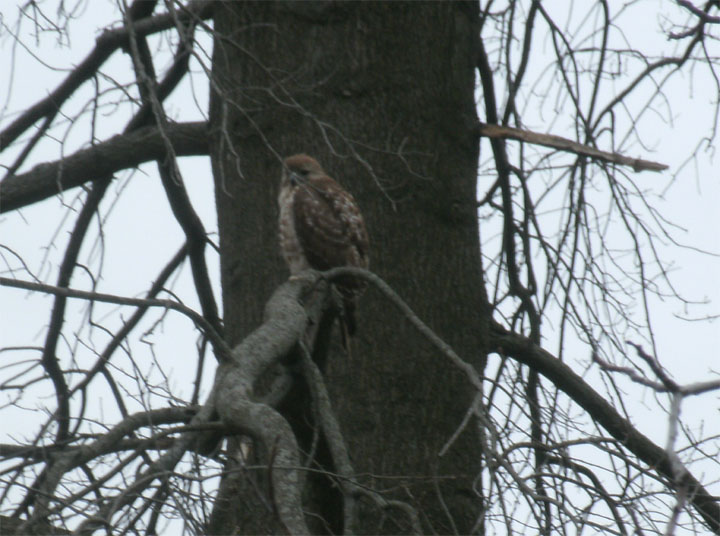
hawk3

Reluctantly, I continued on with my immediate mission. When I returned, I saw that the hawk had turned around to face the pine. I worried about the squirrels and about having a front-row seat to the natural collision of prey and predator. I like both squirrels and hawks. And even though I understand the need for both of their roles within the cycle of nature, I’m a wimp when it comes to witnessing the act in person.

I paused. I considered spending the rest of the morning working in my writing porch, which I hadn’t used since November. I probably could slip into it from the other side without disturbing the hawk, and I could turn on the space heater. I could get even better photos; I could be hawk-inspired for the rest of the day. And if it meant seeing something that I’d rather not see, at least I could write a firsthand narrative about whatever happened.

But it was not to be. The hawk lifted its shoulders, hopped off the branch, spread its wings, and soared away across the neighboring properties. (What a wingspan!) Some of those yards have active bird feeders in them. If the warning cries from the crow hadn’t reached that far – well, I guess this couldn’t be one of my concerns. I turned and went back into the house.

I was happy enough to have watched one of my favorite animals for a few minutes on an early spring morning. I had gotten another glimpse into that other being’s world, and to the life that goes on around us, whether we pay attention to it or not. And it was only because I had used our last postage stamp three days earlier, that was I given the chance to pop onto this scene. Thank you, Universe. And continued Good Hunting to you, Mr./Ms. Hawk. I hope you found a decent brunch somewhere.

Avec Squirrel

by Sandy Stott

My related hawk-watching story also takes place in a pine tree, and it too involves squirrels. On this particular spring day, I was on my way home, passing by a large white pine, when the squalling of a crow drew my eyes up. The crow was atop the pine, but the action was taking place a third of the way down the tree: there, barely visible, were the tail feathers of a large bird, which was clearly at work deep inside some cavity in the tree.

Thirty seconds passed and then, amid backing up and flapping, a hawk worked its way out of the cavity; in its talons was a baby squirrel. Whoa, I thought; that’s deep hunting (I had never seen a hawk hunt inside a tree). Amid crow cries and a scolding from a parent squirrel perched nearby, the hawk flapped twice and rose up and away. I’d witnessed part of the long cycle of relationship between hawks and squirrels, and I turned to walk on.

A friend nudged me, and said, “Look at that!” The parent squirrel had just emerged from the tree cavity, and in her mouth was another baby squirrel. What to do? her posture seemed to ask. But clearly she already knew. Head first down the tree she came, carrying what must have been a third to half her body weight. Then, across the parking lot, up an ash tree and out along a limb parallel to the ground twenty feet above us. Where’s she headed? we wondered.

At the elbow of the branch, where its remainder pointed up to the sky (and light), the mother squirrel disappeared. We relocated for better view, and then we could see a small hole in that woody elbow. Just then the mother squirrel reappeared empty mouthed, reversed her route and brought back baby squirrel number 2 from the pine cavity.

Same route run again. And the same for baby squirrels 3 and 4. No looking over her shoulder for a reappearing hawk, though clearly that was expected; no flagging of effort over her two hundred-foot journeys. And no attention paid to the small crowd of humans who had by now gathered to watch this rescue. Mother squirrel knew her priorities; she knew her hawks.

And, as Henry Thoreau knew so well, we often arrive as Nature’s witnesses when we pay attention, even during our shortest walks.
Roadentia

As noted in a prior posting, we’ve been on the road lately, and the miles of wheeling south have made me think about, well, roads. Always, as we drive, I am aware of bisecting some landscape, of riding right through it at a speed that outpaces perception. Some of that thinking crystallized this morning when I read a posting – What Have Roads Wrought – on the New Yorker’s website.

As often happens when I read studies of ecological observation and effect, I thought of Henry Thoreau and the roads – both highway and railway – that passed by and, at times, animated his stay at Walden Pond. The pond’s east end is skirted by Route 126, and, famously, its west end has 1844’s Fitchburg Line as a tangent.

In the “Sounds” chapter, one of my favorite sections of Walden, Thoreau considers the complicated realities and possibilities of the train: it is both fearsome and expansive: “We have constructed a fate, an Atropos, that never turns aside (Let that be the name of your engine)…I am refreshed and expanded when the freight train rattles by me…I feel more like a citizen of the world [at the sight of the passing freight from around that world.]” The railroad is tireless and relentless and not subject to Nature, but it carries with it a broader sense of the world.

So too these other roads, the highways on which we drive.

Michelle Nijhuis’s New Yorker post – http://www.newyorker.com/tech/elements/roads-habitat-fragmentation?intcid=mod-latest – summarizes decades of some of the Manaus [Brazil] project’s research on habitat fragmentation brought on by our development of roads on which we drive our own “iron horses.” Chief among its findings are precipitous declines in species – flora and fauna – that arrive with roads; that seems especially true along the edges that line our roads. And, of course, the more roads we build the more edges we create.

What caught my eye (and returned me to Henry Thoreau) was the following statement from professor Nick Haddad of North Carolina State University:

The study also demonstrates, using a high-resolution map of global tree cover, that more than seventy per cent of the world’s forest now lies within one kilometer of such a [roadside] edge. “There are really only two big patches of intact forest left on Earth—the Amazon and the Congo—and they shine out like eyes from the center of the map,” Haddad said.

Two thoughts floated up from memory. The first took me back to Estabrook Woods, in my mind Thoreau’s north pole of Concord. In the early 1960s Concord businessman Tom Flint was flying back into Boston and doing what we all do when given a window seat – he was watching the strings and blobs of lights that show where we live. He noticed a large dark patch. “Where’s that undeveloped forest/land?” he wondered to himself. Flint discovered that it was Estabrook Woods, which turned out to be the largest contiguous patch of undeveloped land within the Rte 495 belt. Flint’s discovery launched a 30-year effort to keep Estabrook Woods intact, which, despite a Middlesex School intrusion for athletic fields, it mostly is today.

In Estabrook’s deepness, back from the roads that ring it, a walker can find goshawks, pileated woodpeckers, and Thoreau’s favorite bird, the wood thrush, all species that require uninterrupted forest.

Far (or not so) from the Madding Road

Far (or not so) from the Madding Road

The other thought is a common “game” for wilderness walkers – how far from a road are we? Or, put differently, what’s the most remote spot we can walk to (remote being defined as farthest from a road). It is – surprisingly or unsurprisingly – hard to get many miles away. In the lower 48 states, for example, the point of greatest remove from a road was tracked by Backpacker writer Mark Jenkins in 2008: “Astonishingly, in the entire continental U.S., coast to coast, Mexico to Canada, there is only one place left where you can get more than 20 miles from a road: in the greater Yellowstone region.” (See more at: http://www.backpacker.com/trips/wyoming/yellowstone-national-park/destination-nowhere/2/#bp=0/img1)

In “Sounds” the train goes by, and throughout the night Thoreau rides his most expansive vehicle, that of his imagination. The chapter ends decisively with an image of unfragmented Nature: “Instead of no path to the front yard gate in the Great Snow, – no gate,-no front yard,- and no path to the civilized world.”

IMG_0903

Back on the asphalt paths, I’m thinking again of Nijhuis’s post and this note: “Roads scare the hell out of ecologists,” William Laurance, a professor at James Cook University, in Australia, said. “You can’t be in my line of business and not be struck by their transformative power.”

The North and South of It – Impressions while Voyaging toward Spring

I didn’t go looking for this entry. Yes, I decamped from our snow-caked north and drove south for some family visiting. And yes, as happens to many who drive south at this time of year, I had a time-lapse experience of spring – it arrived as we wheeled down from the Cumberland Plateau into the lower lands of North Carolina, where the grass showed a first green and the maples burned with the gaudy red haze of their flowers at distance. But all of that, even in its visual richness, is predictable. That’s why so many northern cars are loose on southern roads at this time of year.

What brought me to keyboard was an evening reading from early March, 1855 in Thoreau’s journal (a worthy book to bear into spring, yes?). On consecutive days – March 8th and 9th – Henry Thoreau also visited the north and then the south as part of a series of expansive March walks. “To the Carlisle Road,” he writes at the head of the 8th’s entry, which is another way of saying to Estabrook (or Easterbrook) Woods, which lie due north of town.

And then on the 9th, he’s at a spring favorite, the Andromeda Ponds – ah yes, there they are on the USGS quadrangle close by Walden, south of town.

Perhaps it is my own pining for spring as this remarkable winter eases (slowly), but Thoreau’s early March of ’55 reads poignant to me. Every day he goes out, and on most days he mentions that he hopes for a bluebird.

And it is appropriate, I think, that each day begins with Thoreau’s boat: “This morning I got my boat out of the cellar and turned it up in the yard to let the seams open before I calk it. The blue river, now almost completely open…admonishes me to be swift.” 3/8/55

Then, on the 9th, he writes, “painted the bottom of my boat.”

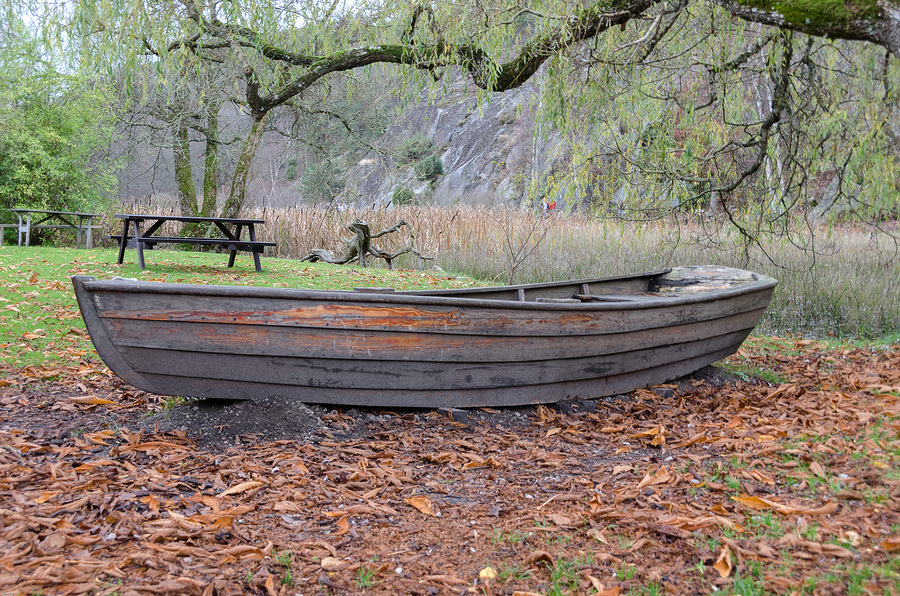
Boatwork Ahead

Boatwork Ahead  Photo:Bigstock

It is clear that Henry Thoreau is ready for some voyaging, and his walks to the north and then south seem to fit this yearning, as he notes also that “I walk these days along the brooks, looking for tortoises and trout, etc.”

Perhaps part of my impression stems also from a descriptive paragraph on pines and their amber drops of pitch. On the 9th Thoreau is also once again on the far side of Fair Haven hill, stepping over and balancing on newly felled “great white pine masts.” The cutters have been at it again, laying bare more Concord landscape, and it is typical of Thoreau that he doesn’t avert his gaze. Instead, he looks closely, and, amid devastation, he finds beauty. And question.

“I was struck, in favorable lights, with the jewel-like brilliancy of the sawed end thickly bedewed with crystal drops of turpentine, thickly as a shield, as if dryads (?), oreads (?), pine-wood nymphs had seasonably wept there the fall of the tree. The perfect sincerity of these terebinthine drops, each one reflecting the world…is incredible when you remember how firm their consistency. And this is that pitch which you cannot touch without being defiled?”

Boats, beauty amid loss, the call of water – the world opens out into spring, and we voyage out to it.