
Category Archives: Environment

On Taking Down a White Pine

Famously, Henry Thoreau built his house in the woods from “some tall, arrowy white pines” that he cut down “still in their youth.” And, less famously, a page or so later in Walden, he contends, “Before I had done I was more friend than foe of the pine tree…having become better acquainted with it.” Perhaps. I’ve had Thoreau’s experience and passage in mind recently as I’ve felt my own imperative to cut down a pine. Here’s that story.

It’s a mid-afternoon in early August when the white truck with WellTree, the company logo, on it rolls up. It’s a bucket truck, and it’s followed by a bulky-bodied cousin dragging an industrial-sized chipper (think Fargo). Two thirty-something men with orange headphones around their necks step down from the trucks in our driveway and begin to size up a large white pine on the front lawn; I walk out to meet them and redirect them to the pine with four leaders on the fringe of the driveway. A few second pass. “Geeze, Jeff,” one says under his breath. “This time of day?”

Pine Presence - this one with 2 leaders stayed.

Pine Presence – this one with 2 leaders stayed.

Jeff is WellTree’s owner, and a few hours ago, he appeared and wondered if his guys could begin on this tree a day early (One of their two bucket-trucks was in for repair, and they had two bucket jobs for tomorrow). “Sure,” I’d said.

And so his guys have arrived, but the 80-foot tree before and above them is not a mid-afternoon tree. “We were expecting something smaller,” the man, who will turn out to be the sawyer, says. Fifteen minutes later, the bucket truck is nosed up to the pine’s trunk and, headphones tight to his ears, he’s lifting off as the mechanical arm unflexes; he seems to fly up into the tree like an actor carried over stage by invisible wires. Thirty feet up, he fires up his saw and trims a spreading branch at the halfway point; then, he shifts the bucket five feet to his left, leans out with one arm and cuts the rest of the limb; it drops to the driveway with a body sound you feel through your feet. The usual day with its usual decisions goes away.

Feeling agitated and vague, I go inside to work; I can’t sit still. The saw snarls. Then the chipper’s motor adds its chewing bass note. I’m up pacing. I feel like the tree, I think; “well, that’s silly,” I say out loud. I sit again, read a sentence, then reread it, wonder what it’s about, can’t recall. “I feel like the tree,” I say aloud. The saw snarls again. The tree’s day has arrived. I have summoned it.

Taking down this white pine has not been a whimsical decision. We’ve been in our house for 11 years, and early on, noting the pine’s lean toward and over that house, we had some branches trimmed as guard against our regular ice storms. That seemed to suffice. And yes, it dripped pitch steadily on whatever was beneath it, but like all trees, as I swept its needles up every so often, it grew neighborly. Or I grew neighborly. But earlier this summer Ray, the man who helps us with our plants, called our attention to a seam in the trunk’s center; that wet, dark line appeared on both sides, and when you stood next to the trunk, the whole tree leaned over you in the direction of the house. “If this were my house,” said Ray, “I’d have that looked after.” And so, in this era when storms seem to have intensified and a new fungus has nipped at local pines’ needles, we called WellTree to have a look.

To begin with, this pine has four leaders, which any follower will tell you is three too many. I learn that pines growing without the tight neighborliness of other pines tend in this direction; they spread into available sky. But as they reach size all this spreading weight begins to pull the central trunk apart; the seam Ray pointed out is likely sign of the leaders’ branching out.

I look up through our clerestory windows. There’s more light in the sky; I go outside to watch. More limbs fall. The two machines snarl and growl, the smaller feeds the larger. Wood chips fly into the truck’s covered body; each chip is smaller than a thumbnail. I realize that I am sad. And once I’ve said “sad” to myself, as a I lean against our car’s body watching, the feeling takes hold deeply. The bucket moves like a conjurer’s arm. More pieces fall; tons remain upright. This, I realize, is going to take some time.

It’s nighttime. The men and their trucks have left. Two leaders of the pine remain at their full 80 feet. It’s raining lightly. I feel tears seep from my eyes. The sadness feels unalloyed, pure. What have I done? I ask. I want to look away; I can’t.

There is explanation; there is sense to be made: I’ve just retired from a 40-year teaching career and its everyday touch of youth and its fast-growing leaders. We’ve moved 130 miles from the school where we lived. Every day I press a littler farther into a shorter future. But really? That’s maudlin, and there’s as much to celebrate as there is to mourn, more really.

And there isn’t explanation. I’ve run the saw, felled trees, sometimes 10s of them in a day; I’ve burned wood for heat. I’ve lived in End-of-the-road New Hampshire in a wood-heated, or at least warmed, house.

Perhaps, I think, the time it’s taking offers some echo of just how long this pine has been aloft, stretching a little each day for the light in the sky, thickening to itself in rings over years. Perhaps it’s because I’ve ordered this, like some near general, and now I must sit in my bunker and watch my orders played out. Perhaps.

On the second morning, it takes longer. The two remaining leaders must be trimmed carefully – they rise over the neighborhood’s wires. And then, bringing their bodies down must happen in alternating ten-foot sections, with the rope tied off to the other leader-trunk. Flakes of sawdust float like a storm-ending flurry of snow.

Whittled now down to 40-foot stalk of pine. With our neighbor, Claude, I’m out watching this final trunk pulled down onto a cross-hatching of its brother stems laid out to protect the lawn some from the final fall. Post-image: after it comes down, and after the trunk is cut into eight-foot lengths, the sawyer is running the hydraulic arm that clasps and lifts each log into the truck’s body; when he raises the section with the seam in it, the log spins, and I can see that the seam goes all the way through the trunk; also, as the log rises a trail of liquid drips steadily from it – too fluid and frequent to be pitch, it must be some watery intermediate: yes, it drips like blood, but it also is some harbinger of rot.

The work order calls for this “low stump” to be left. We’ve said we’ll live with this before deciding what’s next. Now, in the aftermath, I’ve taken a seat there. First I’ve counted the rings, noting the flush years and the lean, saying the numbers aloud to keep from losing my place, then recounting to this: 63. Mild surprise – older, I thought, say in its 80s. The column of air above me where the pine was weighs little, best measured in ounces; the bushes and nearby trees eye the new open space.
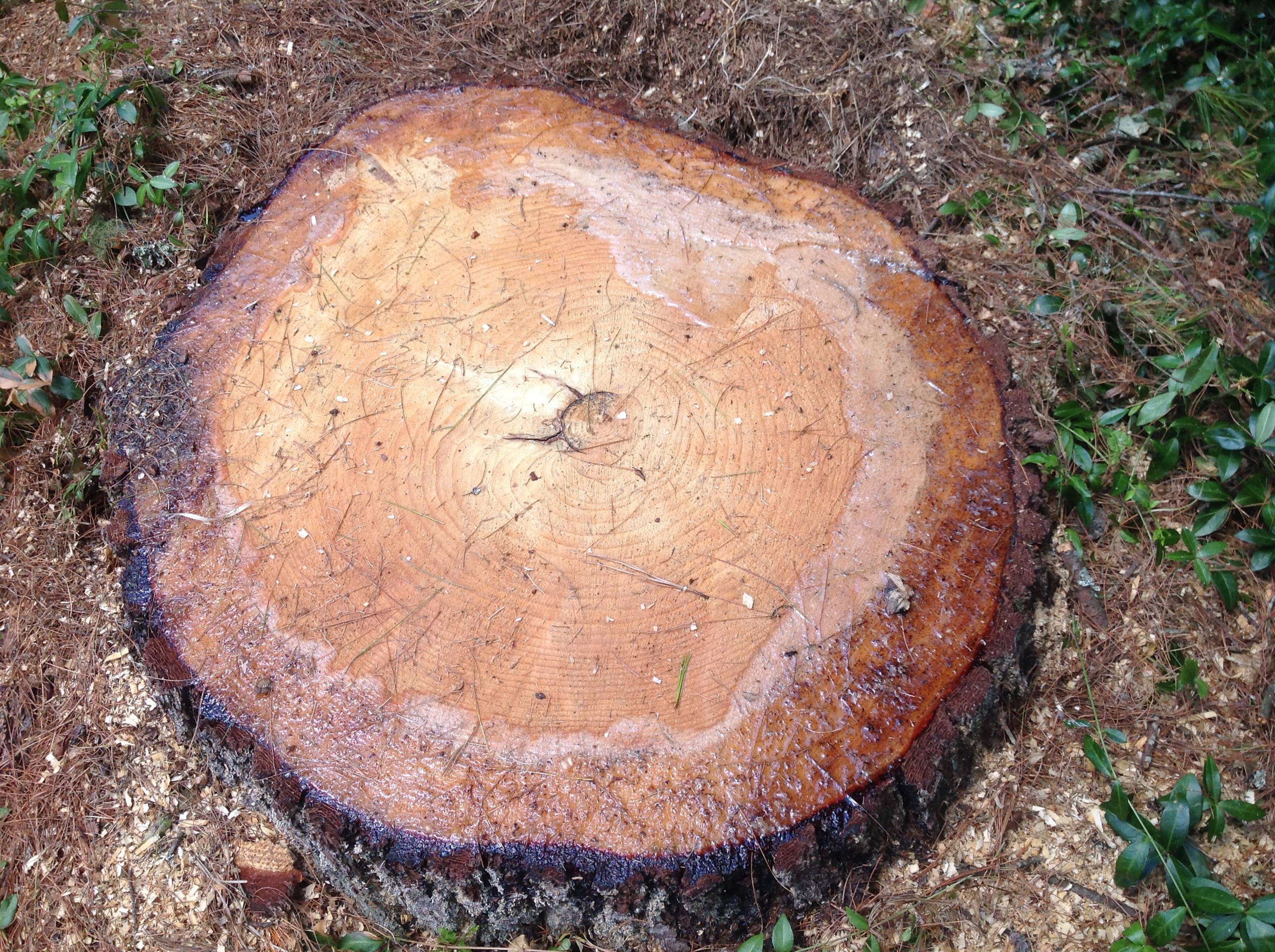
Pine Absence

Pine Absence

Early evening of pine-absence: sunlight punctuated by distant thunder; the light gives way to a faux-dusk. A storm is lumbering in from the north. It breaks: flashed light, immediate thunder, rain that obscures everything beyond the yard – is there room for air amid such water? The backyard pines toss their branches in the furious air; the maples buck up high. I feel washed free.
Fantastic Beauty in the Front Yard

By Ashton Nichols

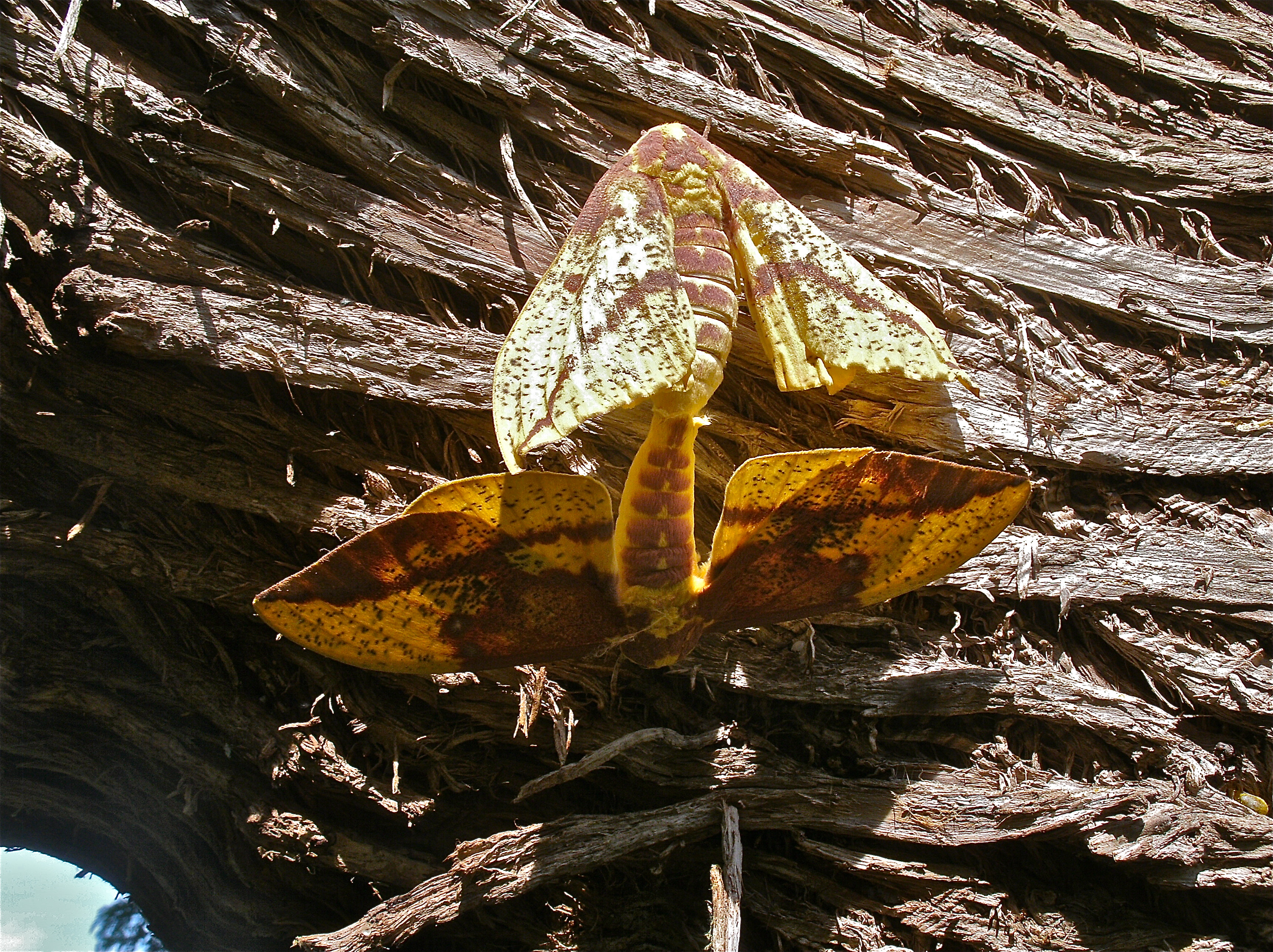
Yesterday morning, while I was pushing my granddaughter Verona on the swing in one of our large cedar trees in front of Creekside, I noticed a sudden flash of yellow against the striated brown bark of the tree’s massive trunk. As I drew closer, I could see that it was two Imperial Moths (Eacles imperialis), beautiful members of the silk moth family, the group that produces the largest moths found in North America. These two were clearly mating, joined at the hind-parts and perfectly still, presumably waiting in their nocturnal way, at least for the sun to go down.

Imperial Moths Mating Photo by Ashton Nichols

Imperial Moths Mating
Photo by Ashton Nichols

Moths can take a full 12 hours to mate. The male’s goal is to pass a spermatophore into the female’s body, so that she can then fertilize her eggs. He has located her by sensing her pheromones in the nearby air and then flying toward the source until he locates his partner. Once together, the moths unite by backing up, abdomen to abdomen until they are firmly joined. Then the male clasps the female with small, finger-like appendages– “claspers”–so that the two can remain connected, even if they have to move from one spot to another during their prolonged “romance.” Research indicates that a mating pair like this, hooked together and unable to separate until their work is done, are especially liable to predation, often by raccoons and other small forest mammals.

These two insects that Verona and I watched today were gorgeous and large examples, a full five inches across from wingtip to wingtip, the female slightly larger than the male. Their bright yellow wings were patterned with a brown that almost shaded to purple; they had a thumb-thick and sharply segmented abdomen, and a wide, furry head and face. The female has a unique–if invisible–anatomical feature, her “bursa copulatrix (literally, organ for “exchange coupling),” where she will store the spermatophore that she receives from the male. This tiny packet of his genetic material also contains nutrient materials to keep the fertilized eggs supplied with “food” in her body, not unlike the way an egg’s yolk and white support the growing chick.

Here is how complicated and technical the entomologist’s description of the Imperial Moth can get: “Both sexes have round, purplish to reddish-brown reniform and subreniform spots on the forewing, the center of each spot filled with gray; as well as a similar discal spot on the hind wing” (this drawn from the Massachusetts “Natural heritage Endangered Species Program”). The last century has seen a dramatic decline in species range and numbers so that now, in Massachusetts for example, the moth–which once covered the state–is only found on Martha’s Vineyard Island and occasionally on the nearby mainland. In our part of Pennsylvania the decline is less pronounced, but the Mason-Dixon line seems to be the dividing line: Imperials in Maryland and south tend to be doing much better than their northern kin.

So there we were, on a warm July afternoon with a single species of declining moth, bringing knowledge to me and wonder to my wide-eyed, three-year-old grandchild. “What are those two moths doing, Baba,” Verona said, with her eyes still wide and staring. “Well, my little girl, they are resting . . . um, ah, ” pause, think, speak: “and they are starting to make babies for the next generation . . . I, uh . . . I mean for their next family of beautiful moths.” “They ARE beautiful, Baba,” Verona said as we turned to come into Creekside to get the camera.

This morning I returned and the pair was gone: he to feed and hopefully to survive a few more months until winter, she off to lay her fertilized eggs and begin their remarkable metamorphic moth lifecycle again.

Henry’s Children

By Corinne H. Smith

The silent Memorial Walk around Walden Pond is a tradition during The Thoreau Society’s Annual Gathering. We meet at the house replica near the parking lot at 7 a.m. on Saturday morning. When we introduce ourselves, we also share the names of people we are dedicating the walk to. The whole group walks in memory of Henry David Thoreau and scholars Walter Harding and Bradley P. Dean. Individuals may choose also to walk for family members, friends, and mentors who have gone on before. I always dedicate my participation to two of my mentors, Thoreau scholar Edmund Schofield and singer-songwriter and environmentalist John Denver. I wear Ed’s tan corduroy hat during the walk, as he often did whenever he spent time exploring Walden Woods.

On this July 12th, about a dozen people stand in our circle. We sing a verse of Happy Birthday in Henry’s honor. Then, when the introductions come around to Jeff Hinich of Ontario, he stretches out his arms as if to embrace the group and says, “I dedicate this walk to all of Henry’s children!” We laugh. We know that Henry and his siblings never married and that no direct descendants of their family exist. And yet: isn’t Jeff right? Aren’t we all Henry’s children? Didn’t he father good books and essays and opinions that in turn brought together followers like us?

I think on this satisfying idea as we walk single file across the road and down to the level of the pond. We edge past a handful of long-distance swimmers preparing to work on their pond-laps. A few are already in the water. Now we turn left in order to round the pond clockwise. As the first one in the line, I often get to see a few things the others don’t. Chipmunks squeak and scurry in front of me, almost underfoot. Robins are in abundance today, too. I play a game of tag with one bird for more than ten yards. It bobs ahead of me, stops to let me catch up, then bobs ahead some more. Finally it realizes that I am not going to stray from the path that we’ve both been using. It flies up into a small tree and watches our group pass from this vantage point. I try not to laugh out loud.

Otherwise, it’s a pretty calm scene at Walden Pond. Some fishermen quietly cast lines from boats or from the shore. Even the train tracks lie idle. The MBTA continues to make improvements and repairs on this section and has suspended weekend service for most of the rest of 2014. So we wait for the train that doesn’t come, then continue on to the site where Henry’s house once stood. Here we fan out and take our time, thinking about Henry and our loved ones, too. Some take a few seconds to stand in his doorway and look down to the cove.

For most of the fourteen Memorial Walks that I’ve been on, I’ve seen white Indian pipes growing in select spots around the cairn and outside of the house markers. This time, there are none. I tiptoe to all of the places where I’ve seen them in the past, and no white shoots are beginning to lift the leaf litter. The weather conditions must have been different this year. Maybe the heat or moisture levels haven’t been right. Maybe the unique curved heads will pop up later in the season, when they can amaze other visitors. Or maybe they were quite early, and I missed them. I feel disappointment at their absence.

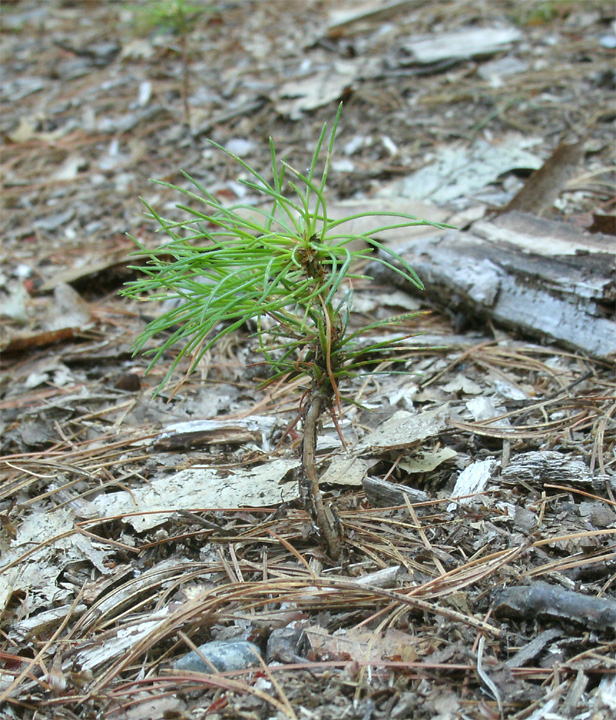
What I notice instead is all of the small pine trees rising here. Many aren’t even as big as the one Charlie Brown places a single red ornament on each Christmas. One is certainly less than four inches tall. Yes, I’ve seen seedlings before. But either there are more of them today, or I’m somehow extra aware of them now. Then it dawns on me. These little guys are Henry’s children, too! He once planted hundreds of white pines in this area. Granted, we have no easy way of proving that these specific saplings came from his specific plantings. But in the grand and symbolic scheme of the Walden Woods ecosystem, we can call them descendants. More of Henry’s children. And at this thought, I smile again.

Faith in a Seedling

Faith in a Seedling

We saunter back to the parking lot. Now, families loaded down with beach paraphernalia hurry toward us, eager to stake out some sand and sun for the rest of the day. Some of them may be Henry’s children, too: if not now, then perhaps at some future moment. How many children does Henry David Thoreau have? It’s an innocent enough question that’s hard to answer. But on this particular morning, and only at Walden Pond, I count at least a dozen people and hundreds of seedling pines. Many more are sure to surface in the years to come.