Category Archives: Environment

Uplands of Time

It’s been nearly a year since I stepped out the door, turned left at the driveway’s end and walked off into these New Hampshire hills. But even as the town road bears right uphill and I go straight along this spur’s tire-flattened gravel, the images arrive: in them I (or we) are setting out, often with the Oregon Ridge in mind. It could be blueberries on the ledges; it could be relief from the heat; it could be hope of another moose antler; it could be solitude. Any of these pretexts will do.

Fifty years seems a long stretch, unless, as I have, you have been reading a book set in geological time; then, fifty years seems a mere intake of breath, a shallow one at that. I have a mind habituated to the ephemeral, the thought equivalent of a day moth, whose 24-hour life cycle seems hurried, but usual. But on this return to the ridges I first walked 55 years ago, I keep making a conscious effort to see the slowest motion of long time and its events. The tilted planes of rock remind of a time when they were not aslant. And the pluton of Cardigan itself, a resistant dome of weathered rock, reminds of all the companion rock and soil washed away over millennia to reveal this mountain.

On my way up the aptly named Skyland Ridge, I drop into a small drainage, where a clear brook burbles its little July song. The climb up the bank on the east side is reach-out-and-touch-the-ground-before-your-face sharp, and, as a I look back down some 50 nearly sheer feet to the brook, I take in the cutting it has done… is doing, even as I watch its little summer flow, taking down this mountain a few molecules at a time.

Usually the shift to this sort of deep time meditation is too great a leap, and I return soon to looking at leaves, musing about mosses and listening to birds sing their territories. The nearby drumming of a pileated woodpecker reminds of time’s more immediate beat, as do the fist-sized holes in a trailside tree. But on this day a recurring perception keeps nudging me back to longer spans of time, and, after a while, I realize that I am also looking at changes in the land over the 55 years. In particular, I keep seeing the slow crawl of trees as they recolonize and reclaim the bare rock.

Cardigan’s brother peak is named, arrestingly, Firescrew. As a boy, I simply noted that it topped out just above 3000 feet and hurried toward it summit, repeatedly. Later, I began to wonder about its odd name, and I found it derived from a massive forest fire in 1855; its heat was so intense that it burned with a swirl (or screw) of flame and smoke visible for many miles. Then the charred, sterile soil washed off both mountains, leaving them as domes of rock, with views worthy of their higher northern neighbors, the White Mountains.

Firescrew's Ridge and Its Returning Forest (note Mt. Washington in the Farground)

Firescrew’s Ridge and Its Returning Forest (note Mt. Washington in the Farground)

As a boy I reveled in the Cardigan’s exposed mountain feel; it played much bigger than its 3100 feet; so too did Firescrew. The absence of trees and brush created this feel; it was all elemental rock pressed up into the sky. Over these decades, soil and seeds have blown into creases in the stone, and generations of grasses have lived and died. Gradually enough soil has accumulated to host bushes, in spots the much-loved blueberry. And on: more growth, more decay, deeper or taller brush, with trees following. It takes only a little imaginative effort to see both peaks reforested some hundreds of years in the future.

And with this little effort and this day’s walking, the door to the room of deep time opens. In this room the rocks live and move; we are kindred, I think, as I sit here looking out.
Raptors and Riparians

by Ashton Nichols

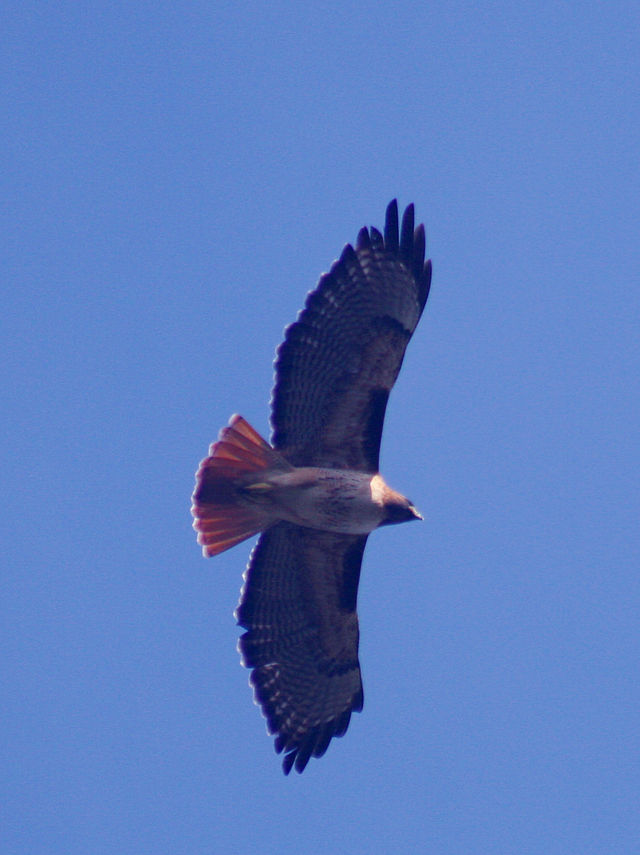
In addition to songbirds, our Creekside is also a realm of raptors; that is to say, it is busy with that expansive group of avian species that include the hawks, and the eagles, and the owls. “Raptor” derives from a Latin word rapere, which means–as you might imagine–to seize forcefully. This morning it was just two red-tailed hawks circling high above the farm fields near us, squawking a call that is known to all of those who remember the television show Northern Exposure: “Awwkkee, aawwkkee!” they cry, as gangs of crows circle around them in small flocks, working hard to chase them away. But the red-tailed hawks often win. Today it seems like a draw, as the crows disperse and scatter into the tall trees off toward the western horizon, and the red-tails sail away into the distance in the direction of North Mountain. With this dramatic encounter of hawks and crows, I thought I was done with my bird-watching for the day, but I was not very prophetic on this blue-skied dawn.

Red-tail: Unharried on High. photo by Brocken

Red-tail: Unharried on High.
photo: http://en.wikipedia.org/wiki/Redtail_hawk#mediaviewer/File:Red-tailed_hawk_in_flight.jpg

Hawks like these aggressive hunters are here almost every day. Usually it is red-tails like this pair, but sometimes it is Cooper’s hawks or sharp-shins, kestrels (not really much larger than large songbirds) or broad-wings. These hawks in their kettles all gather here because the hunting is so good: field mice and moles, voles and even big rats, all drawn by the hundreds of acres of seeded farm-fields around us, by the stacks of grain and corn in the barns, and by the smaller birds that hawks are also willing to eat. I have seen a peregrine falcon take a sparrow right out of the sky in front of me, in a flash of feathers that looked like an explosion of bird-life.

There are also cats on the farm here, as you might well expect: barn cats in their low dozens: tigers and tortoise-shells, an orange-and-white that is one of my favorites, and even a jet black bit of bad luck, but I like her a lot. Yet even all of these felines cannot keep the microtis (the word that means “small-eared” when it refers to little furry mammals) that surround us at bay. There cannot be too many cats for the hawks; there cannot be too many cats for the rats. Here at Creekside we witness the delicate balance of nature: hawks and cats, mice and rats, and even thousands upon thousands of spring-peeper frogs, but more about them and their role anon.

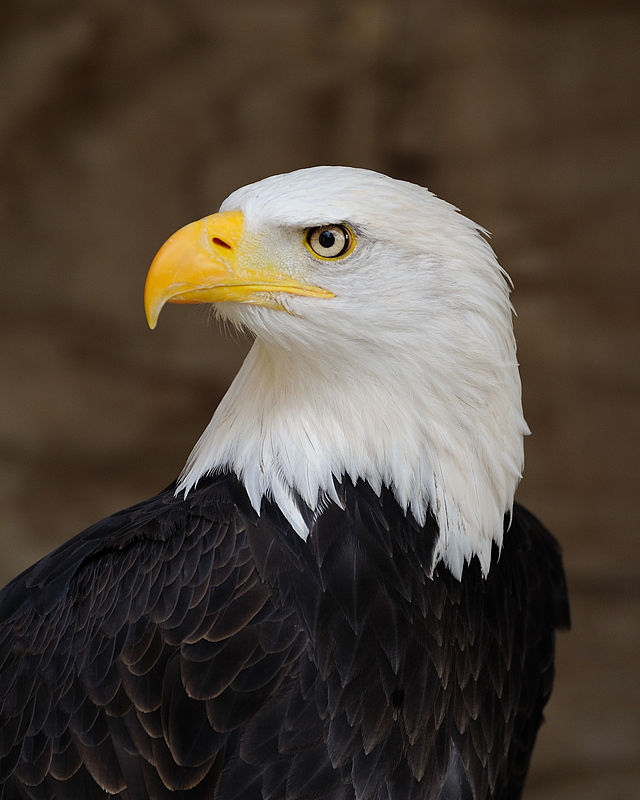
We also have bald eagles at Creekside this spring and early summer, at least two often-seen juvenile birds that we have been watching closely for almost six months now. We have watched them as they have grown and matured, as they soar from one wide farm-field to the other, and then as they sail away down toward the wide-open creek bed, and especially as they change their wide-winged plumage from brown-and-white splotches to the beautifully characteristic white head and tail. Bald eagles are born with almost as many white feathers as brown ones scattered throughout their wide body and wings and then, as they grow, the brown number increases, and the white one shrinks to just their heads and tails. In the male, as all good Americans know, this white ends up only covering the head and the sparkling white tail. The adult female, however, unlike most other bird species, looks almost exactly like the adult male, but she is a little bit larger all over: her wingspan is wider, she weighs a bit more, her beautifully curved bill is a bit longer, and so are the sharp rear talons on her wildly lizard-looking legs.

Photo by Lloyd MacKenzie

Photo by Lloyd MacKenzie

Several years ago, there was a registered bald eagle’s nest about five miles to the northwest of us along our same winding creek. A registered nest has watchers from the Audubon Society, and other official birding groups, who regularly report on the condition of the nest, the number of eagle’s eggs, and just how the young develop as they hatch and then mature. But these two juveniles that we have been watching this year are clearly from much closer by; the nest from which they fledged must be just down the hill from us or along the wide ox-bow that winds across and along the creek to our immediate west. These two birds fly close enough to us sometimes so that we can see their curved beaks and reptilian talons. They roost in tall pine trees nearby and the locust trees just behind the house, and then they swoop down and soar across the nearby fields and creek in search of prey. Once, at least once, we saw one of these magnificent birds with that very same prey in its talons, captured and spiked right through with razor sharp claws, a small rodent or other immature mammal, dead now and soaring off across the wide fields toward the mountain ridge above us, another kill, another capture, another protein feast for this fine national bird that we call America’s.

Finally, our owls are the last group of raptors here with us at Creekside. We have never seen one, at least we have not seen one yet, but we often hear them in numbers at night, calling from deep down in the Conodoguinet creek bed. Most often it is the barred owl, with its characteristic, “Who cooks for you all; who cooks for you?” and then sometimes, when we get lucky, we hear the noble great horned owl, with a more stately and solemn, “Whooo, whooo, whoo, whoo! Whoo, whoo, whoo, whooo!”

Often Heard, Seldom Seen - the Spring Peeper. Photo by Zach Welty

Often Heard, Seldom Seen – the Spring Peeper.
Photo by Zach Welty

Some nights these owl calls even drown out the chorus of spring peeper frogs, or these two choruses–avian and reptilian–vie for supremacy, first the frogs taking over, “Kee, ke, ke, kee, keek–Kee, kee, ke, kee,” and then the owls, especially that booming great horned sound, “Whoo, whoo, whoo, whoo; whoo, whoo, whoo, whoo!” We drift off to sleep with these sounds in our heads: the huge owls off in the distance and then these tiny frogs, thousands of them not much bigger than the size of your thumbnail–just two hundred to three hundred yards away–peeping loudly: “peeeep, peeep, peep-peep, peeeep,” and we are lulled into unconsciousness by these booming repeated raptor calls followed by these delicate riparian replies.

Heat, Humidity & Henry (Or: In Touch with the Past, Part II)

By Corinne H. Smith

Yesterday we had one of those hot and humid days. Ick. You know the kind. Not only was it darn uncomfortable just to sit around and breathe, but it also caused every hair on my head to curl in a different direction. Neither cap-wearing nor combing could remedy the situation. And the hot and humid day turned into a hot and sticky night. The occasional whiffs of air from an open window didn’t do much to cool off the bedroom. I couldn’t get to sleep.

After two hours of just lying there, I decided to get up and to get some work done instead. I might as well be productive, as long as I was awake. I fired up the computer and got out some of my Thoreau books. I wanted to scan his journal for references to a plant I had found in our yard. I hoped Thoreau had seen and felt the same way about it that I did. I had hoped to write a post here in response to whatever he had written.

I opened the first of my two-volume Dover set: a reprint of the 1906 journal volumes that Sandy Stott mentioned in his recent post, “In Touch with the Past” (https://thoreaufarm.org/2014/06/in-touch-with-the-past/). These books are slightly more portable, take up less room, and contain the same text as the ones Sandy uses. But all I found were Henry’s glimpses of the plant, and some of the dates when he saw that it had blossomed. I wanted more details, more substance. This time, he wasn’t forthcoming. I sighed. This particular subject wasn’t going to work. What was I going to write about instead?

Then I stumbled upon this entry:

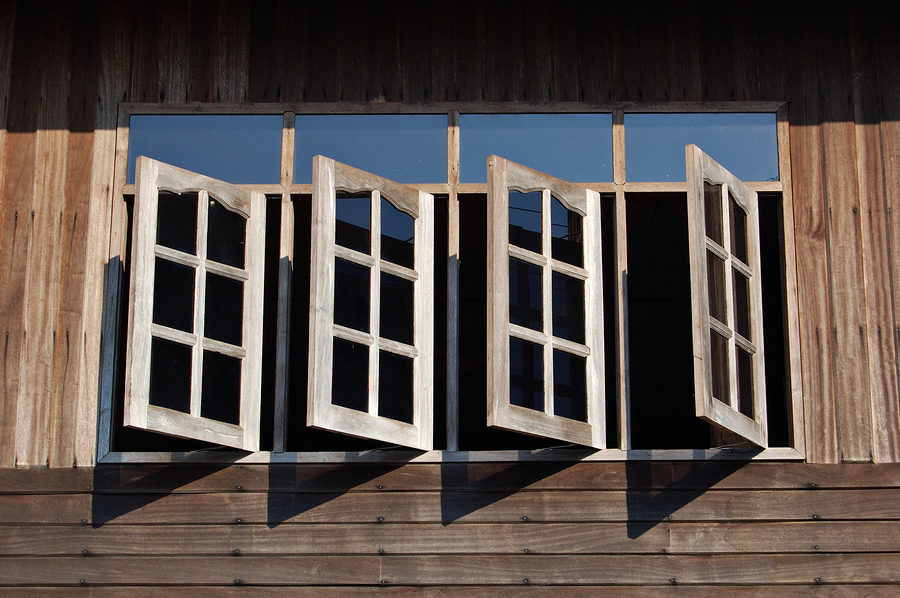
“June 21. … The warmest day yet. For the last two days I have worn nothing around my neck. This change or putting off of clothing is, methinks, as good an evidence of the increasing warmth of the weather as meteorological instruments. I thought it was hot weather, perchance, when, a month ago, I slept with a window wide open and laid aside [it] a[s] comfortable, but by and by I found that I had got two windows open, and to-night two windows and the door are far from enough.” ~ June 21, 1853

No Matter How Many Windows Open...

No Matter How Many Windows Open…

I shook my head. Here we were, sharing the same discomfort, across the span of 161 years. No matter how many bedroom windows we’ve opened, they’ve done nothing to bring us relief. The times, they are not a-changing. This painted a picture of Henry Thoreau that I had not thought of before. The naturalist, the writer, the surveyor, the saunterer, the philosopher? Sure. Someone who lies awake on a steamy summer night and considers the relationship between the rising temperatures and how much clothing a person is wearing? No. But it’s certainly an interesting image. Then again, what else could he do under the circumstances? He didn’t have a computer for entertainment, where he could check his e-mail and what his Facebook friends were doing at midnight.

Alas, Henry. I suspect we will have more of these unbearable and sleepless nights in the next three months. I’ll think of you again whenever the act of opening two windows and a door isn’t enough to cool the bedroom.