Category Archives: Walden

Declaration

Two years, two months, two days.
Henry Thoreau was wary of symbols

thoughts and things that go two
by two into the ark of the mind.

And when he took time off, absconded
with it to the pond on July 4th,

1845, he scoffed at those who saw
declaration of independence, in truth

he might have said, I am more
dependent than ever, on this pond

on this earth, on these feet, not
to mention the sky that shines

in the water, a medium really
for seeing up and down, for

seeing two ways at once, a unity
upon which I row my boat and

in which I bathe every day.

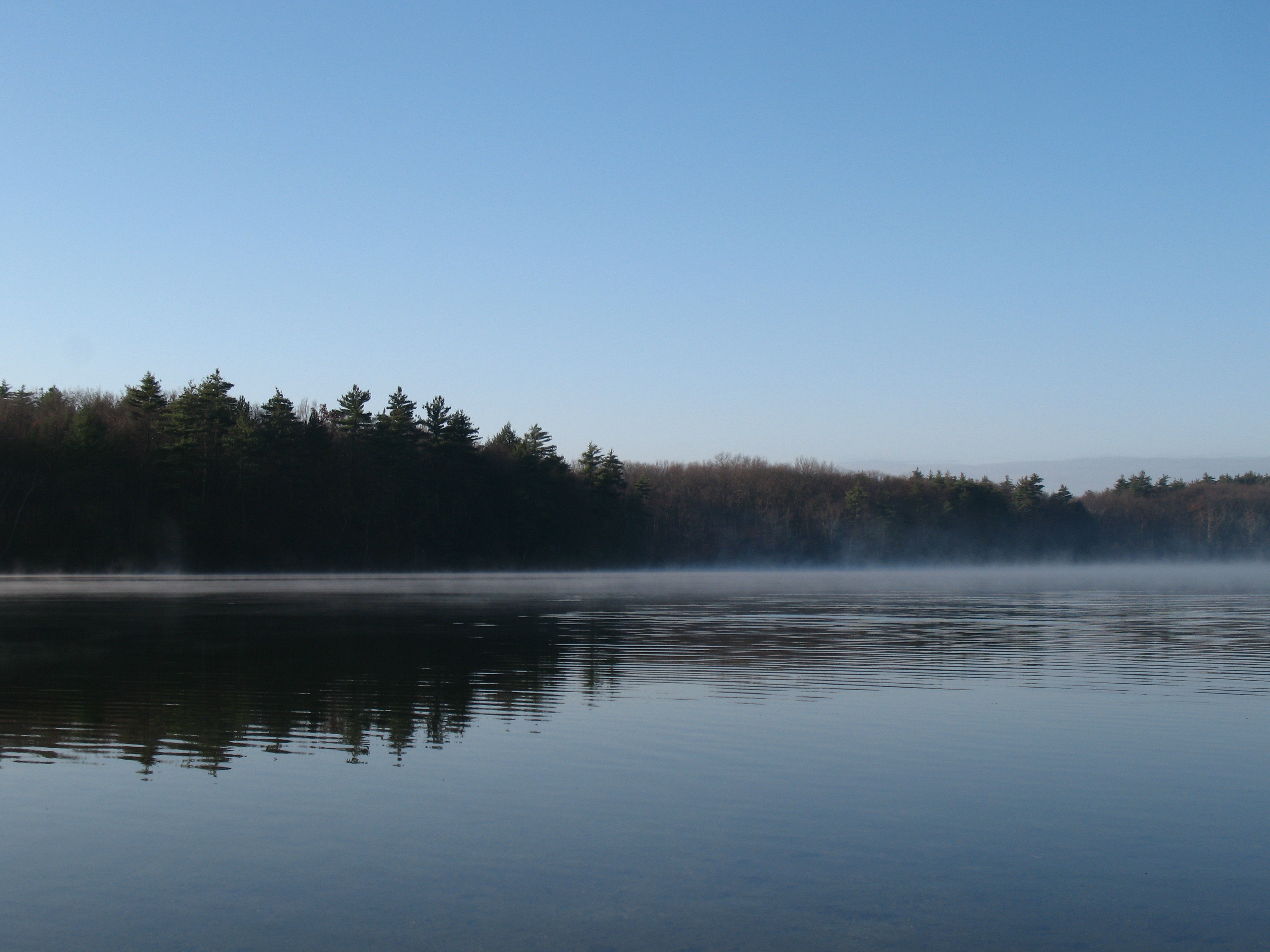
Walden water

Walden water

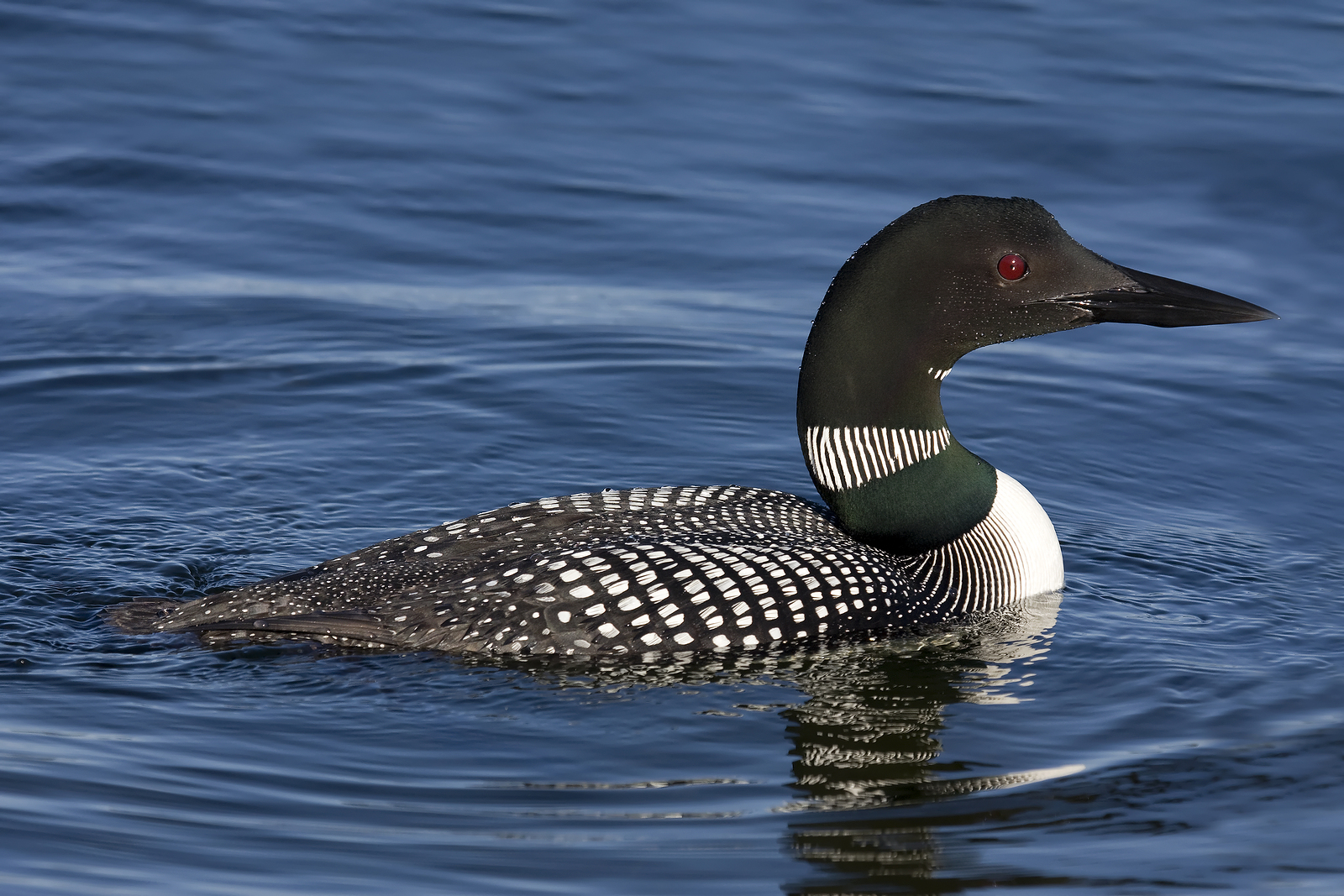
Loon

“I found that it was as well for me to rest on my oars and wait his reappearing as to endeavor to calculate where he would rise…” – Walden (from the chapter Brute Neighbors and its famous “Pretty Game” section, where Thoreau plays with a loon on Walden Pond)

The bird breaks surface ten feet to the right of my bow. On this nearly windless day beneath a bright sun, the sudden stir of water startles me, breaks a reverie brought on by repeated paddle strokes and the silky parting of my boat’s passage. My boat and vision settle; there he is, looking at me, loon.

Later, I’ll learn that he is probably a juvenile in his 2nd year. Loons père and mère are inland on northern lakes during this, their nesting time; their earlier successes are here along the coast, the loon equivalent of high school it seems, waiting their paired, parental turns.

Today, a young loon’s life looks pretty good to me, and for some minutes we pay attention to each other – I sit still in my boat and stare out from the dark little cave of my cap; the loon faces away and angles his head so I’m in view. But he too stays put. As a minute passes, I feel a little thread of connection. Perhaps the loon senses something, because he dives immediately, and I am watching empty water.
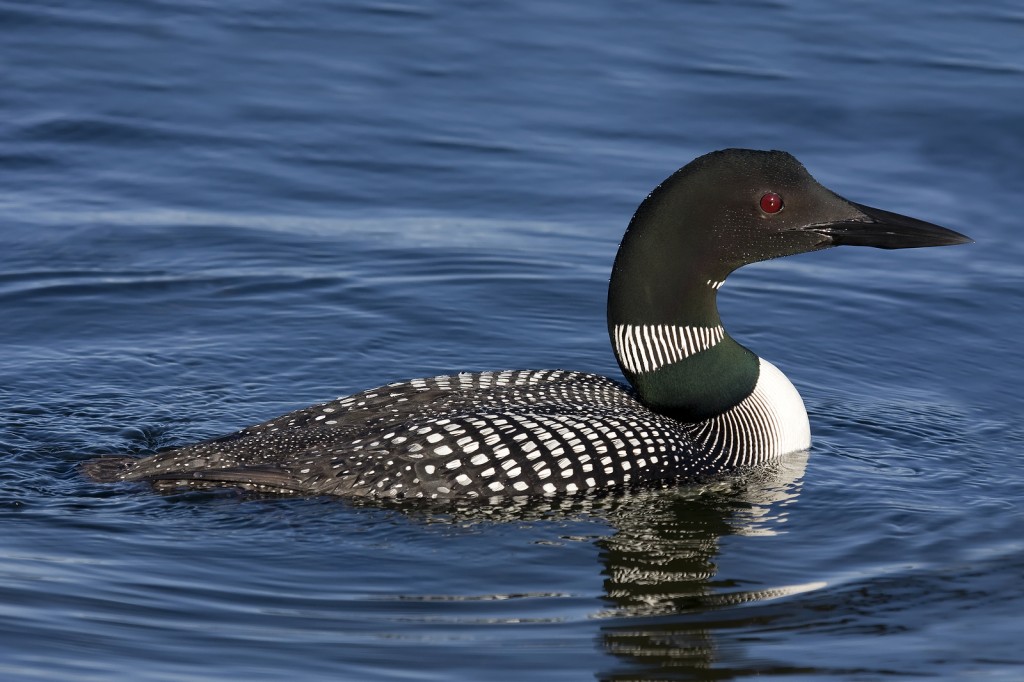
Photo - Bigstock

Photo – Bigstock

Well, I think, that’s as long a close look as you’ve ever had, probably time to press on. And I do just that, pushing my paddle shaft forward, driving the blade on the other side back; my boat sidles ahead. Then, the spirit of the day catches me up again, and I drift.

Here he is again, ten feet to my right. We resume eyeing each other; we drift on the half-knot tide; someone presses pause; another minute passes. Then, he dives again.

Well, that’s surely it, I think. Any more of this and you’ll be calling him brother. Still I drift, reluctant to take any action, to stir any water, to reach for the rest of the day. If I had outriggers to keep me from tipping, I could easily slip into a nap.

Oh, it’s you brother loon. And now I wish I had an offering – a little fish perhaps, a tiny amulet for your neck. I offer instead an awkward attempt at “talk.” My poor tremolo makes you turn your head, as if you can’t quite believe your hearing. I warble again.

Really, his posture seems to say, if you are going to speak, at least learn the language. He dives again, and this time he does not return. A quarter mile away, some seals mutter on their ledge. They sound a bit like dogs. Perhaps they are discussing the odd sound rising from that nearby boat. Perhaps I’ll paddle over for a talk.

Added note in response to a query: I didn’t paddle over to the seals, who were hauled out on a ledge. I know enough not to stress them and their possible pups with my approach, which would make them splash into the water from their ledgy lolling. My narrative ending was more in tribute to the sort of drift-and-muse brought on by my time with the loon, a sort of closeness I’d not experienced before.

Knotty Work

June 10th: It’s a short drive from home to the site of the Captain William A. Fitzgerald USN, Recreation and Conservation Area in Brunswick, Maine. A few years ago the US Navy decamped from Brunswick, and this is one of the parcels of land that reverted to the town after more than 50 years of Navy use. It’s an open, rumpled landscape of sand and grass and brush, stippled with some pitch pines, and now is the time to help it toward the sand-grass plain it wants to be, naturally.

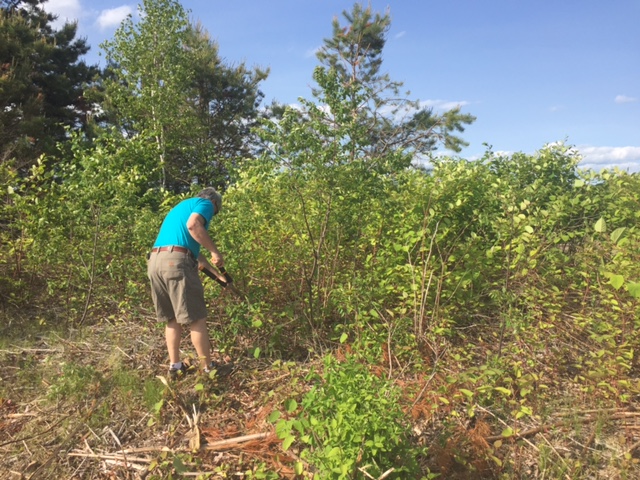
So five of us, working as the town’s Conservation Commission, arrived at the battered gate, took the old access road in and pulled up at the evening’s work – a clump of invasive knotweed. The weed, first brought to North America as an ornamental in the late 19th century, was well rooted, and, from its stand, clearly eyeing the acres of open ground around. We were doped for bugs and tick wary, and we had our cutters and loppers ready to have at the knotweed.

Having at the knotweed.

Having at the knotweed.

The setting – former naval base – the term “invasive, and our “attack” on it had cast my mind in a military set. As I reached a thumb-thick stalk of knotweed that rose to head height before me, Henry Thoreau flashed to mind. He too did battle with invasive weeds, though their invasion was not a trans-oceanic one. Still, as he labored among his beans during year one at Walden, he joined with the weeds that would crowd out his beans; he went at them with fervor:

A long war, not with cranes, but with weeds, those Trojans who had sun and rain and dews on their side. Daily the beans saw me come to their enemies, filling up the trenches with weedy dead. Many a lusty, crest-waving Hector, that towered a whole foot above his crowding comrades, fell before my weapon and rolled in the dust. -Walden

Ah, the mock heroic. And yet, in its dailiness, in its usualness, the real heroic too. This work of helping the land say, Beans, or, in our case, Grass, is part of the cultivation that forms culture, that, in the long run, helps us “to know beans.”

I sized up this knotty Hector and cut him down.

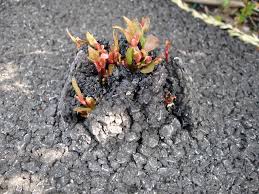
The troop at ease, where the knotweed once stood.

The troop at ease, where the knotweed once stood.

Well, all this metaphorical battling is a bit bloody for what we actually did, but just as Thoreau came “to know beans” through his close contact with them, we too came to know knotweed. And that brought me a little closer to knowing the variousness of this piece of land and what it might become. And I gained also a sense of knotweed’s tenacity and power. We may have leveled this stand, but clearly, the weed would be back for another round.

So too would we.

A powerful weed, a worthy foe.

A powerful weed, a worthy foe.