
Category Archives: Nature

Leafing Out

Suddenly, it seems, my field of vision is crowded – from accustomed long sightlines over sweeps of terrain it has narrowed to pinholes and hints of what’s beyond. The greeny leaves have unfurled, and I am back in the lime-lit world of the immediate. Also now, the merest stir of air lends an arrhythmic wobble to each leafy mobile as the breeze passes, and even a mild wind bends whole branches to its will. All of this news is sung each morning; starting just before 4:00 a.m. with the birds, spring is expressed.

That it has been a cold spring is a still strong memory, and perhaps that accounts for the sudden feeling of the leaves’ arrival. The buds swelled early, it seemed. But the buds always swell well before they offer leaves. We wait out the days of their return.

Much has been made recently of spring’s surge to earlier and earlier expression, and Henry Thoreau’s records of its advent have offered the sort of precise observation that satisfies scientists and floats popular narratives. Boston University scientist, Richard Primack, has made compelling use of Thoreau’s work as part of the tsunami of evidence that suggests our climate is changing.

Here, at the Concord school where I work, we have our own modest set of observations that add to this legacy of looking for spring. One of our scientists has been photographing the maple tree behind our meeting house for the past 8 years, and one of the occurences he has tracked is the date of the first leaf on the tree. This May 11th our first leaf appeared – and we haven’t been this late for leafing out since 7 years ago. This spring is almost 2 weeks later than what we’ve been experiencing for the past 2 years.

2008 12-May
2009 10-May
2010 2-May
2011 1-May
2012 29-Apr
2013 30-Apr
2014 11-May
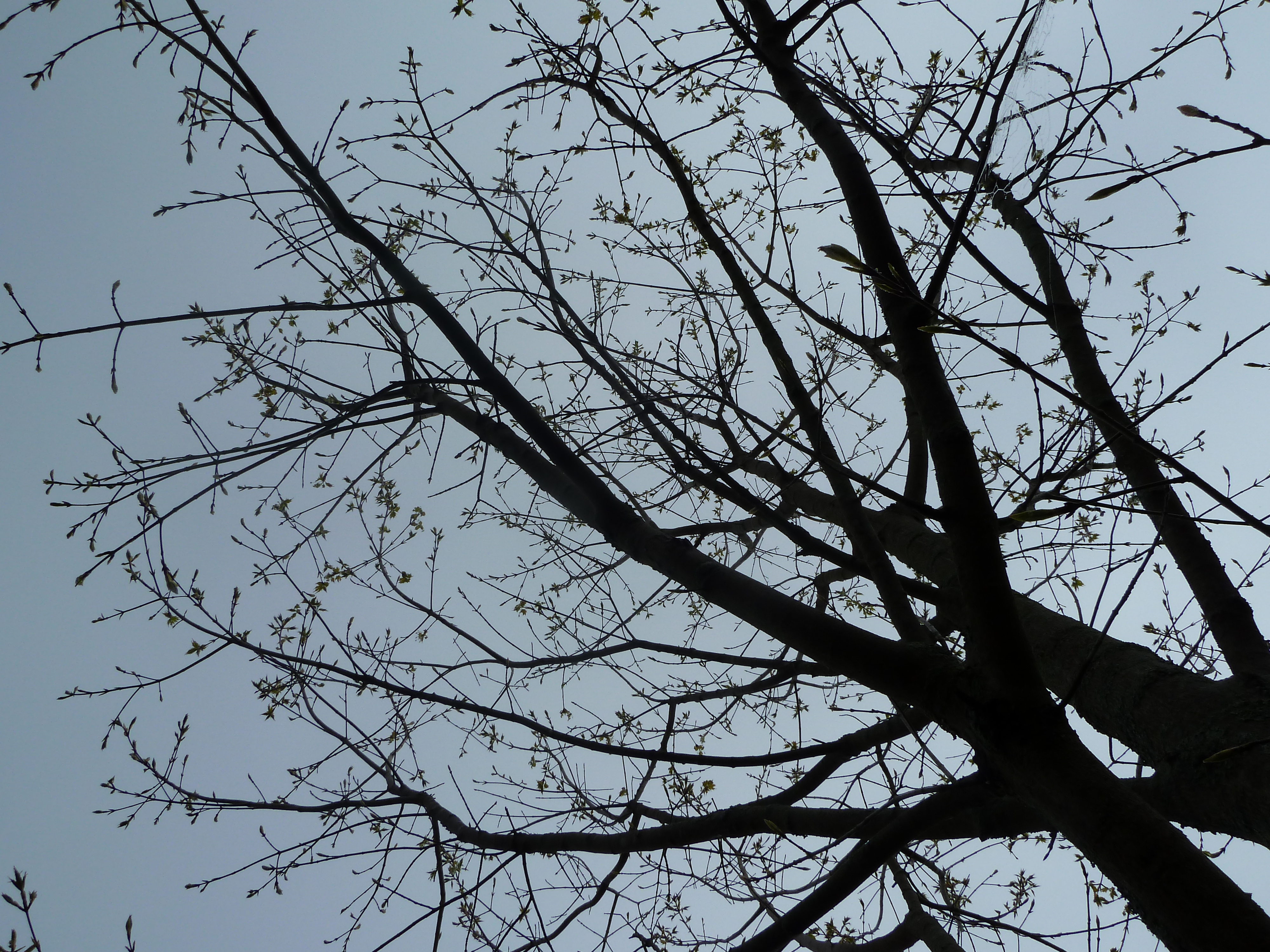
P1020601

It’s modest example, but of such variability is public skepticism of climate change made. We are, with our 360-degree sense of touch, characters of the immediate; even in our most cerebral and farsighted moments what touches us often varies from what prolonged observation and reason support.

Today, the wind is from the south, and the hazy air is thick with the scent of lilacs; we’re only a few degrees short of drowsy. Stringing the steel wire of will to long-term findings and change is hard work for this immediate animal, especially as the body feels the soft stir of warm air that it loves.
How I Missed the Anniversary…of Thoreau’s Death…Again

May 6th. You’d think it would be embossed in my mind – all these years of reading and teaching Thoreau, and yet, it slipped by again.

On the evening of this slippage, while I supervised an impatient study hall, I wondered to myself: why is that?

Here’s what I answered: it sounds simple, hokey, even, but for me, Henry Thoreau lives on. It would be a cliche to point to Walden and other works and say, “see, all around the world people read these words and then look up and change; all around the world people read and develop or renew their faith in I.” True…but trite to write.

And I’ve been reading through his spring journal of 1855, even as I live my spring of 2014. We have shared hawks and peepers and redwing blackbirds, woodland meanderings. All good, but…

Here then is a more personal truth: years of living with Henry Thoreau’s writing have given me new eyes. Every day when I walk out the door, I look up, I scan the peripheries of each world I step into – yesterday the robin nesting in the dwarf pine was facing east as she sat atop her two blue eggs; today, she’s facing south. The copper beech in the yard is kicking finally last year’s dun leaves from a hold that endured quite a winter. The parking lot maple prepares a riot of seeds…so much faith.

It all begins…again.

Little Feats

Note: no quotations from Henry Thoreau in this post, but I like to think a similar spirit suffused his mountains.

The other day, while small-stepping along the trails that lead to and from Walden, I got to thinking about footwork. A lifetime of trails has kept me reasonably adept at the juggling cadence needed for New England trails and their studding of rocks and roots, often disguised by leaf litter. But it was a sharp downhill that triggered this running meditation.

Not long ago, I’d heard from a younger friend who runs mountain trails. I’d asked for a report about a loop I like, and I had gotten back a detailed account of a daylight-long ramble. At its close he wrote, “the last five miles go by pretty quickly with a bomber descent off Flume and a flat mile out to the road.” ‘Bomber descent,’ I thought as I short-stepped down the sharp, forty-foot drop off an esker; ‘no way no way no way no no way…’ – this one-syllable no-mantra set up with my stepping.

All of New England’s mountains genuflect to their northern shaper, the glaciers, gone to water for now, but likely to cycle back at some point. The upended, frost-split rock is their residue, and everyone who visits our uplands must contend with its odd angles.

As boy turned loose for the first time from parental supervision, I began to stride and run through the White Mountains. I was seventeen; I was in a hurry. Beyond each summit was another, and that was where I wanted to be.

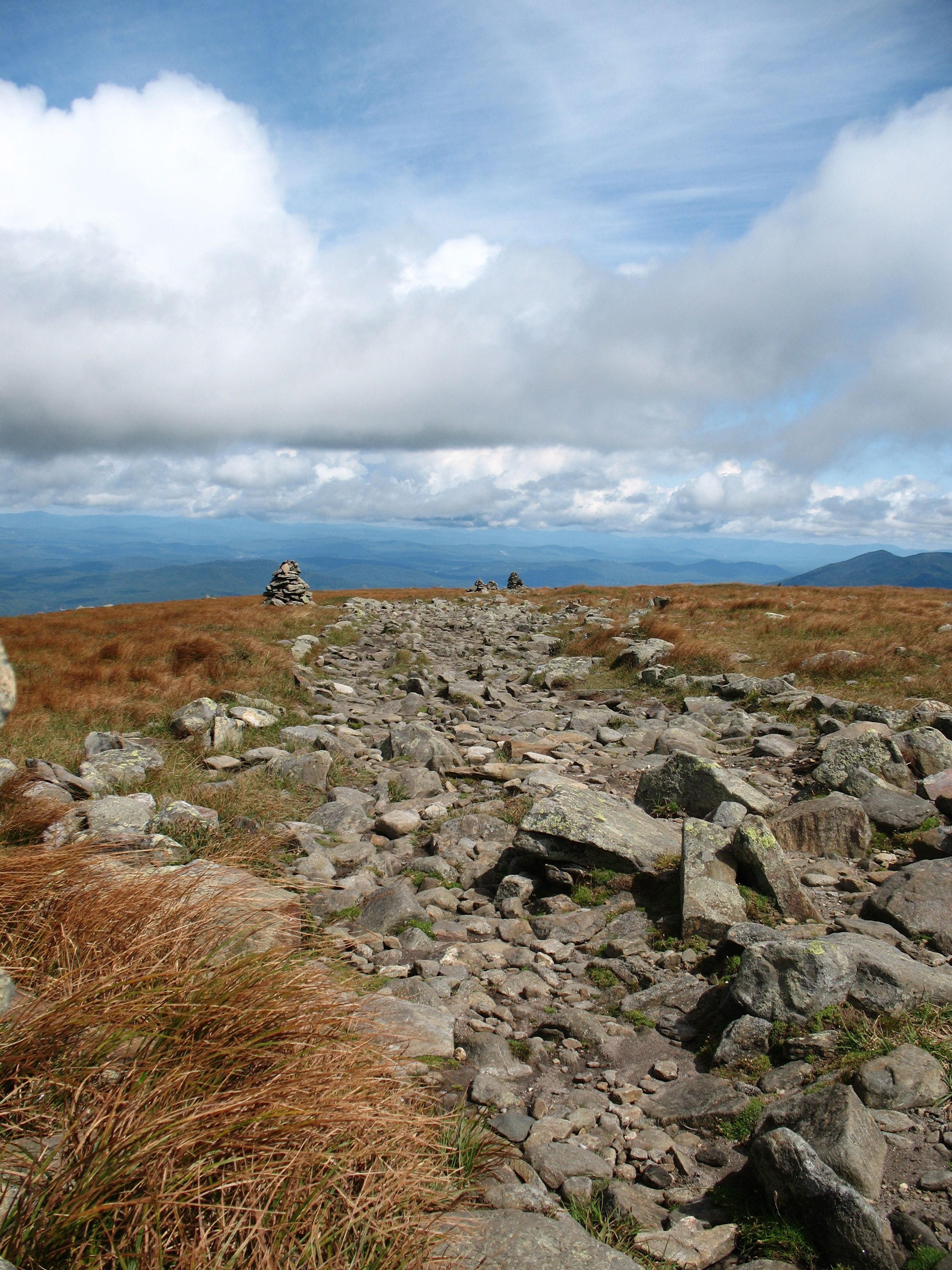
Rock-strewn Way

Rock-strewn Way

Memory’s scrapbook holds images from a summer day moving north along the ridge that joins Mt. Washington to Mt. Jefferson; I am with a 17-year-old friend who is new to these hills and their jumbled trails; I am his trail-tutor. “Look,” I say, eyeing the half-mile descent of Mt. Clay’s flank, “it’s more fun to run this.” I don’t think so,” he replies, and he starts down in a stolid fashion. “At least take my pack,” I say, and he returns, shoulders it (only a day pack) and turns downhill again. I watch him grow steadily smaller.

The amperage loose in my system has me edgy, which is another way to say sharp. I see my first five steps and figure the rest will appear. They do. I land on various edges, listen to the hollow clunk of my boots and odd knocking stones, and when I can’t find my next step immediately, I do what my mountain-running counselor taught me at fourteen – I “go up.”

“Going up,” jumping higher when you see no landing, may sound counterintuitive, but it works. In those few airborne seconds, you find your next step, even if it is a thin edge of stone; and then you quick-step on. This is rock-dancing, and in that era of life that was my way.

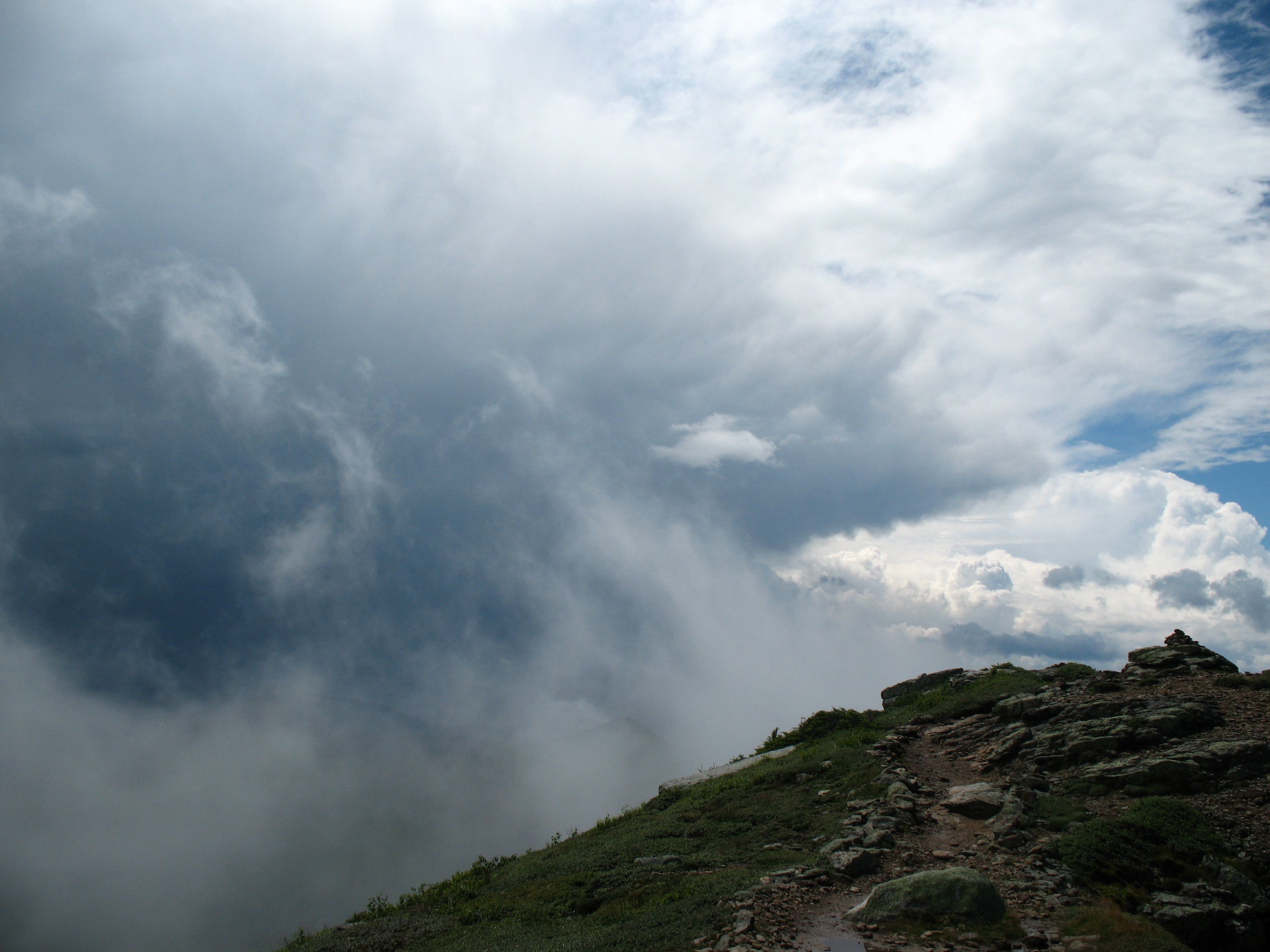
Up There - Franconia Ridge

Up There – Franconia Ridge

That memory leads to appreciation for the ways our walking changes over time. And so, even as I walk and shuffle the same trails as my younger friend and my younger self, I leave the bombing to them and dance now in short steps. They are my little feats.

Post note: surely, when you consider the ground Henry Thoreau covered on his walks and in the hills, he too must have “danced” or “bombed” some of his descents.