Category Archives: General

Refilling the Feeder – The Cardinal’s Yard

Recently, at the end of a long day, we pulled into our driveway ready to re-up for the slow arrival of Maine’s spring. The dirt-infused snow was still deep on the front yard, and the bushes around the house still slumped beneath the winter’s weight. But there in greeting also was a lozenge of fire, red atop the rhododendron – the cardinal who knows our yard as his territory looked directly at us and offered announcement, sort of a squall of welcome. What, he seemed to say, are you going to do about the feeder out back?
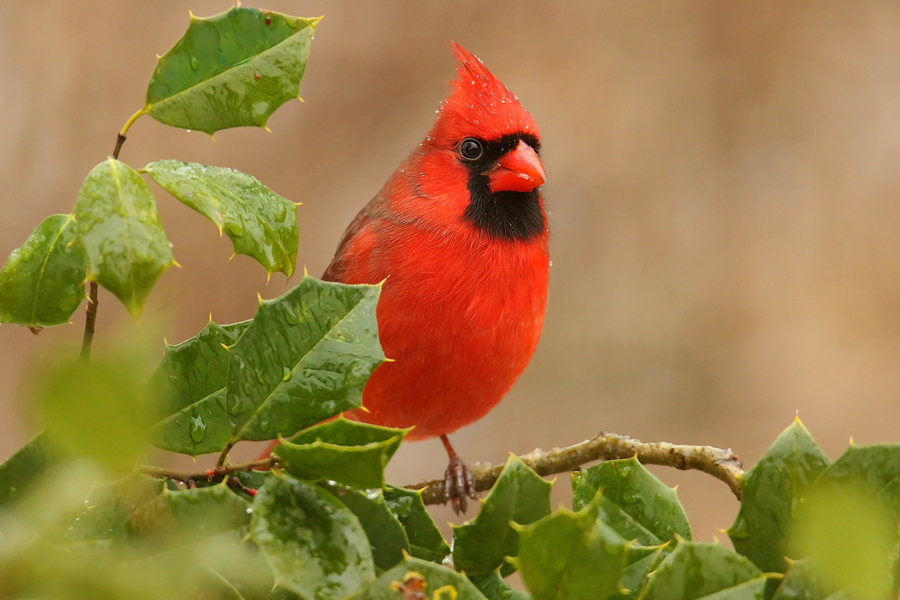
We have a holly, and we have a cardinal, but these are not they. Photo: Bigstock

We have a holly, and we have a cardinal, but these are not they. Photo: Bigstock


So, before unpacking the car, I went to that feeder and shook out the residue of seed husks, then filled it with fresh provender.

This morning brought reward in familiar flurries. Chickadees and nuthatches, including a red-breasted one, flew in and lit to take their accustomed single seeds, which they then carried to a nearby pine. House sparrow arrived and performed his usual task – grabbing and then flinging seeds here and there before settling on one to actually eat.

The sparrow must be the cardinal’s friend because not long after he’d flung seeds this way and that, the cardinal stopped by for the sunflower seeds now on the ground. Ever-alert, he hopped and sorted among the downed seeds until he found one he liked; then he split the husk and downed the seed in a gulp. Then on to the next.

Yesterday, the goldfinches arrived. There, suddenly, they were, looking like yellow thumbs (up).

So too, one of the neighborhood cats, for whom I am a backyard Maori – unaccustomed to being chased, cats run from the expletive-spewing, hand-waving emergence from our backdoor; then at the fringe of the woods, they always look back in further disbelief, before vanishing.

I’d welcome some not-too-antisocial advice about discouraging cat-visits. I’m loathe to go to the warning sting of a b-b or pellet gun, but, clearly, I’ve considered it. Perhaps coyote urine, easily purchased these days? Perhaps you have a favorite solution? Perhaps I will post our little stamp of land, alert our neighbors, and then have at whatever slinking cats appear.

Or, perhaps, I can entice our local rooster to hang out more in our yard; the cats seem wary of him (as am I).

We’re a little too suburban to need to heed the advice to take down our feeders in April as guard against bear-visits – no bears live in and wander our local woods, even as I see sometimes a fox step from them and the wild percussion of our pileated woodpeckers sets my toe tapping.

And so, until summer starts offering its menu, I’ll keep heeding the cardinal and filling the feeder. Surely, I get more back than I give.
Spring’s Songs – Jonathan Franzen and Henry Thoreau and Birds

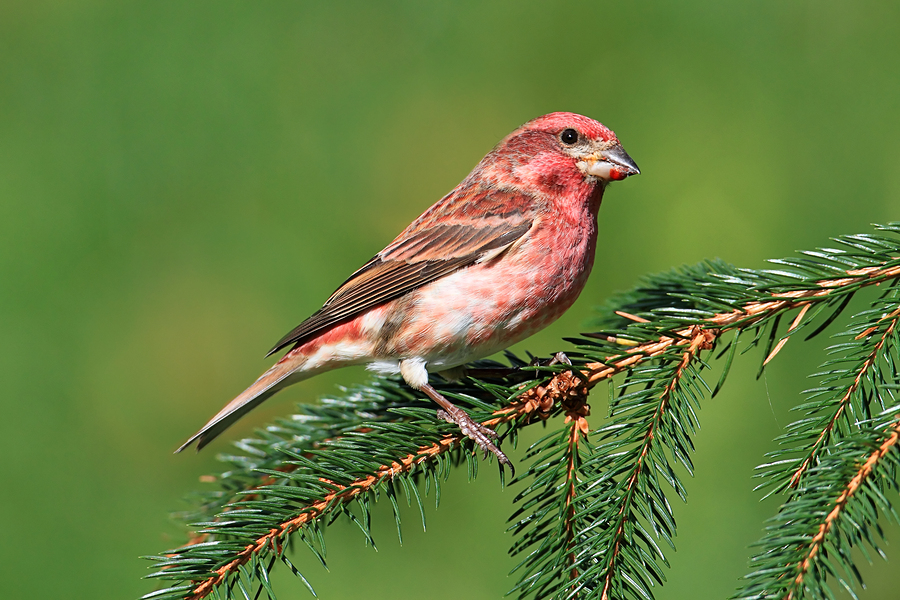
A purple finch showed up in our yard yesterday, just hours ahead of the last (I hope) snowfall. And my daily footwork was again suffused with bluebird song. These birds then triggered a rereading of an essay that had caught my eye but then slipped into the welter of partially-read pieces.

Purple Finch (carpodacus Purpureus)

You, if a reader of this blog, have grown used to our stepping onto the springboard of Thoreau’s journal writings; from there, we often dive into something daily, some moment of the local world. Today we climb a little higher, then drop a little farther from the platform of Jonathan Franzen’s recent essay, Carbon Capture, ( http://www.newyorker.com/magazine/2015/04/06/carbon-capture)  in the April 6th New Yorker. From (and in) it, we consider the vast challenge of climate change and the sliver of effect we call personal response. Franzen’s piece, the best response to this calamity that I’ve read, brings us back to Henry Thoreau – not by specific mention, but by its suggestion that local attention and conserving work can be redemptive, can be a daily way forward in a difficult time.

In struggling to come to personal terms with climate change and its vast pronouncement, Franzen writes of birds, of local study and care that echoes Thoreau’s understanding that, when it came to universal concerns and understanding, he had “traveled a good deal in Concord.” Franzen’s central thought is direct: climate change is real and unstoppable; its scale so dwarfs a person’s efforts as to negate them, and so, even as large environmental organizations and figures recommend combating it, focus on climate change draws a person away from work where she or he can have effect, can live a life – working for conservation of habitat for birds and other animals, for example.

As he considers himself and us, Franzen identifies two central strains of thought that divide us: the Puritan, guilty-as-charged school and the positive, life-affirming Franciscan school. In shifting his focus from guilt-inducing efforts to have personal effect on climate change to life-affirming work for bird habitats, Franzen chooses life and whatever measure of joy it may contain. His implied question is a simple one: do you want to live a guilt-ridden, powerless life or a commitment-suffused one?

Franzen is not naive. He knows that climate change will alter habitats, will affect every thing. But he points out that global scale trouble and guilt finally overwhelm and paralyze. If, every time you have an effect – which is of course, every minute – you feel guilty about it, you step finally away from such wearying awareness. If instead, you feel you are working at least some of the time for some small sector of life, local habitat, for example, you can be buoyed by small victories, lifted by your embrace of the local.

Thoreau, of course, knew the lure and redemption of the local. His journal is a record of engagement and, yes, love, of where he walked and what he found.

Journal, April 9th, 1856: 7 A.M. – To Trillium Woods…The air is full of birds, and as I go down the causeway, I distinguish the seringo note. You have only to come forth each morning to be surely advertised of each newcomer into these broad meadows. Many a larger animal might be concealed, but a cunning ear detects the arrival of each new species of bird. These birds give evidence that they prefer the fields of New England to all other climes, deserting for them the warm and fertile south. Here is their paradise. It is here they express the most happiness by song and action.

I have taken a nuanced, developed essay and simplified it (without too much damage, I hope). It is worth reading in its fullness. Just as the birds singing in today’s new snow remind that today is there to live in its fullness.

Breaking Up Is Hard To Do

Neil Sedaka and Henry Thoreau – not your usual pairing. Still, both share a fascination with iced water’s set world. And with the grip it has on us. Both also wrote words, lyrics, that can take over the mind.

So it was that during our one-day spring (55 degrees!) last Friday, I approached our nearby bay at the shuffle-pace I call running. The snow’s remainders lay in thick strips of drift across the tan fields, and, having just returned from southern sojourn, I was wondering what I’d find. In mid-March, when we’d left in search of spring, the ice on the bay was more than a foot thick, and it stretched beyond the islands a mile off shore; I’d watched a family ski on (frozen) water out to those islands. Not, as we can all agree, a usual winter.

Through the barely budded trees, I could see the water, and it was streaked with white. Ice still!, I thought. As I drew nearer, I saw also gaps in that white, leads of open water colored greeny gray. A low rustling sound rose from the bay – ice rubbing ice, wearing itself away. Neil Sedaka’s lyrics popped into my head (and they are still there): breaking up is hard to do.

Out on the water, a pair of ducks paddled up to one miniature berg and clambered aboard, settling into contented crouch as their small world was jostled by others. A sheet of ice as big as a playing field floated seaward, impelled, it seemed, by some invisible force. Gulls cried through the air. The whole bay was alive.

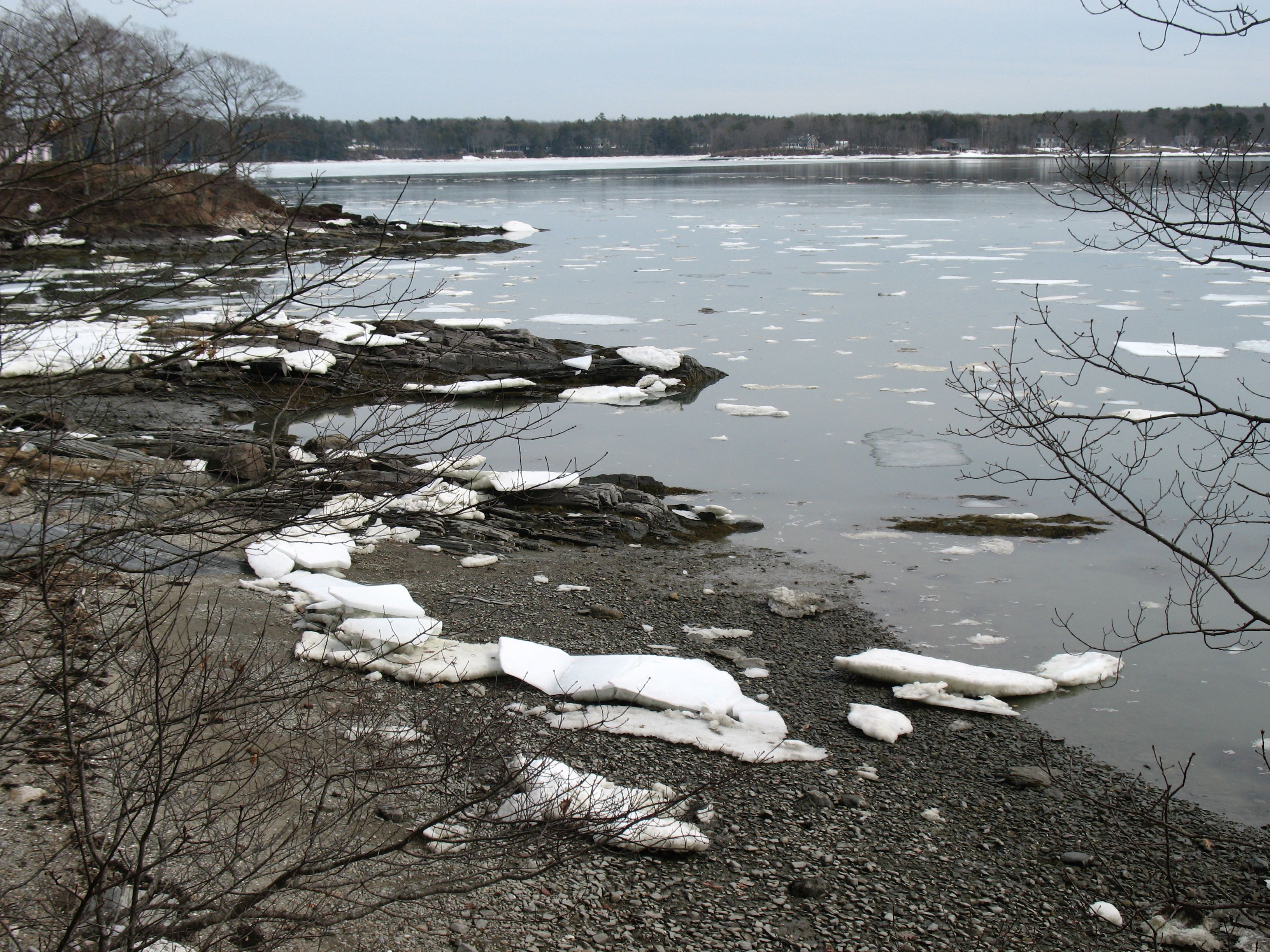
Remnant ice, with the still unbroken sheet in the background.

Remnant ice, with the still unbroken sheet in the background.

As I left to return to my shuffle, I tried to force Neil Sedaka from my mind by thinking about Henry Thoreau and his break-up stories of Fairhaven Bay, the expanse of the Sudbury River broad enough to behave like the sea sometimes. Invariably, Thoreau’s spring journals arrive at Fairhaven to chronicle its break-up.

The winter of 1856 bore good resemblance to this year’s – March stayed cold, the snow was deep, ice thickened even as the light grew longer. Thoreau was out and about measuring the ice (nearly two feet thick on Walden) and walking still down the Sudbury’s center in late March. Still, as his long entries about spring signs make clear, he was eager for and alive to the new season.

On April 7th he finally was able to launch his boat:

Launched my boat, through three rods of ice on the riverside…Up river in boat…The first boat on the meadows is as exciting as the first swallow or flower. It is seen stealing along in the sun under the meadow’s edge. One breaks the ice before it with a paddle, while the other pushes or paddles, and it grates and wears against the bows.

And on April 8th, he reached Fair Haven Pond:

By the side of Fair Haven Pond it was particularly narrow. I shoved the ice on the one hand and the bushes and trees on the other all the way…For all this distance, the river for the most part, as well as the pond, was an unbroken field of ice.

“Comma comma down doobie do down down,” I half-sang, “comma comma down…” and my feet aligned their steps to Sedaka’s song.

Breaking with this song is as tough as slipping the grip of winter; O, this will not end soon, I thought. And clearly these days later, even as our ice retreats, it hasn’t.

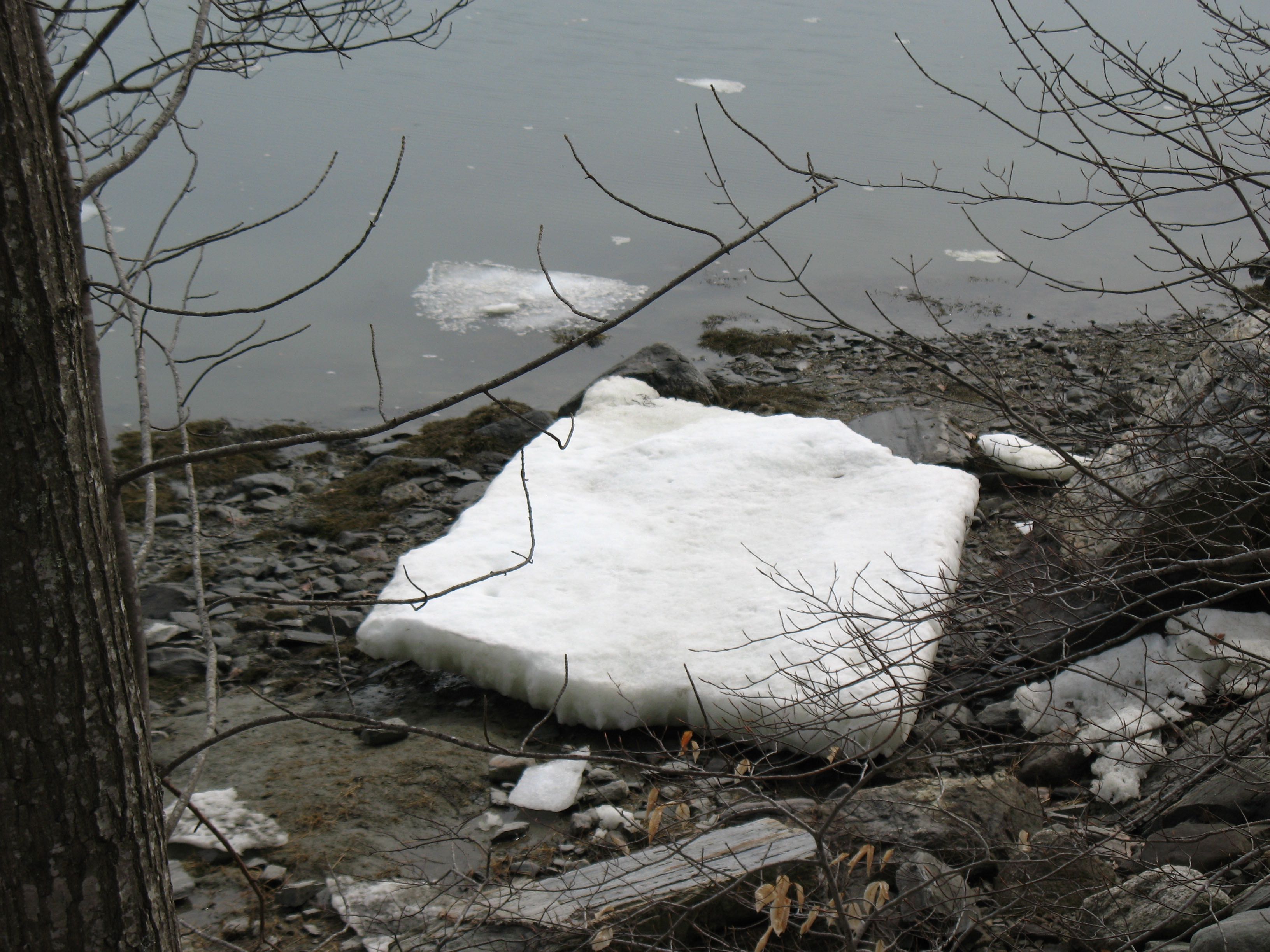
Stranded berg

Stranded berg

Breaking up is hard to do. Comma comma…

Added note: a while later, in a tree at a field’s edge, a bluebird sang, then flew, its sky-blue back flashing in the sun.