
Tag Archives: Henry Thoreau

Thermal Being: a little winter walking, or “an adventure on life”

“When he has obtained those things that are necessary to life, there is another alternative than to obtain the superfluities; and that is to adventure on life now, his vacation from humbler toil having commenced.” “Economy,” Walden

Scene from a few days ago: The short-long month dwindles to a day, even as the morning temperature (ten below zero) offers reminder of its power. I’ve just returned from some days in the White Mountains, where, true to their name, winter’s grip endures. Each day, I climbed out of night’s valley toward the ridge-tops, feeling the cold sharpen as I got higher, and heeding its insistent reminder that winter climbing is all about carefully managing temperature, a lesson in essential heat that Thoreau considers at the outset of Walden.

Walking up on snowshoes also gives you ample time to think- it is the slowest form of walking I know – and I spent some of that time considering my little island of heat on the way up. The counterintuitive trick in deep cold is to avoid overheating and its bath of sweat, which, if generated, tends quickly toward ice when you stop and cool. As all winter walkers know, this focus leads to a parsing of layers of clothing that is different for each walker. I spent considerable steps debating 3 versus 4 layers, adding in consideration of a tucked versus an untucked underlayer.
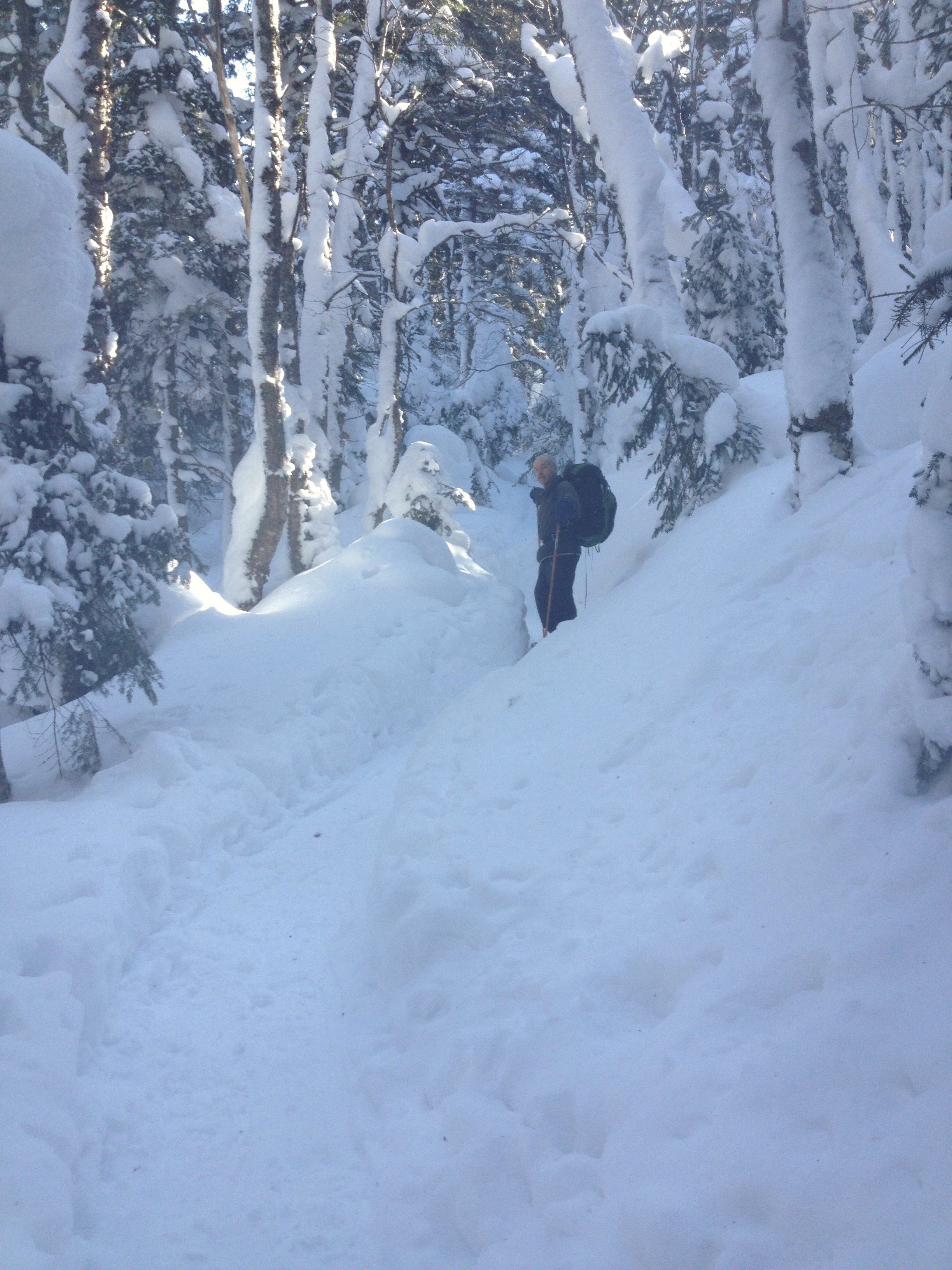
Deep Snow along the Crawford Path (hat off to shed heat). Photo by Paul Ness

Deep Snow along the Crawford Path (hat off to shed heat). Photo by Paul Ness

Then, there was our adaptability to cold to figure – in short the longer your exposure to cold, the more you acclimate to it. Even my three days of climbing pointed this out. By day three, I was down a layer, even as the temperature stayed stubbornly near zero. And, as further example, I recalled a few years ago being out on Zealand Mountain on a zero-degree day, when the caretaker for the nearby hut passed us wearing only shorts and a halter top as she cruised up the trail. Yes, she did admit to “layering up” once she reached the open ledges near 4000 feet, but her winter of living in an unheated hut had given her impressive resistance to cold.

Finally, there was the feeding of my “firebox,” a practice nearly identical to that of keeping a wood stove going throughout the day. (Thoreau notes this analogy as well.) I learned stoves during a winter in a wood-heated cabin when I was in my early 20s. By March, I could mix woods of varying density and dryness to get the consistent heat of a slow burn day and night. And, having become inured to the cold, I kept the cabin at around 50 degrees. So too with the burn of the body’s fuel during winter walking – mixed feedings, often while still walking, keep you warmer. And here is happiness: enduring cold asks for calories of fat. You like cream cheese or butter? Bring (or layer) it on. It’s not unusual for someone out in deep cold to burn 5000 calories in a day. Falling short of that intake can bring on insistent chill.
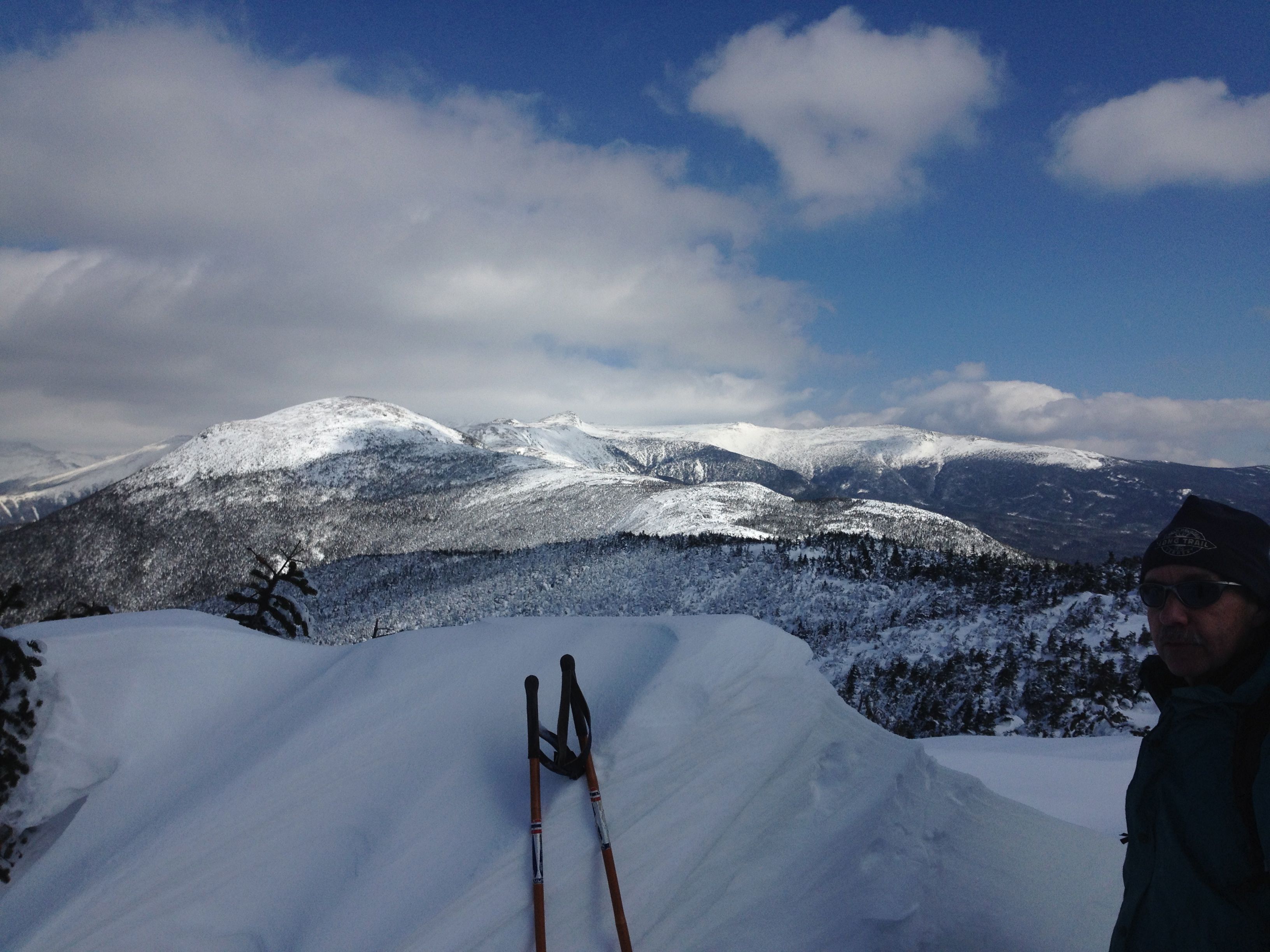
Zero and Windy - a look at Mt. Washington. photo by Paul Ness

Zero and Windy – a look at Mt. Eisenhower.
photo by Paul Ness

I know too Henry Thoreau set out on snowshoes when winter was deep – I saw his snowshoes at last year’s exhibit of Thoreauvia at the Concord Museum – and surely he left a record of sensitivity to temperature – both his and that of the Walden world. Thoreau understood that we are truly thermal beings; sometimes it takes winter drive home our dependence.

Postscript: for 24 hours after returning from days outdoors in the cold mountains, I got thermal reminder: indoors, even with central heating set low, I burned with heat. Then, the fat worked through my firebox, and I returned to the temperate feedings and feelings of the lowlands.
Thoreau & Twain on Learning and Loss

By Corinne H. Smith

Unless you’re shelving classics in alphabetical order by surname, the names of American authors Henry Thoreau and Mark Twain don’t usually surface at the same time. The two men never met, although their lives overlapped by 27 years. Twain began his writing career just as Thoreau was ending his. By then, they were based on opposite sides of the country. Their writing styles and choices of topics differed widely, of course. But both wrote travel narratives. And both were known for their keen powers of observing the activities of nature and man. Overall, Henry focused more on the first; and Mark, more on the second. Both had unique senses of humor, too.

Thoreau and Twain Together

Thoreau and Twain Together

One issue they may have agreed on was the costs they both incurred by choosing a certain way of earning money. They could have debated their results. Is it possible to be TOO familiar with Nature? Do we lose something irreplaceable when we gain too much technical knowledge of the natural world? Consider these two passages.

In his journal entry for January 1, 1858, Thoreau mourns the loss of finding wildness after conducting a lot of surveying:

“I have lately been surveying the Walden woods so extensively and minutely that I now see it mapped in my mind’s eye – as, indeed, on paper – as so many men’s wood-lots, and am aware when I walk there that I am at any given moment passing from such a one’s wood-lot to another’s. I fear this particular dry knowledge may affect my imagination and fancy, that it will not be easy to see so much wildness and native vigor there as formerly. No thicket will seem so unexplored now that I know that a stake and stones may be found in it.”

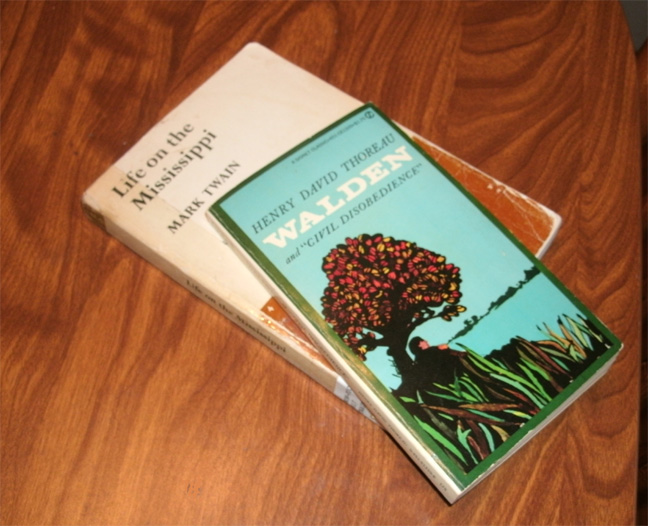
Compare these thoughts to those in Twain’s book, “Life on the Mississippi,” in Chapter IX, called “Continued Perplexities.” He describes losing the ability to see beauty after learning to navigate a steamboat across the muddy Mississippi:

“Now when I had mastered the language of this water, and had come to know every trifling feature that bordered the great river as familiarly as I knew the letters of the alphabet, I had made a valuable acquisition. But I had lost something, too. I had lost something which could never be restored to me while I lived. All the grace, the beauty, the poetry, had gone out of the majestic river!”

Twain recalls – to a time when he was known as Sam Clemens – how he once had been captivated by sunsets or by moonlight reflected in the water. He could relish the sights of ripples, sunken logs, and other imperfections that made the river view more interesting. These were the same idiosyncrasies that could have consequences if you happened to be steering a paddlewheel craft through the water. Now all he could see were potential navigational obstacles.

“But as I have said, a day came when I began to cease from noting the glories and the charms which the moon and the sun and the twilight wrought upon the river’s face; another day came when I ceased altogether to note them. … No, the romance and beauty were all gone from the river. All the value any feature of it had for me now was the amount of usefulness it could furnish toward compassing the safe piloting of a steamboat.”

These are sad words to read. Especially since both men were writing about their home territories and about places they loved. Walden Woods. The Mississippi River. I hope they both overcame these losses, and that these were only temporary setbacks. Or maybe the stresses were more complex. Maybe the men also inwardly bristled at the situations that forced them to be responsible to others for that keen but necessary focus on science and mechanics. Henry reported to the landowners. Young Sam Clemens’s duties were to a steamboat company and to an ever-changing packet of passengers. Neither had much time for sheer appreciation of the landscape.

And yet, I keep Thoreau and Twain in mind as I continue to read and learn more about plants and animals and habitats and such. If I’m in the forest, and I come upon a leaf that I recognize, will I be apt to say, “That’s a white oak,” and never look up at the terrific silhouette of the tree it came from? I wonder: If we learn “enough” about the natural world, do we risk never having another chance to witness its wildness or beauty? Will the facts always get in the way?

I can’t be the only one who worries about this dilemma. Surely scientists and park rangers must wrestle with it, too. Do you?

Tiny Promise

More fun with shovel on the roof today, and, yes, the arctic has reannounced itself (13 below this morning). I pitched my pounds of snow out into the air, and they fell with the thud of stone. But up there, on its slight southwestern pitch, I also got a face full of light, and in the little coves of my scarf, I could feel that light’s heat gathering. I leaned on my shovel, closed my eyes, and felt Spring coming on.

It is common announcement, but it feels like miracle as well, this tiny promise. And, as often happens when I’m outside, Henry Thoreau’s nosings about came to mind. In particular, I thought about his musings on the way seeds move with the wind and over the snow during the winter. Below me, the snow was littered with twigs and seeds from a recent gale, other tiny promises that, when linked with sun and water, would become the next season of growth.

More Promise

More Promise

In mid-February of 1856, Thoreau was, as usual, out walking and seeing what he could see:

I was struck today by the size and continuousness of the natural willow hedge on the east side of the railroad causeway, at the foot of the embankment, next to the fence. Some twelve years ago, when that causeway was built through the meadows, there were no willows there or near there, but now just at the foot of the sandbank, where it meets the meadow, and on the line of the fence, quite a dense willow hedge has planted itself. I used to think that the seeds were brought with the sand from the Deep Cut in the woods, but there is no golden willow there; but now I think that the seeds have been blown hither from a distance and lodged against the foot of the bank, just as the snow drift accumulates there…

…Thus they take advantage of even the railroad, which elsewhere disturbs and invades their domains. May I ever be in as good spirits as a willow! How tenacious of life! How withy! How soon it gets over its hurts! Journal 2/14/56

Blown this way and that by a winter of renown, I felt as if I had come to rest at the base of this bank of light; I felt its warmth. It seeds me for spring.