
Tag Archives: Henry Thoreau

Solstice Dance

Solstice – In The Long Light of the Journals

The light woke me before five this morning. Often, these days, it’s the birds, whose singing begins with a single fluted call just after four; that call garners response. Then, the avian neighborhood joins in. But today, appropriately, it was the light, which seemed intent on my living the fullness of this “longest” day of the year. I got up, brewed some coffee and went to a morning chair to read.

Through these days in 1855, Henry Thoreau was also making the most of the long light, spending hours out and about, and, for the most part, recording only the nests he observed in short journal entries. These days form a skein of regeneration: as the light peaks the whole world seems to be rising and chirping from its many cupped circles. Young birds break from their eggs, squall for food, fledge finally, and Henry, as he walked, must always have been looking up. A whole sky alight suggested as much.

But one day, the 18th, on his way to or from The Hemlocks, Henry catches motion on the ground. First one, then another, painted tortoise appears: “I saw a painted tortoise just beginning its hole; then another a dozen rods from the river on the bare barren field near some pitch pines…I stooped down over it, and, to my surprise, after a slight pause it proceeded in its work, directly under and within eighteen inches of my face.” For long minutes Henry stays still in this “constrained position,” watching, as the turtle digs her hole and lays five “wet, flesh-colored” eggs. His description is typically precise, satisfying, and now, this reader thinks, it’s time to rise from this cramping crouch and move on. Perhaps to the next local miracle.

From Henry's Point of View

From Henry’s Point of View

Henry, however, stays; I stay too. And I am rewarded with a recovered favorite image, a dance of completion that seems just right for the days of maximum light:

After these ten minutes or more, it without pause or turning began to scrape the moist earth into the whole with its hind legs, and, when it had half filled it, it carefully pressed it down with the edges of its hind feet, dancing on them alternately, for some time, as on its knees, tilting from side to side, pressing by the whole weight of the rear of its shell…The thoroughness with which the covering was done was remarkable. It persevered in drawing in and dancing on the dry surface which had never been disturbed long after you thought it had done its duty, but it never moved its forefeet, nor once looked round, nor saw the eggs it had laid.

Painted Turtle Laying Eggs

I put the journal down. I have seen such dancing, for me snapping turtles crawled up from a nearby bog. Now the image is fresh again, a dance of the solstice lit by the long day of Henry Thoreau’s writing.
Heat, Humidity & Henry (Or: In Touch with the Past, Part II)

By Corinne H. Smith

Yesterday we had one of those hot and humid days. Ick. You know the kind. Not only was it darn uncomfortable just to sit around and breathe, but it also caused every hair on my head to curl in a different direction. Neither cap-wearing nor combing could remedy the situation. And the hot and humid day turned into a hot and sticky night. The occasional whiffs of air from an open window didn’t do much to cool off the bedroom. I couldn’t get to sleep.

After two hours of just lying there, I decided to get up and to get some work done instead. I might as well be productive, as long as I was awake. I fired up the computer and got out some of my Thoreau books. I wanted to scan his journal for references to a plant I had found in our yard. I hoped Thoreau had seen and felt the same way about it that I did. I had hoped to write a post here in response to whatever he had written.

I opened the first of my two-volume Dover set: a reprint of the 1906 journal volumes that Sandy Stott mentioned in his recent post, “In Touch with the Past” (https://thoreaufarm.org/2014/06/in-touch-with-the-past/). These books are slightly more portable, take up less room, and contain the same text as the ones Sandy uses. But all I found were Henry’s glimpses of the plant, and some of the dates when he saw that it had blossomed. I wanted more details, more substance. This time, he wasn’t forthcoming. I sighed. This particular subject wasn’t going to work. What was I going to write about instead?

Then I stumbled upon this entry:

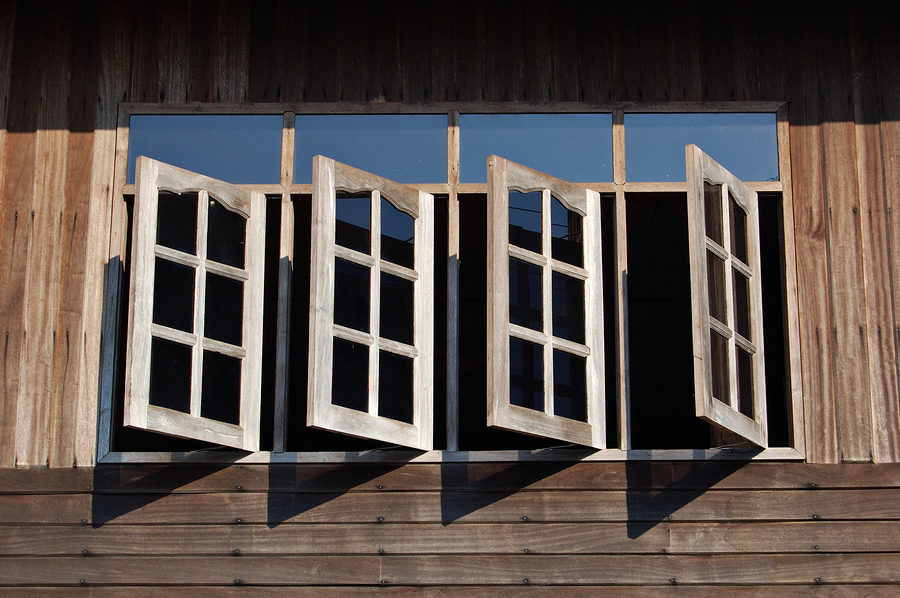
“June 21. … The warmest day yet. For the last two days I have worn nothing around my neck. This change or putting off of clothing is, methinks, as good an evidence of the increasing warmth of the weather as meteorological instruments. I thought it was hot weather, perchance, when, a month ago, I slept with a window wide open and laid aside [it] a[s] comfortable, but by and by I found that I had got two windows open, and to-night two windows and the door are far from enough.” ~ June 21, 1853

No Matter How Many Windows Open...

No Matter How Many Windows Open…

I shook my head. Here we were, sharing the same discomfort, across the span of 161 years. No matter how many bedroom windows we’ve opened, they’ve done nothing to bring us relief. The times, they are not a-changing. This painted a picture of Henry Thoreau that I had not thought of before. The naturalist, the writer, the surveyor, the saunterer, the philosopher? Sure. Someone who lies awake on a steamy summer night and considers the relationship between the rising temperatures and how much clothing a person is wearing? No. But it’s certainly an interesting image. Then again, what else could he do under the circumstances? He didn’t have a computer for entertainment, where he could check his e-mail and what his Facebook friends were doing at midnight.

Alas, Henry. I suspect we will have more of these unbearable and sleepless nights in the next three months. I’ll think of you again whenever the act of opening two windows and a door isn’t enough to cool the bedroom.

Narcissus and Henry

Reflective Writing Near the Water’s Edge

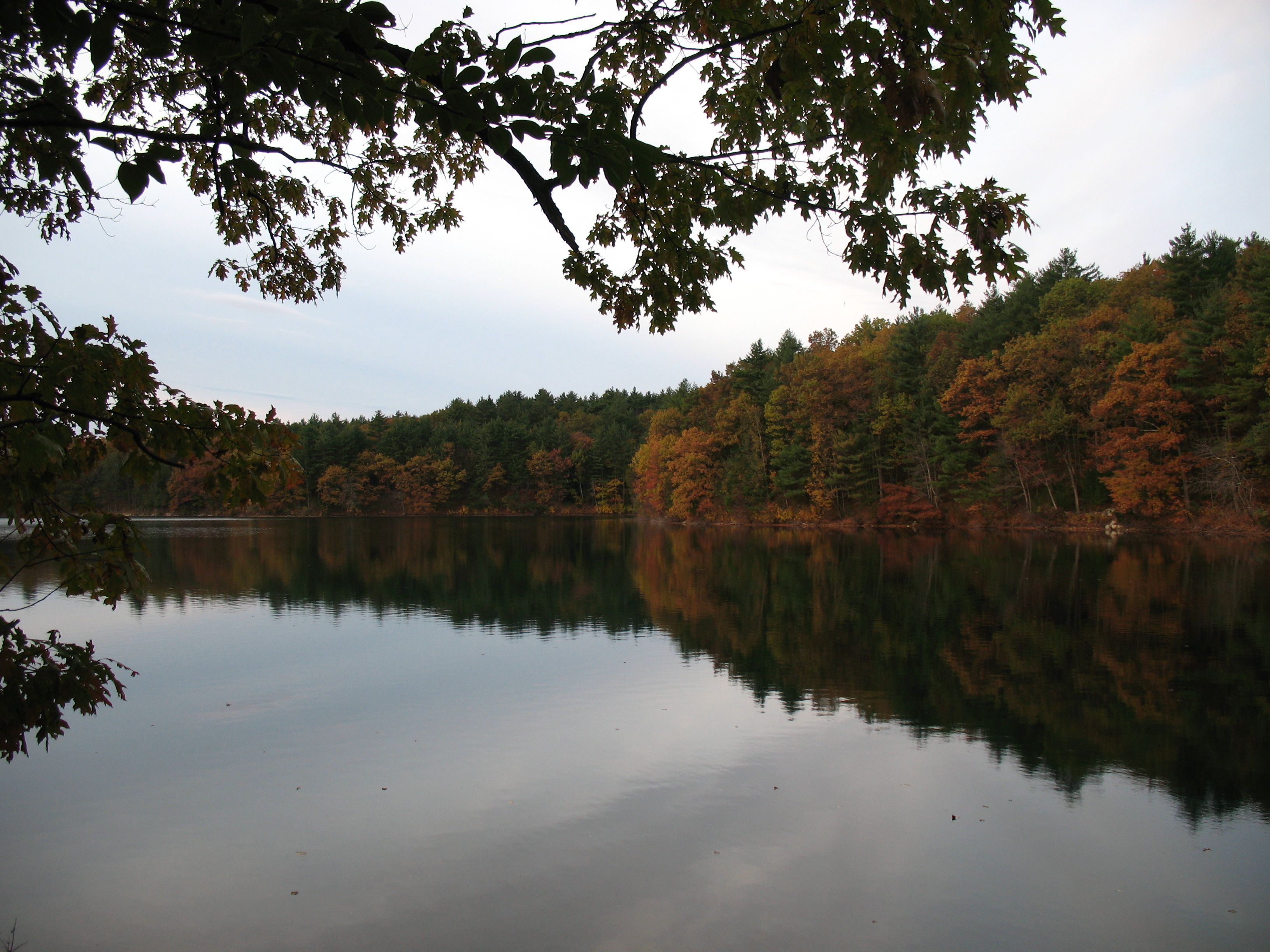
Walden Pond is alive again with wind and light. I’ve been there often during the past month, admiring its blues and greens (depending upon where I am in elevation and the day’s light) and wondering at its still-clear waters. One day soon I’ll wade in. But for now, as the water warms a bit each day, I’ve only been looking, and, as looking often does, this pond-gazing has triggered memory.

Walden's Reflective Waters, (albeit in a different season)

Walden’s Reflective Waters, (albeit in a different season)

Last spring, a student sat down to describe a dilemma she’d encountered while writing about her reading of Walden. “As I write, in part about myself, I don’t want it to seem narcissistic,” she said. This worry followed a description of the expansive pleasures of meeting with friends to talk about whatever ideas were current in the air of school, to talk about something other than the self.

As we talked over her concern, a thought grew. First we looked up the legend of Narcissus and reread the story of his falling in love with his reflection, which he took to be real. Before he saw himself, Narcissus was puzzled and harried because the local nymphs simply wouldn’t leave him alone. “I’m just me, just a man,” he seemed to be thinking as he wandered and pondered this unwanted attention. Then, he came to a pool of water and looked down. All that attention seemed merited now; Narcissus couldn’t bear to leave the pool in which his beautiful image floated, and so he wasted away there.

Then we began to talk about Henry Thoreau and water.

Henry too looked into the waters of Walden often, she noted, but, when he did so, he saw something other than himself; he saw, in fact, another being, perhaps a companion-self – the pond.

All of this got me to thinking that what we were really talking about was the difference between Thoreau’s faith in “I” and our society’s fascination with “I.” At the beginning of Walden, Thoreau points out that he will write about himself, about “I,” in no small measure because he knows no one else so well. But this writing will not celebrate the trivial “I,” the “I” of gossip and small affairs. It will, instead, follow the questing “I,” the one who would learn of the world and send that learning on to others…with the admonition, finally, that they learn for themselves, that they learn the “I’s” they are.

So, to see yourself in a pond, not because it looks like you, but because it lives like you seems the right distinction. As we emerged from our conversation, my student went off to write, and I thought about my faith in the “I” she is and will be.