Category Archives: Walden

Dependence Day

July 4th 1855

Like many of us, Henry Thoreau headed for the shore as his summer deepened. After all of June’s recorded nestings and fledgings, perhaps he too had the need to travel some beyond Concord. And, of course, this date must have resonated for him annually, because ten years before, he had set out for his life-defining sojourn at Walden.

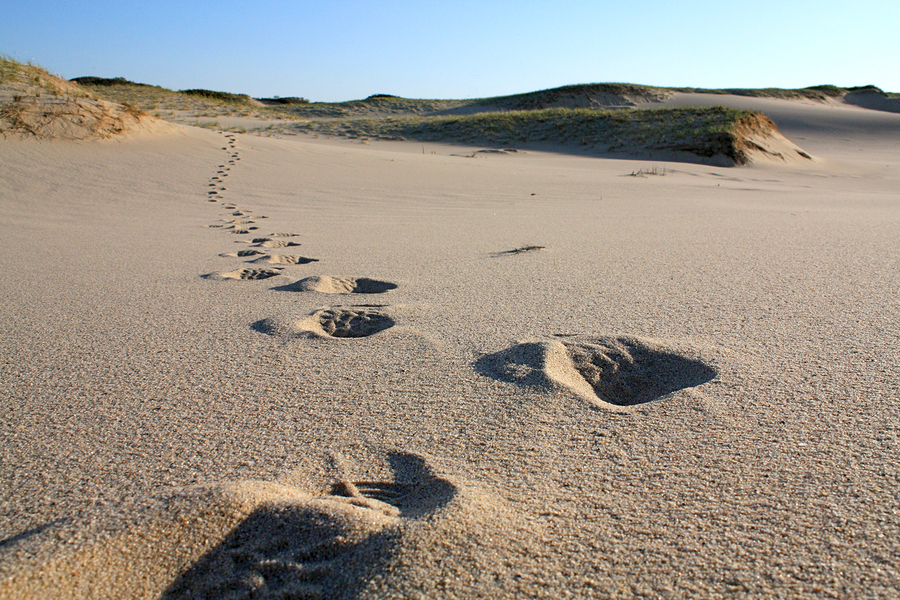
Cape Sand-walking

Cape Sand-walking

But what I like about Thoreau’s journal entry for 7/4/55 is its short dialogue with a ship’s captain and its exclamation points of consternation. Here it is in its entirety:

To Boston on way to Cape Cod with C.
The schooner Melrose was advertised to make her first trip to Provincetown this morning at eight. We reached City (?) Wharf at 8:30. “Well, Captain Crocker, how soon do you start?” To-morrow morning at 9 o’clock.” “But you have advertised to leave at 8 this morning.” “I know it, but we are going to lay over till to-morrow.” !!! So we had to spend the day in Boston, – at the Athenaeum gallery, Alcott’s and at the regatta. Lodged at Alcott’s, who is about moving to Walpole.

There, in a brief exchange and three exclamation points of comment, is summary of all summer travels, especially the dependent kind. Thoreau’s day passed pleasantly enough, it seems, though we get no comment about the gallery or the regatta, both of which we’d like to see through his eyes. And of Alcott we learn the expected: he is about to move…again. Instead, it is the waiting to travel and Captain Crocker – stand-in for everyone in charge of getting us somewhere – that draw Thoreau’s sparse comment. Once “there” – on the Cape – his subsequent entries swell with detail again, and we see what catches his eye. But here on the 4th, we wait and feel lodged in its amber room. Independence will have to wait too.

Getting to the Cape has always been troublesome, it seems.

Summer Reading – Walden’s Shore

In Search of Bedrock at Walden

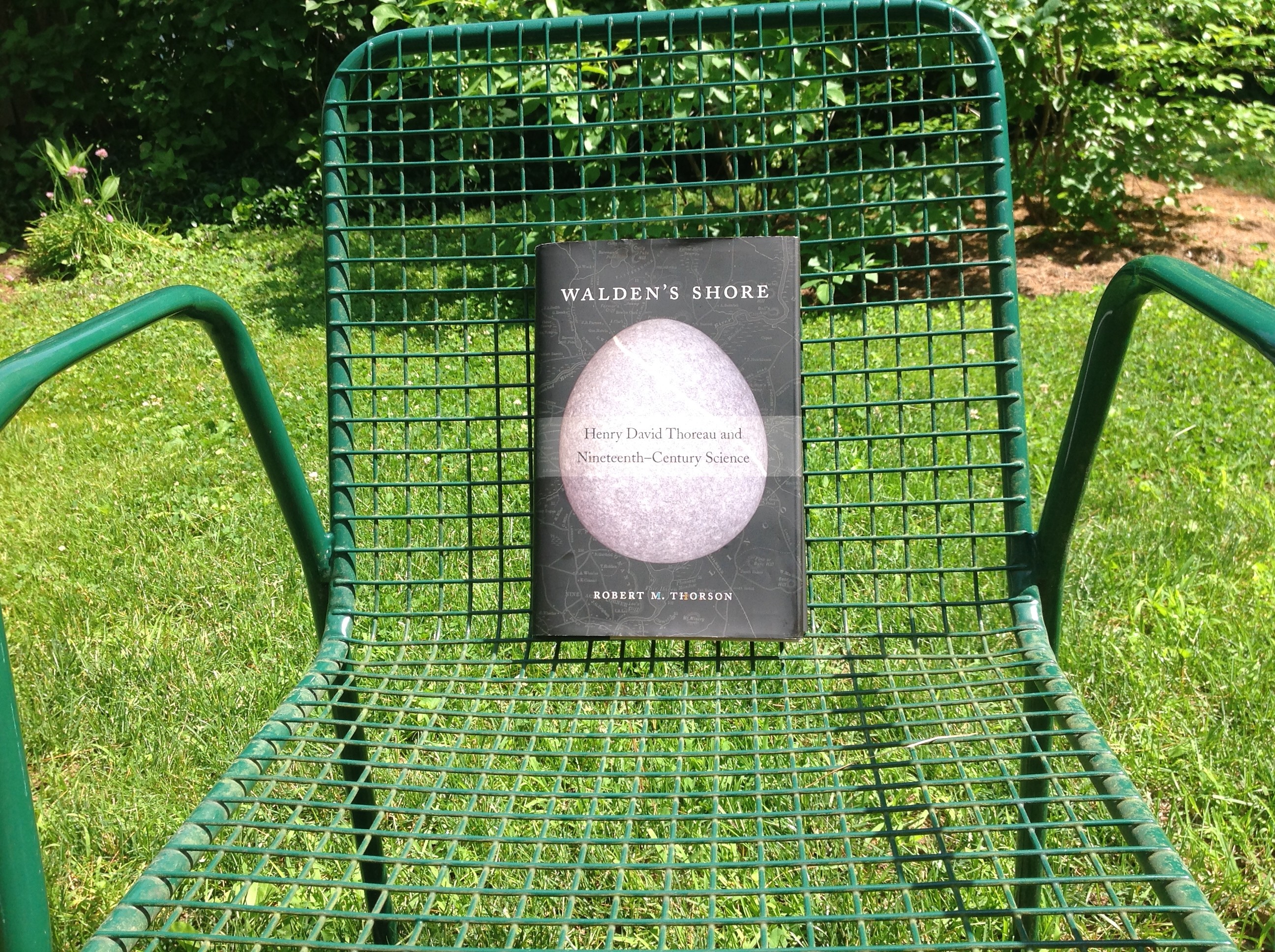
Part of summer’s joy lies in its liberal stretches of reading time. And so the gift of a book often offers immediate rather than delayed pleasure. The other day I received such a gift: Robert Thorson’s Walden’s Shore is a detailed examination of Thoreau and 19th-century geo-science. Thorson is a geology professor at University of Connecticut, and he brings an earth scientist’s deep knowledge of what we walk upon to the work of watching and walking with Henry Thoreau throughout his lifetime.

photo

Noted Thoreau scholar, Jeffrey Cramer, offers a book blurb saying, “Walden’s Shore has no predecessor in the field of Thoreau studies. It is a welcome addition and needed reassessment of an iconic figure.” I’ve found this true. Part of the difficulty of reading Thoreau lies in his transcendence of time – he speaks across ages with insights that lift him from the context of his own time, and a reader can end up looking up to him in a way that leaves that reader ungrounded. There is irony in this of course, because Thoreau’s vision is rooted in his ability to stay very much on the ground, to see in fact into it and take the measure of whatever moves on and through his days in Concord.

Thorson’s gift is also to see beyond the immediate and into what’s often called “deep time” and the shaping of the world we walk. We learn how the surface features at and around Walden tell stories remarkably similar to those intuited by Thoreau during his intense examination of those features. And, from Thorson’s particular reading of Thoreau’s journals, we see a tracery of Thoreau’s deepening tendency toward scientific measurement and thinking as he writes Walden. Thorson keeps track of “every entry where Thoreau seemed to be mensurating or thinking spatially beyond what would have been expected of a competent naturalist of his day.” Before 11/23/50, Thorson finds 
no cases; from that date forward to the close of the Walden period on 4/27/54,” Thorson counts 62 cases. This reading makes a nice summary of Thoreau’s evolving scientific mind.

“Let us settle ourselves, and work and wedge our feet downward through the mud and slush of opinion, and prejudice, and tradition, and delusion, and appearance, that alluvion which covers the globe…till we come to a hard bottom and rocks in place, which we can call reality,” Thoreau writes in Walden. And Thorson then endeavors to show his readers just where that bedrock bottom is and how Thoreau, ever prescient, apprehended it, well before modern sensing and imaging devices confirmed many of his views.

Thorson also sums up scientific thinking before and up to Thoreau’s writing of Walden, and limns Thoreau’s place in the scientific ferment of his day, when that era’s creationists first felt the swelling power of Darwin’s theories. This is useful, necessary context for a deeper appreciation of Thoreau’s work and intelligence. But, if that were all Walden’s Shore offered I would have stalled in mid book.

For me, a reader (and sometimes writer) of stories, Walden’s Shore’s gifts and appeal are deepened by the interlacing of imagined narratives throughout the book. Just when geologic theory threatens to deaden or swamp my mind, Thorson cuts to narrative – there, then, is Thoreau out walking and recording and opining about what he sees. Here then is the living character in real time, and the drift of continents and clash of tectonics becomes – as it is in our lives – backdrop for our fascination with people.

As Thorson writes in his introduction, “This book is heavily biased toward presenting Thoreau as a competent, pioneering geoscientist. With few exceptions, I emphasize what he got right and overlook what he got wrong or didn’t notice. Mine is not a fair and balanced treatment.” Yes…and because this is at root a narrative of human exploration that seems just fine.

Added note: Thorson writes with clear sentences and an understanding of narrative’s lures and power. That may sound like usual praise; it is not.

Songbirds at Creekside

By Ashton Nichols

The songbirds here are like nothing I have ever seen or heard, not when I lived in Virginia, or West Virginia, Maryland, Alabama, or London, England, or even at other locations in Pennsylvania. Bluebirds, scarlet tanagers, goldfinches, orioles, and more: the colors bust out like tiny sprays of rainbow, as bright as the sun, as clear as the sky. The songs are trilling and cool, thrilling and crackling, burbling and cackling. It must be that the wooded two-acre forest edge of our small Creekside farm creates a much-needed roosting and feeding spot in the middle of the wide-open swath of cultivated farmland that surrounds us here.
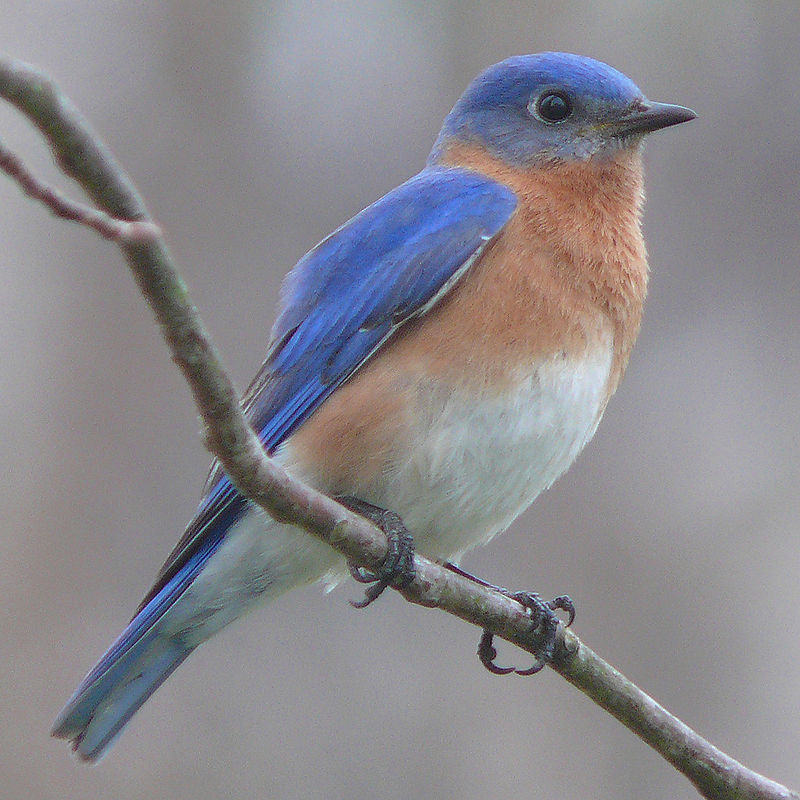
Bluebird

Bluebird

In his chapter in Walden entitled “Sounds,” Thoreau speaks of the birds close by on numerous occasions: of the birds who “sing around or flitted noiseless through the house,” while Henry sits in his “sunny doorway from sunrise till noon, rapt in a reverie, amidst the pines and hickories and sumacs.” Or he tells of the nearby tree branch that is “bending under the weight of the reed-birds flitting hither and thither,” of the sad sounds of the screech owl that remind him “sometimes of
music and singing birds; as if it were the dark and tearful side of
music, the regrets and sighs that would fain be sung,” and finally of the cockerel, our common rooster, which was once a wild pheasant–“This foreign bird’s note is celebrated by the poets of all countries along with the notes of their native songsters.” Thoreau is often wondering at birds of Walden Pond.

Here at Creekside, we are in the midst of several thousand acres of open space that stretch out to the east and to the west along the center of the Great Valley, with the North Mountain off in one direction and the much older South Mountain off in the other. This South Mountain, which rises near Mount Holly Springs, is renamed the Blue Ridge when it reaches West Virginia and Virginia. According to my geologist colleagues, it is one of the oldest mountain ridges in the world, almost three-quarters of a billion (750,000,000) years old. There were once mountain peaks here that rivaled the five-mile-high Himalayas, but they have been eroded and worn down over millennia to their current 2,000-2,500 foot height.

The wide-spreading oxbow of the Conodoguinet Creek twists its way through the valley here, with huge tree-filled circles, open plowed spaces, and scrub brush fencerows. There are lots of wide spaces of land with few trees at all, no trees for roosting or food spotting, no nesting holes or tree-close clearings for wild mating dances. So the songbirds come to our exceptional and unusual two-acres of Creekside trees; these birds come in their dozens: no, in their hundreds. On some mornings there are too many separate songs to count, too many different body styles to keep track of, and too many various feeding habits to follow.

Oriole

Oriole

The oriole is by far the most startling of these songbirds, a veritable clown-bird, with a bright orange-yellow color that is just as bright as the brightest of Halloween pumpkins, then suddenly saturated with black stripes and splotches spread between the yellow-orange outbursts. Next come the bluebirds, not so much sky-blue as some secret Mediterranean blue or ocean blue–known only to world travelers–always one pair of these bluebirds at least, nesting in the small bark-sided bluebird nest tacked to the northwest side of the house. The male bluebird always perches out alone on a stalk of paradise tree that rises out of the abandoned fire circle, an overgrown scrub spot in the middle of the lawn.

Tanager

Tanager

Then suddenly, the scarlet tanager flashes brightly, so brightly it is hard to believe this is a natural color, and then a third bluebird, and just as quickly comes a songbird’s call that I have never heard any version of, a new sound: fluty and liquid, delicately musical and very wild at the same time. And always, of course, there are swifts and starlings, blackbirds and sparrows, flycatchers, mockingbirds, and blue-jays, and even a massive red-tailed hawk roosting and hunting small mammals from the tall locust trees in the small woodlot behind us.