
Category Archives: The Roost

A blog at Thoreau Farm, written and edited by Sandy Stott

Outward or Upward Bound

One of the writing projects I’ve taken on is a biannual column about mountain accidents and searches and rescues for the Appalachian Mountain Club’s Appalachia Journal. The column’s primary purpose is educational – if we read the stories of those who fall or go astray in New Hampshire’s White Mountains, we may become wiser walkers. At least that’s the theory. The column’s readership also knows the lure of disaster stories. Along with these stories of misfortune and perseverance in the backcountry, I offer analysis of what went wrong (and right) in each instance. And I hear from readers who like to point out their own takeaways and share their own stories.

So during the warm ease of summer’s heartland, I take some days to revisit mountain tales accrued during the winter past; the column then will appear at the outset of winter next, and, theoretically, its readership then goes wiser into the winter hills.
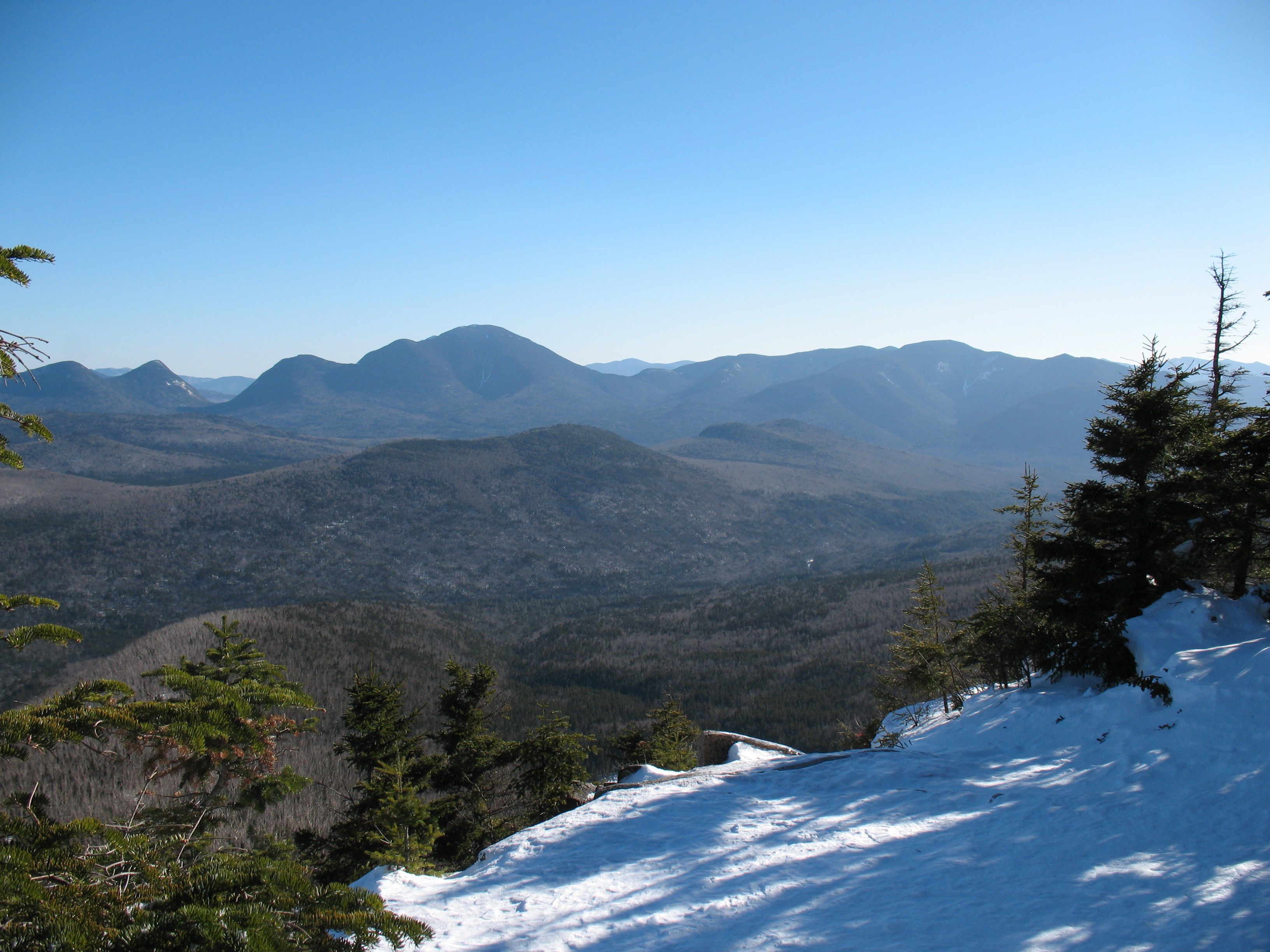
The Winter Hills - White Mountains

The Winter Hills – White Mountains

The other day, as the rain pattered companionably on the roof, I was mulling over an incident, and, at the same time, wondering what familiar walk I would take later when the rain let up. This wondering brought Henry Thoreau to mind. Famously and early in “Walking,” Thoreau sets his criteria for a walk: “If you are ready to leave father and mother, and brother and sister, and wife and child and friends, and never see them again, and are a free man, then you are ready for a walk.”

It is, of course, an “extreme statement,” and in its extremity designed to jar us from the complacency of routine – a little work, a little walk…ho hum…what’s for dinner?

The incident I was contemplating and then writing up was about a college student, who during finals week, went to the mountains, purportedly to clear his head. Here’s the summary, written in the column’s reportorial style:

On December 12th at 3:00 a.m., New Hampshire Fish and Game received a call about a missing hiker in the Franconia Notch area. David F., a Lyndon State College student, had left school to go hiking and climbing in that area the day before. He was reported to be well equipped. David had also given his roommate his intended route, and Fish and Game officers decided that he might simply be delayed and to give him time to hike out on his own. Morning temperatures were very cold (on Mount Washington at 5:17 a.m. it was -15 with the wind registering 73 mph; a windchill advisory was in effect) and there was still no sign of David F., so Fish and Game began to organize a search, which would necessarily be broad and people intensive. At 12:30 p.m., as the search was getting under way, Fish and Game learned that hikers on the Falling Waters trail had come across David not far from the summit of Little Haystack.

Fish and Game believed that David F.’s condition merited an airlift off the ridge by a New Hampshire National Guard helicopter. He was treated for mild hypothermia at a local hospital. In an interview with Fish and Game, David said that he had begun his climb on the Falling Waters trail at 9:00 a.m. on the 11th, diverging later to climb an off-trail drainage called Lincoln’s Throat; eventually he became lost, spent the night in his sleeping bag and wrapped in a space blanket and tarp, then found his way to the Falling Waters trail in the morning. When found, David F. was without his pack and gear, saying he must have lost them that morning.

Such a report sets off head-wagging among the mountain cognoscenti, as it should – conventions violated, personal ability overestimated, etc. But most of us recognize too the need to slip the trap – whether it is a spate of final exams, a daily job or the overly-civil layerings of language over experience – and go free. “Westward I go free,” wrote Thoreau later in his essay, and it takes only a slight change to say, upward I go free. I remember that, even as I point out a student’s errors in pursuit of that freedom.
Fantastic Beauty in the Front Yard

By Ashton Nichols

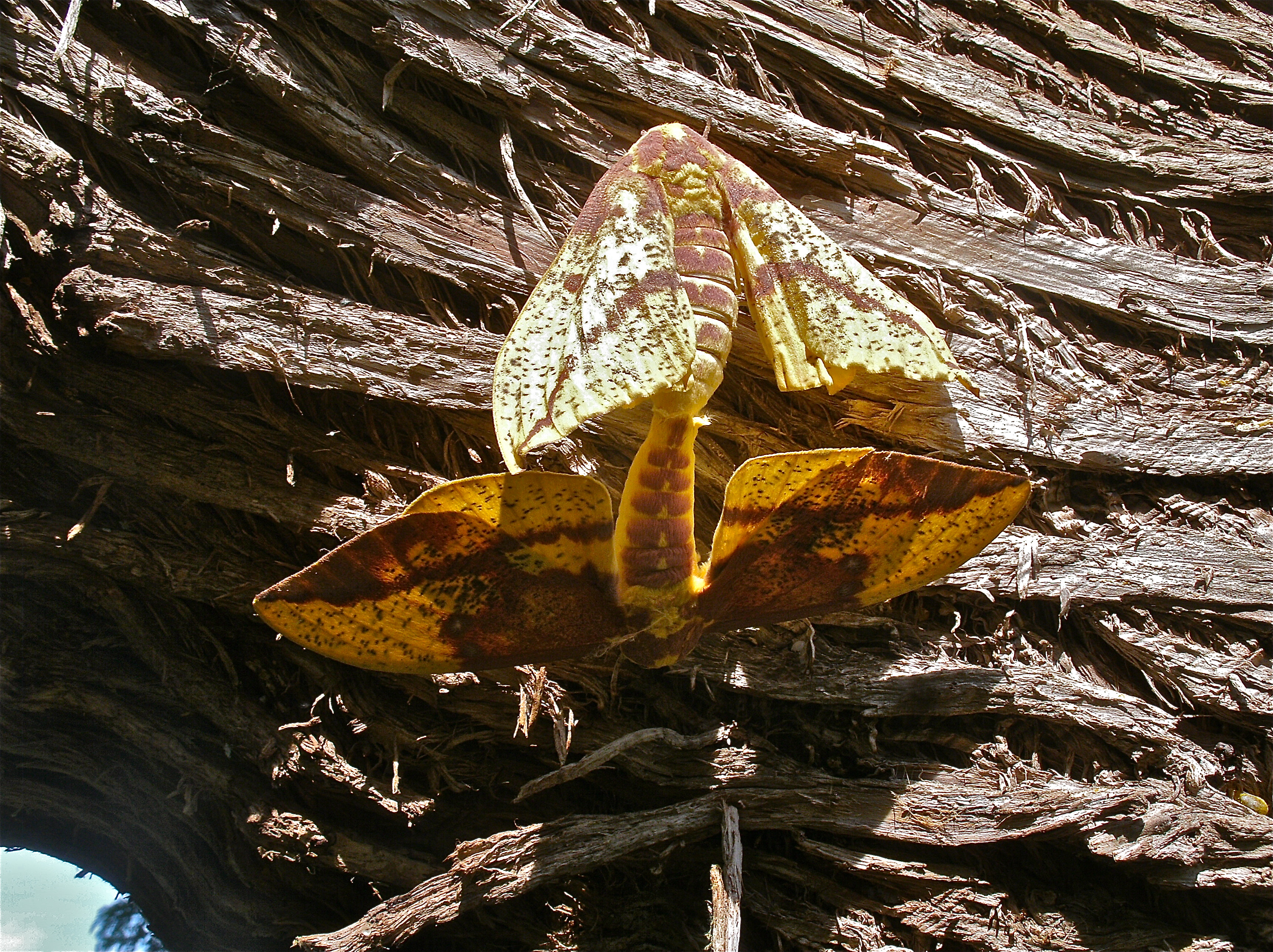
Yesterday morning, while I was pushing my granddaughter Verona on the swing in one of our large cedar trees in front of Creekside, I noticed a sudden flash of yellow against the striated brown bark of the tree’s massive trunk. As I drew closer, I could see that it was two Imperial Moths (Eacles imperialis), beautiful members of the silk moth family, the group that produces the largest moths found in North America. These two were clearly mating, joined at the hind-parts and perfectly still, presumably waiting in their nocturnal way, at least for the sun to go down.

Imperial Moths Mating Photo by Ashton Nichols

Imperial Moths Mating
Photo by Ashton Nichols

Moths can take a full 12 hours to mate. The male’s goal is to pass a spermatophore into the female’s body, so that she can then fertilize her eggs. He has located her by sensing her pheromones in the nearby air and then flying toward the source until he locates his partner. Once together, the moths unite by backing up, abdomen to abdomen until they are firmly joined. Then the male clasps the female with small, finger-like appendages– “claspers”–so that the two can remain connected, even if they have to move from one spot to another during their prolonged “romance.” Research indicates that a mating pair like this, hooked together and unable to separate until their work is done, are especially liable to predation, often by raccoons and other small forest mammals.

These two insects that Verona and I watched today were gorgeous and large examples, a full five inches across from wingtip to wingtip, the female slightly larger than the male. Their bright yellow wings were patterned with a brown that almost shaded to purple; they had a thumb-thick and sharply segmented abdomen, and a wide, furry head and face. The female has a unique–if invisible–anatomical feature, her “bursa copulatrix (literally, organ for “exchange coupling),” where she will store the spermatophore that she receives from the male. This tiny packet of his genetic material also contains nutrient materials to keep the fertilized eggs supplied with “food” in her body, not unlike the way an egg’s yolk and white support the growing chick.

Here is how complicated and technical the entomologist’s description of the Imperial Moth can get: “Both sexes have round, purplish to reddish-brown reniform and subreniform spots on the forewing, the center of each spot filled with gray; as well as a similar discal spot on the hind wing” (this drawn from the Massachusetts “Natural heritage Endangered Species Program”). The last century has seen a dramatic decline in species range and numbers so that now, in Massachusetts for example, the moth–which once covered the state–is only found on Martha’s Vineyard Island and occasionally on the nearby mainland. In our part of Pennsylvania the decline is less pronounced, but the Mason-Dixon line seems to be the dividing line: Imperials in Maryland and south tend to be doing much better than their northern kin.

So there we were, on a warm July afternoon with a single species of declining moth, bringing knowledge to me and wonder to my wide-eyed, three-year-old grandchild. “What are those two moths doing, Baba,” Verona said, with her eyes still wide and staring. “Well, my little girl, they are resting . . . um, ah, ” pause, think, speak: “and they are starting to make babies for the next generation . . . I, uh . . . I mean for their next family of beautiful moths.” “They ARE beautiful, Baba,” Verona said as we turned to come into Creekside to get the camera.

This morning I returned and the pair was gone: he to feed and hopefully to survive a few more months until winter, she off to lay her fertilized eggs and begin their remarkable metamorphic moth lifecycle again.

Henry’s Children

By Corinne H. Smith

The silent Memorial Walk around Walden Pond is a tradition during The Thoreau Society’s Annual Gathering. We meet at the house replica near the parking lot at 7 a.m. on Saturday morning. When we introduce ourselves, we also share the names of people we are dedicating the walk to. The whole group walks in memory of Henry David Thoreau and scholars Walter Harding and Bradley P. Dean. Individuals may choose also to walk for family members, friends, and mentors who have gone on before. I always dedicate my participation to two of my mentors, Thoreau scholar Edmund Schofield and singer-songwriter and environmentalist John Denver. I wear Ed’s tan corduroy hat during the walk, as he often did whenever he spent time exploring Walden Woods.

On this July 12th, about a dozen people stand in our circle. We sing a verse of Happy Birthday in Henry’s honor. Then, when the introductions come around to Jeff Hinich of Ontario, he stretches out his arms as if to embrace the group and says, “I dedicate this walk to all of Henry’s children!” We laugh. We know that Henry and his siblings never married and that no direct descendants of their family exist. And yet: isn’t Jeff right? Aren’t we all Henry’s children? Didn’t he father good books and essays and opinions that in turn brought together followers like us?

I think on this satisfying idea as we walk single file across the road and down to the level of the pond. We edge past a handful of long-distance swimmers preparing to work on their pond-laps. A few are already in the water. Now we turn left in order to round the pond clockwise. As the first one in the line, I often get to see a few things the others don’t. Chipmunks squeak and scurry in front of me, almost underfoot. Robins are in abundance today, too. I play a game of tag with one bird for more than ten yards. It bobs ahead of me, stops to let me catch up, then bobs ahead some more. Finally it realizes that I am not going to stray from the path that we’ve both been using. It flies up into a small tree and watches our group pass from this vantage point. I try not to laugh out loud.

Otherwise, it’s a pretty calm scene at Walden Pond. Some fishermen quietly cast lines from boats or from the shore. Even the train tracks lie idle. The MBTA continues to make improvements and repairs on this section and has suspended weekend service for most of the rest of 2014. So we wait for the train that doesn’t come, then continue on to the site where Henry’s house once stood. Here we fan out and take our time, thinking about Henry and our loved ones, too. Some take a few seconds to stand in his doorway and look down to the cove.

For most of the fourteen Memorial Walks that I’ve been on, I’ve seen white Indian pipes growing in select spots around the cairn and outside of the house markers. This time, there are none. I tiptoe to all of the places where I’ve seen them in the past, and no white shoots are beginning to lift the leaf litter. The weather conditions must have been different this year. Maybe the heat or moisture levels haven’t been right. Maybe the unique curved heads will pop up later in the season, when they can amaze other visitors. Or maybe they were quite early, and I missed them. I feel disappointment at their absence.

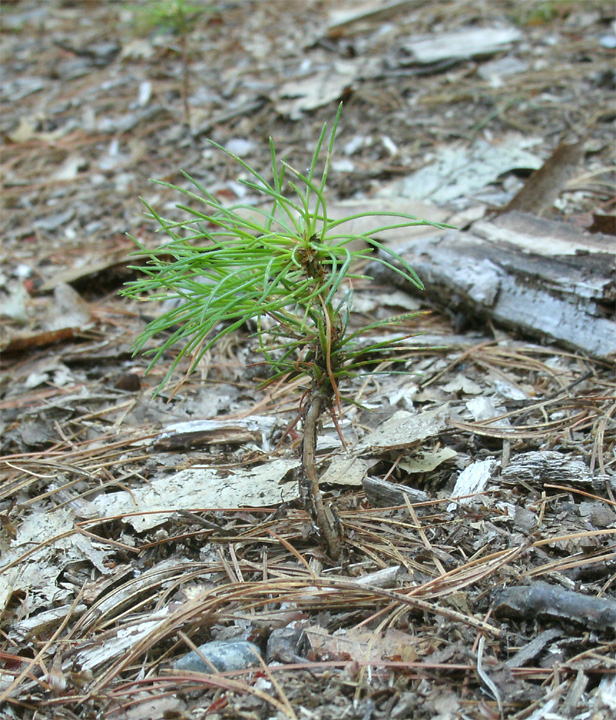
What I notice instead is all of the small pine trees rising here. Many aren’t even as big as the one Charlie Brown places a single red ornament on each Christmas. One is certainly less than four inches tall. Yes, I’ve seen seedlings before. But either there are more of them today, or I’m somehow extra aware of them now. Then it dawns on me. These little guys are Henry’s children, too! He once planted hundreds of white pines in this area. Granted, we have no easy way of proving that these specific saplings came from his specific plantings. But in the grand and symbolic scheme of the Walden Woods ecosystem, we can call them descendants. More of Henry’s children. And at this thought, I smile again.

Faith in a Seedling

Faith in a Seedling

We saunter back to the parking lot. Now, families loaded down with beach paraphernalia hurry toward us, eager to stake out some sand and sun for the rest of the day. Some of them may be Henry’s children, too: if not now, then perhaps at some future moment. How many children does Henry David Thoreau have? It’s an innocent enough question that’s hard to answer. But on this particular morning, and only at Walden Pond, I count at least a dozen people and hundreds of seedling pines. Many more are sure to surface in the years to come.