Category Archives: The Roost

A blog at Thoreau Farm, written and edited by Sandy Stott

Cold Fridays (or Other Days of the Week)

By Corinne H. Smith

“Mother remembers the Cold Friday very well. She lived in the house where I was born. The people in the kitchen – Jack Garrison, Esther, and a Hardy girl – drew up close to the fire, but the dishes which the Hardy girl was washing froze as fast as she washed them, close to the fire. They managed to keep warm in the parlor by their great fires.” ~ Thoreau’s journal, January 11, 1857

If you have visited Thoreau Farm, you can no doubt picture this scene. An assortment of family members and a few servants were huddled beside the large fireplace in our first-floor parlor. They had abandoned working in the kitchen in the salt-box shed attached to the back of the house. Outside the wind whipped across their fields. None of them knew how long they would have to stay here. And if they had to keep building “great fires,” perhaps we should feel fortunate today that they didn’t accidentally burn down the whole house back then.

Every region has its dramatic weather stories. For winter records, New England has the Blizzard of 1978, the Great Snows of 1717, and the Cold Friday of January 19, 1810. (Perhaps the Winter of 2014-2015 will get a fancy name and will be added to the list.)

Yes, that's cold.

Yes, that’s cold.

Thursday, January 18th, 1810 had been an unseasonably warm day. Some spots reported temperatures as high as the 50s and low 60s. But by sunset a line of snow squalls moved into western Massachusetts “with the power and fury of a tornado,” according to one source. “Desolation marked its course.”

Temperatures plummeted as the storm moved from west to east. By midnight, many thermometers were down to zero. On Friday, they dropped to -14, even -20. And those readings didn’t take what we call now wind chill into consideration. Wind velocities weren’t reported then, but they must have been catastrophic. The front brought a sustained “high wind, cold and piercing in the extreme, and of such force as to prostrate many trees and buildings.” Tree trunks were sheared off at various heights. The meeting house in New Ipswich, New Hampshire, was just one of the buildings that lost its roof. The wind and cold abated a bit by Monday, but the rest of January remained frigid.

Cold Friday was tragic enough that it was written about in town histories. In Woburn, Massachusetts, Joseph and Benjamin Brooks had gone to a nearby woodlot to chop wood that Thursday. On Saturday, they were found frozen to death. In Sanbornton, New Hampshire, Jeremiah Ellsworth’s house was torn apart by the wind. He pushed his way against the gale to a neighbor’s house for help, then returned to his own to rescue his wife and three children. The wind tore the children’s clothes right off their bodies. In spite of their best efforts, Jeremiah and his wife lost all three.

While other New Englanders dealt with dire losses of property and lives, the Dunbars and Minots and their friends stayed safe in this two-and-a-half story frame house we now call Thoreau Farm, built in 1730. According to entries in Henry Thoreau’s journal, members of his mother’s generation brought up memories of Cold Friday whenever the winter was particularly cold or snowy. Cynthia Dunbar had been 22 years old back then: still two years away from becoming Mrs. John Thoreau, and seven years away from giving birth to little David Henry.

As we in the Northeast hunker down to experience our own version of cold Friday, perhaps we can take inspiration from Cynthia and the people of Concord in 1810. They made it through the cold, and we can, too. Let’s hope ours isn’t one for the record books.
Deeper Still – Digging Back into The Great Snow of 1717

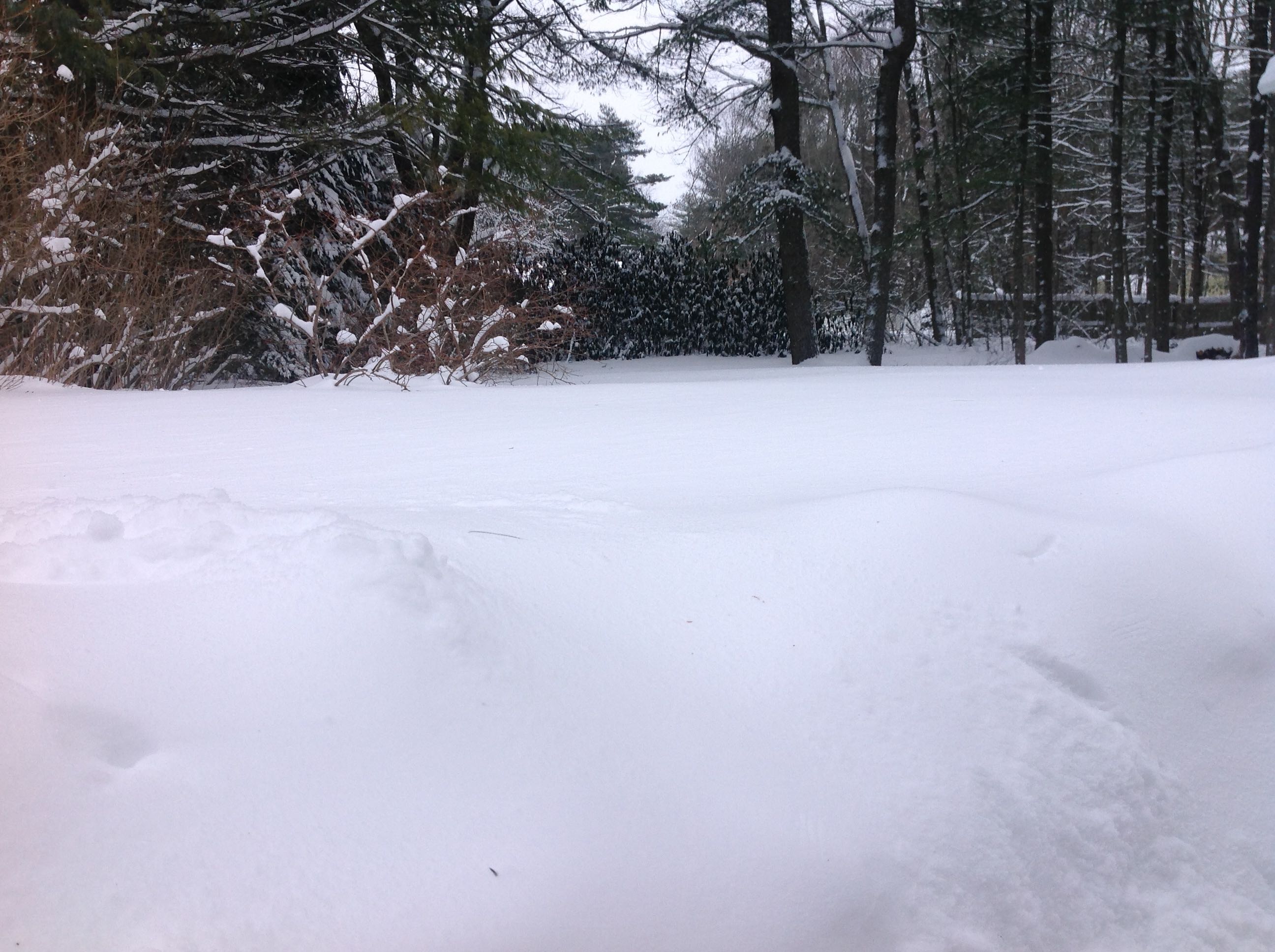
I’ve just come in from hoisting more snow off the driveway and onto the banks along it. I use the word “hoisting,” because the usual dig-and-fling of shoveling won’t work anymore. Instead I’m now tossing snow back at the sky, which seems to underline the futility of the work.

8-foot tall blueberry bushes "innived" (left foreground)

8-foot tall blueberry bushes “innived” (left foreground)

Whenever Henry Thoreau wants to evoke wallowing snows and winter awe, he turns back to the Great Snow[s] of 1717. Then, in the very month of February, huge, wind-driven snows laid down Buffalonian depths that buried both houses and pastured animals. In “Winter Visitors,” he writes of “that early settler’s family in the town of Sutton, in this state”:

…whose cottage was completely covered by the great snow of 1717 when he was absent, and an Indian found it only by the hole which the chimney’s breath made in the drift, and so relieved the family.

And a little earlier, at the end of “Housewarming,” he returns from being “exposed to the rudest blasts” to this thought:

It would be easy to cut their [humanity’s] threads anytime with a little sharper blast from the north. We go on dating from Cold Fridays and Great Snows, but a little colder Friday, or greater snow, would put a period to man’s existence on the globe.

Both moments in Walden point to the narrow span that we call “normal” and what waits outside it; they make his point amply. But for drifts of detail equal to the snows they describe, we go to his journal, where Thoreau, in turn, records an eyewitness account from Cotton Mather in a December letter from 1717. The letter begins with understatement:

On the twentieth of last February there came on a snow, which being added unto what had covered the ground a few days before, made a thicker mantle for our mother than what was usual.

Okay, we think, big storm atop prior snowfall; we’ve seen the like. But like our current winter with its more than 5 feet of snow for Boston in the past 17 days (ah, the recurring 17), there was more to come:

On the 24th day of the month comes Pelion upon Ossa [see mountainous imagery]: Another snow came on which almost buried the memory of the former, with a storm so famous that Heaven laid an interdict on the religious assemblies throughout the country…The Indians near an hundred years old affirm that their fathers never told them of anything that equalled it.

There follows vivid description of all sorts of snow-burials – cattle entombed, sheep too:

For no less than eight and twenty days after the storm, the people pulling out the ruins of above an hundred sheep out of a snow bank, which lay sixteen foot high, drifted over them, there was two found alive…A man had a couple of young hogs, which he gave over for dead, but on the 27th day after their burial, they made their way out of a snow bank, at the bottom of which they had found a little tansy to feed upon.

So, given this ’17 comparison, not so deep for us…yet. When last I checked, we still have “a little tansy to feed upon.” Still, there’s more winter to come.

Added note for those looking for winter words: Mather uses the word “innived” for those animals buried in snow. Just the word for our winter, I think – may your days be enlivened for being innived.

Found Feathers

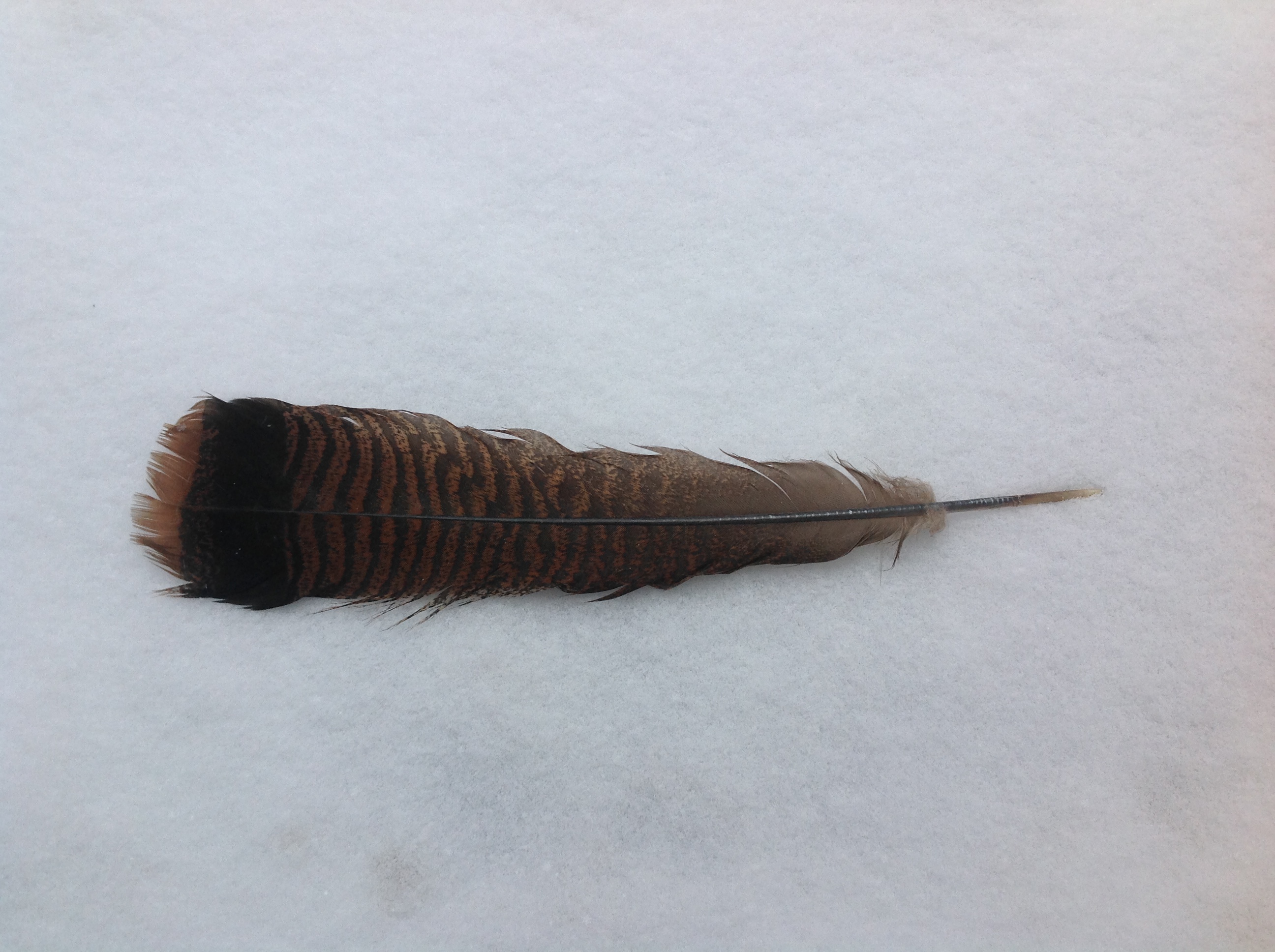
Whenever and wherever I walk I keep an eye out for feathers, though I will say that during blueberry time, I see only those of the blue jay; then, all awareness is aimed at discovery of blue. Many of our birds don’t wear gaudy coats, and so whatever they shed as they fly or flurry is some shade of brown or gray. And so, not easily seen. Until you begin seeing them; then, they turn out to be everywhere. Or at least in many places.

Trace of turkey

Trace of turkey

In midstate New Hampshire, where we go to find mountains, we keep a glass of found feathers. Over the years, visitors have also added to this clutch, until the glass has become a sort of aviary, or record of one. But none of us has Sibley-like ability to identify all the former owners of these feathers. Yes, there are the unmistakable – we think – yellow and brown of the cedar waxwing, the ubiquitous jay, and, of course, the flashy cardinal. And the wild turkey, which at times dominates a nearby upper pasture in big flocks, scatters its distinctive feathers liberally, though watching a turkey struggle to be airborne, one would think it had no feathers to spare. At one time, I wanted to gather a small book, a book of feathers, that would help walkers identify the birds who left these feathers on the ground. An artist friend would draw each feather, and we would figure out to which bird it should be reattached, offering a short paragraph and picture of the bird. I’ve settled for our glass record of flight instead.

IMG_0330

But many of the solitaries in the glass, (some large flight feathers from hawks or owls I like to think), draw attention not for their former owners’ (imagined) names, but instead for the winter flower they form together. There, curving up and out from their wine glass, is reminder, flower of flight, in the midst of this cold season when we often feel grounded. And in all seasons, these feathers are record of attention as we walk, little findings that draw us deeper into both walk and world. Another sort of flight.