Category Archives: The Roost

A blog at Thoreau Farm, written and edited by Sandy Stott

Little Feats

Note: no quotations from Henry Thoreau in this post, but I like to think a similar spirit suffused his mountains.

The other day, while small-stepping along the trails that lead to and from Walden, I got to thinking about footwork. A lifetime of trails has kept me reasonably adept at the juggling cadence needed for New England trails and their studding of rocks and roots, often disguised by leaf litter. But it was a sharp downhill that triggered this running meditation.

Not long ago, I’d heard from a younger friend who runs mountain trails. I’d asked for a report about a loop I like, and I had gotten back a detailed account of a daylight-long ramble. At its close he wrote, “the last five miles go by pretty quickly with a bomber descent off Flume and a flat mile out to the road.” ‘Bomber descent,’ I thought as I short-stepped down the sharp, forty-foot drop off an esker; ‘no way no way no way no no way…’ – this one-syllable no-mantra set up with my stepping.

All of New England’s mountains genuflect to their northern shaper, the glaciers, gone to water for now, but likely to cycle back at some point. The upended, frost-split rock is their residue, and everyone who visits our uplands must contend with its odd angles.

As boy turned loose for the first time from parental supervision, I began to stride and run through the White Mountains. I was seventeen; I was in a hurry. Beyond each summit was another, and that was where I wanted to be.
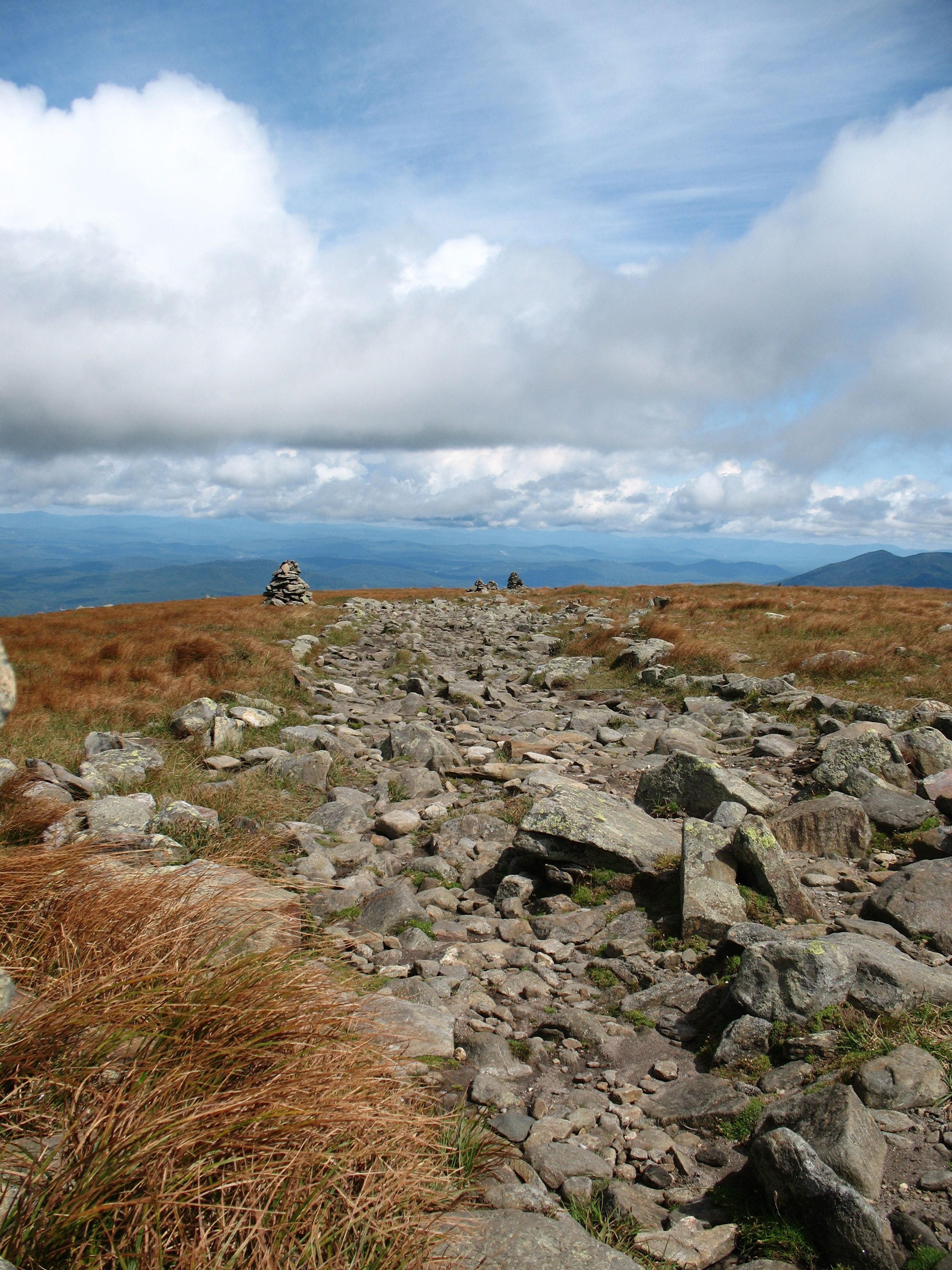
Rock-strewn Way

Rock-strewn Way

Memory’s scrapbook holds images from a summer day moving north along the ridge that joins Mt. Washington to Mt. Jefferson; I am with a 17-year-old friend who is new to these hills and their jumbled trails; I am his trail-tutor. “Look,” I say, eyeing the half-mile descent of Mt. Clay’s flank, “it’s more fun to run this.” I don’t think so,” he replies, and he starts down in a stolid fashion. “At least take my pack,” I say, and he returns, shoulders it (only a day pack) and turns downhill again. I watch him grow steadily smaller.

The amperage loose in my system has me edgy, which is another way to say sharp. I see my first five steps and figure the rest will appear. They do. I land on various edges, listen to the hollow clunk of my boots and odd knocking stones, and when I can’t find my next step immediately, I do what my mountain-running counselor taught me at fourteen – I “go up.”

“Going up,” jumping higher when you see no landing, may sound counterintuitive, but it works. In those few airborne seconds, you find your next step, even if it is a thin edge of stone; and then you quick-step on. This is rock-dancing, and in that era of life that was my way.
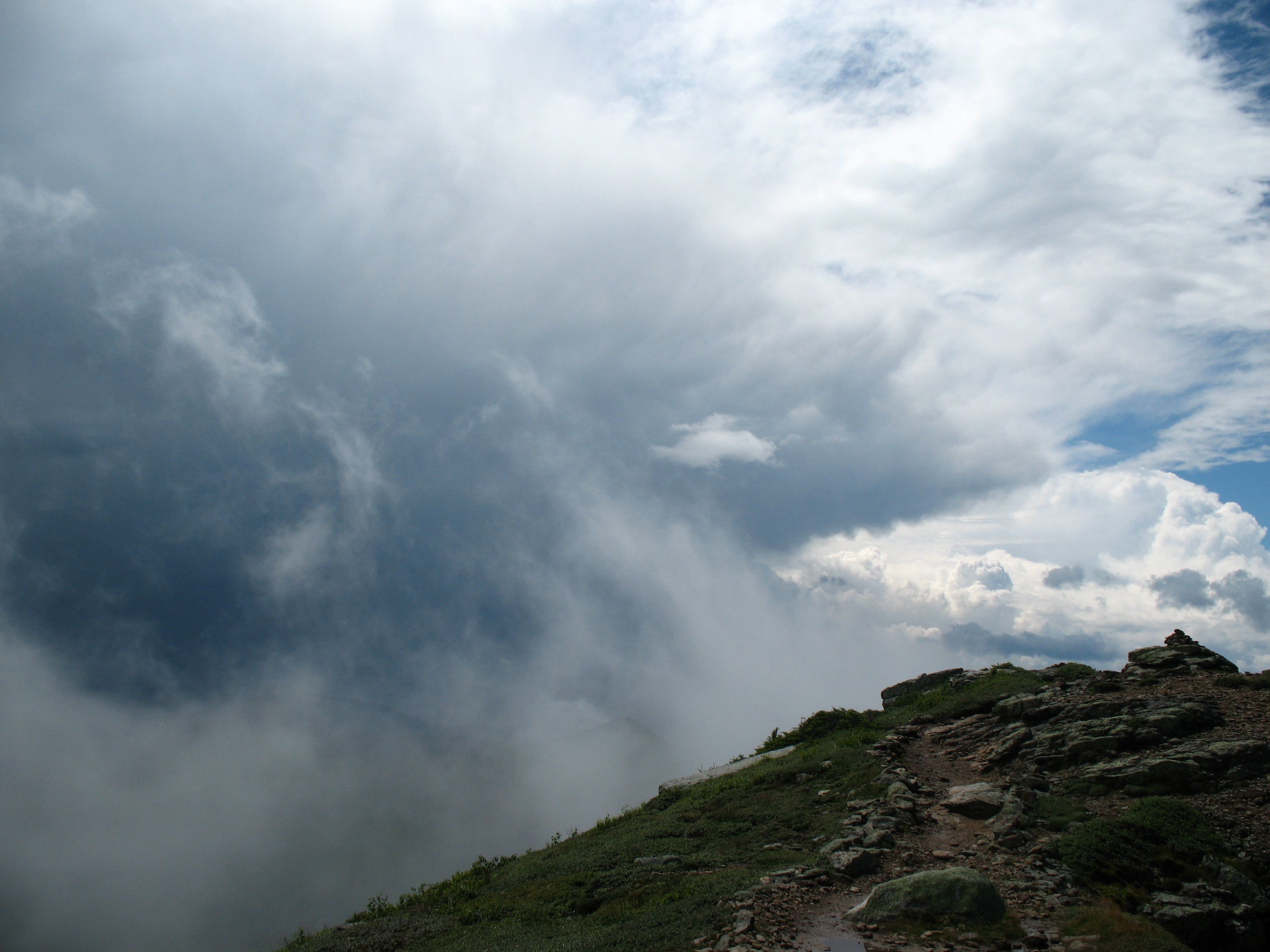
Up There - Franconia Ridge

Up There – Franconia Ridge

That memory leads to appreciation for the ways our walking changes over time. And so, even as I walk and shuffle the same trails as my younger friend and my younger self, I leave the bombing to them and dance now in short steps. They are my little feats.

Post note: surely, when you consider the ground Henry Thoreau covered on his walks and in the hills, he too must have “danced” or “bombed” some of his descents.
Hawk and Crow

Hawks were much on Henry’s mind during the April days of 1855. Often, he had taken to the water, and, as he rowed and floated, he saw fish hawks; being Henry, he wanted to know what these hawks were eating, and a number of entries have a catalogue of pout parts found beneath a hawk’s perch – another recorded arc in our round world’s cycles. And whenever he walked he scanned for them too: “Going up the hill, I examined the treetops for hawks.”

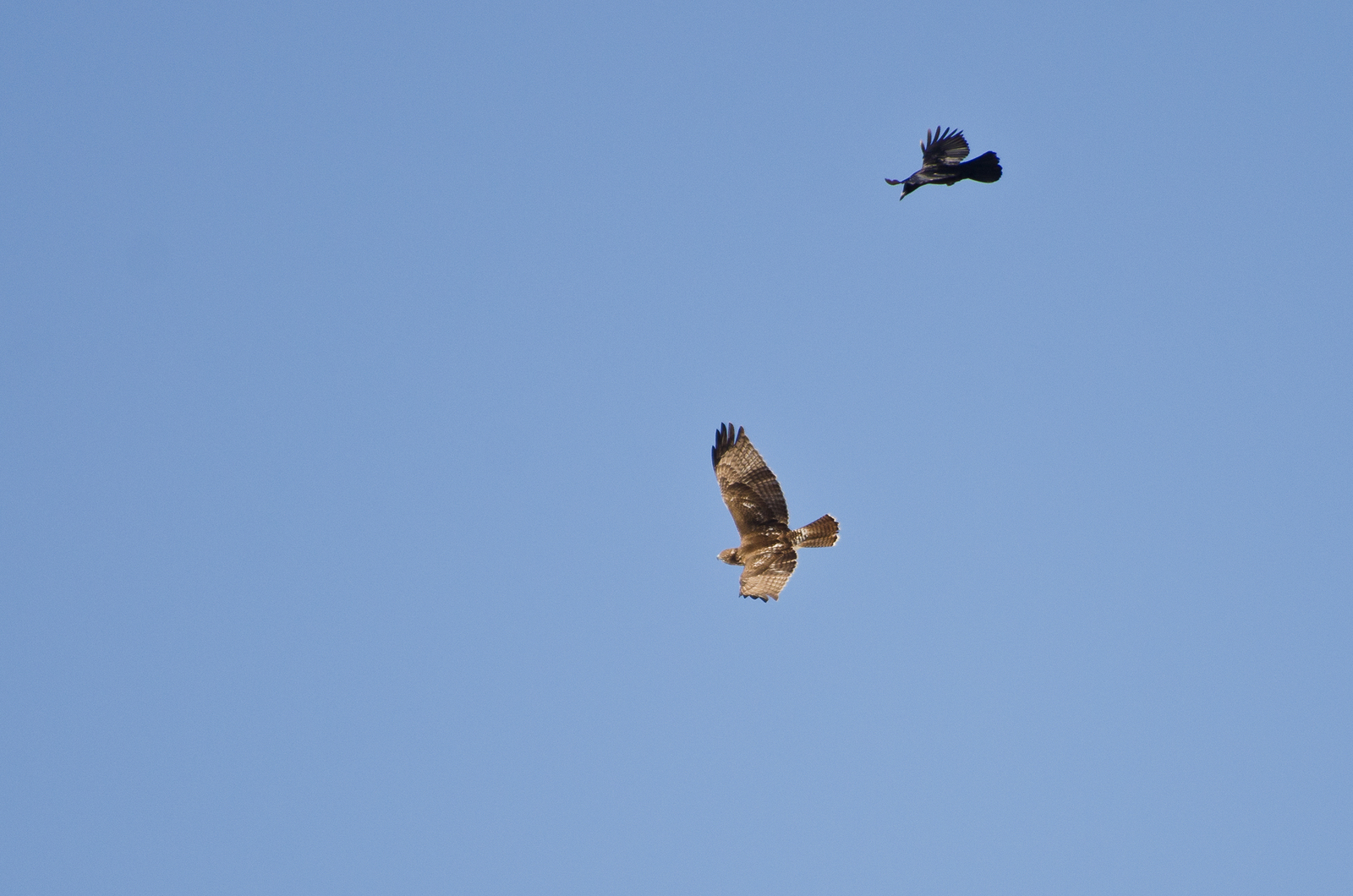
Throughout these days and lines wherever hawks appear so too does the loud, dark shadow of the crow. For days now I’ve had this avian pairing in mind as another chapter of its story plays out atop a tall hemlock next to the Sudbury River.

Air Dance - Hawk and Crow

Air Dance – Hawk and Crow

Hawk Notes from Three Spring Days

Most mornings this spring, the tall hemlock by the Sudbury River has been topped by his figure. Still from this distance, sentinel-like, this young redtail hawk takes in the floodplain, and were I a four-footed scurrier, I’d hope to be aware he’s there.

Morning after a strong front blew through: no time to be totem for the redtail today. He comes to his morning perch and lights, folds his wings; immediately he has to flare them for balance, then the red rudder of his tail fans out and tips him forward. He looks like a child on a teeter-totter, or an athlete rehabbing his bum ankle. For a full minute he wobbles; the whole world of his vision must rock. Then he opens his wings, flies off downwind, sinking to and skimming the field before pulling up into the gray branches of just-flowering, shorter maple.

And this morning under low clouds, I’m watching as the hawk pulls up flaring wings to his perch; above and fully engaged is a single crow, and the crow begins a series of inverted parabolas, diving on the hawk, whose feathers are truly ruffled – he still looks as if he slept in them. Then, for a minute or so, the crow lights in a nearby tree crown, and, through binoculars I can see him “talking” at the hawk, who turns to face him. “Yo, young fella,” he seems to say. “I’m comin’ right back; I’ll be on you all day like red on your tail.” The crow then lifts off and resumes his diving harassment, and, at each near approach, the hawk ducks his head a little and opens his beak…and I wonder if there’s a price for flying too close, or if this is another part of the world’s tutorial for this young hawk, who also seems to be in his first molt.

On this third morning the washed air after a rain makes the redtail shine, even as his primary color is dun. He is perched to the right and below his usual uppermost point, and perhaps that’s because his black nemesis is here too. Can this be the same crow? Did he sleep nearby, open his yellow eye and say, “Where’s my hawk?” stretch his wings and resume his inverted parabolas of outrage? Really? As I watch through glasses, the hawk tracks the swooping dives of the crow, opening his beak and flaring a wing and cringing (it must be said) at each approach; the crow drops into my magnified field of vision, accelerating to and by the hawk’s head, then rises away and out of sight. I time his appearances – every 7 or 8 seconds, he’s back; when a longer interval arrives, I put down the glasses and find him atop a nearby maple. Even without magnification, it’s clear he’s still talking at the hawk, even as he must be doing whatever the bird equivalent of panting is.

Then, after all this, the crow suddenly arrows away south; the hawk watches him go, wondering, I’m sure, when he’ll be back. I wonder too. For now, the hawk is again alone on top, totemic, imperturbable.

Spring is bird season in Henry’s journals – and here today. Their morning chorus chases off the cold winter silence, and everywhere they are constructing the coming season from beakfuls of grasses and twigs. Overseeing it all is a Sudbury River hawk.

A Visit to Two-boulder Hill

By Corinne H. Smith

“Went to what we called Two-Boulder Hill, behind the house where I was born. There the wind suddenly changed round 90° to northwest, and it became quite cold … Called a field on the east slope Crockery Field, there were so many bits in it.” ~ Henry Thoreau, Journal, January 31, 1860

One morning at the end of March, six people accompanied me on a nature writing walk to Two-Boulder Hill, behind Thoreau Farm. We were armed with our journals and open eyes, ears, and minds. We were awake and alive. We wanted to see what we could see, on this muddy day that happened to overlap both winter and spring. The sun was shining and the robins were bobbing for worms in the front yard when we started out. We hoped to beat the expected heavy rain, which we had heard would arrive by afternoon. Off we went.

Following Thoreau’s advice, we were also determined to leave behind all of the big concerns of the day, including the unrest in Ukraine, the search for the Malaysian jetliner, and the devastation left by that massive mudslide on the opposite coast. “I am alarmed when it happens that I have walked a mile into the woods bodily, without getting there in spirit,” Henry wrote in the essay called “Walking.” “It sometimes happens that I cannot easily shake off the village. The thought of some work will run in my head and I am not where my body is – I am out of my senses. In my walks I would fain return to my senses. What business have I in the woods, if I am thinking of something out of the woods?” Yes, for at least a few hours today, we wanted to shake off the village and return to our senses. If we each found something nifty to write about, so much the better.

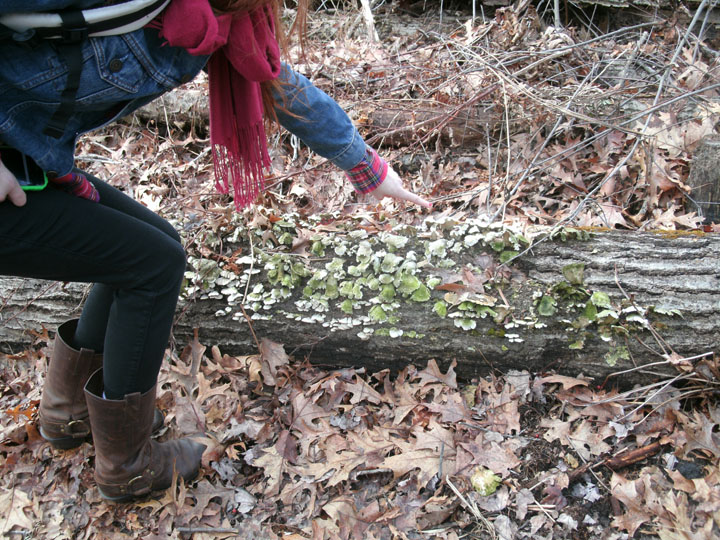
We stepped carefully around a few remnants of winter: some random patches of snow that had hardened into thick, slick ice. And we considered with wonder this landscape that had been covered for months with more layers of white. We found spots where we could only suspect that something tragic had happened. The sight of several piles of gray fur with no visible skeletons raised more questions than it answered. Several scat deposits lay in the middle of our path as well: one from a rabbit (perhaps), and another from a coyote (perhaps). (Note to self: Next time, bring along an animal tracking book that identifies such droppings.) The green fungi on a fallen log caught our interest, too.

Green Fungi en Route

Green Fungi en Route

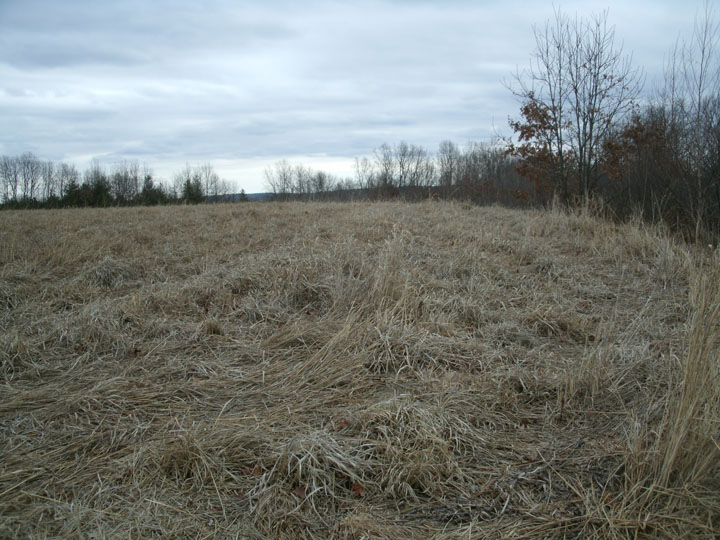
We crossed what Thoreau called “Crockery Field.” Its tall grass from last summer had been flattened by the snow. If you looked closer, though, you could see bits of green moss peeking out from underneath the sharp tan blades. The story goes that before Thoreau’s day, this place was owned by a man who worked at the Middlesex Hotel on Monument Square in Concord. He brought home the slop bucket from the hotel kitchen in order to feed his hogs. That’s why Henry found bits of the hotel china in the dirt. More pieces may still be here.

Crockery Field

Crockery Field

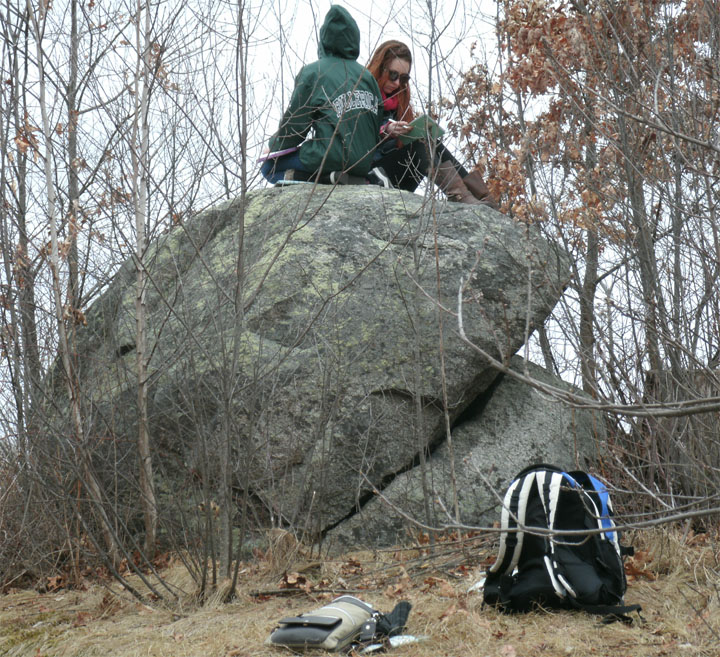
We spent a good long while at Two-Boulder Hill. Each one of us found a sitting space where we were inspired to write in our journals. Some climbed up onto the actual boulders. From the nearby woods, we could hear the sounds of occasional birds, like cardinals, chickadees, crows, and woodpeckers. Sitting as we were in the direct line of Hanscom Field’s east-west runway, we also had low planes flying over us, on their way home. Each one of them had a different voice, too.

Atop Two-boulder Hill

Atop Two-boulder Hill

I scribbled some of my own thoughts into my notebook. Then I began to notice a growing rustling. The sunlight had faded, and the air had chilled. The shrub oaks on this hillside were still holding on to their brown leaves from last fall. A sudden wind was now blowing through them. I turned back to see what Thoreau had written in 1860. “There the wind suddenly changed round 90° to northwest, and it became quite cold.” I tried to orient myself and imagine the compass directions. Was this wind coming from the northwest? Maybe. I smiled and shook my head. We had wanted to follow in Henry’s footsteps. We sure had. We were experiencing something very similar to what he had felt at this very spot, 154 years ago. Wow!

When our group came back together for the return trip, I wasn’t the only one smiling. The others had felt and heard the wind change too. We all got the Thoreau connection. We couldn’t have planned our adventure any better.

The clouds were really rolling in when we got back to the house Henry was born in. Sure enough, the rain began soon afterward. Our timing was perfect.

We shared a few of our own impressions with the others. The fifth-grader had picked up a cool rock that she deemed as being “igneous,’ having just learned the three categories of minerals. We encouraged her to take it to school the next week. Then we parted our temporary and pleasant company. Each one of us left with a lot to think about. And none of it would be broadcast on the evening news.