
Category Archives: News and Events

December Immersion – from Walden to Paris

No, I’ve not been soaking in Walden water, or any other water, as our winter comes on, but I have been re-immersed recently in Henry Thoreau’s words. Prompted by an invitation to explain Thoreau’s experiment in living to 20 graduate students at Institut des Hautes Études en Arts Plastique (IHEAP) in Paris, I’ve returned to Walden, and, as always happens when I reread this deeply familiar book, I’ve been amazed by its insights and universality.

At the same time, I’ve been challenged by the “seminar” that lies ahead this week. Not only will it be via SKYPE, not for me a familiar way of being with others, but the group of artists from around the world I’ll be working with reportedly have only the slightest sense of who Henry Thoreau was. And, as added complexity, a number of them will be working in a 2nd language.

How to bring Henry into sharp and real focus in our 90 minutes?

IHEAP’s focus for this year’s program is a help: soustraire, or subtraction, as method for and in support of creativity and art is the year’s theme, and I’ve found it a fine lens for looking at Henry’s Walden experiment. After all, Walden is all about subtracting the usual or familiar from life in pursuit of awakening and then adhering to the real, and Thoreau, crucially, has to subtract the expected self in favor of finding a real self.

Hmmm…I’ve just reread the last sentence and found myself saying, “show me what you mean.”

Okay, here’s example: Henry Thoreau, possessor of exceptional physical and mental vitality, and – very rare for his day – a college education, would have been expected to be a central figure in Concord. He became just that, but not in the way local society would have imagined. Rather than becoming a “select” man of the town, at 27 Henry decamped for a nearby pond and set up solitary living. “What’s that Henry (or David) Thoreau up to?” many must have muttered. Added to that consternation was Thoreau’s determination to become a writer. “He’s gone off the tracks,” more than one Concordian must have declared. And indeed he had (as well as going off on the tracks, but that’s a pun only Henry would like.)

What more did Henry subtract from his life so that he might develop his insights and art? Here’s a partial list of identities not pursued or subtracted: husband, father, teacher, householder, pillar of town society, rich man, majority member, all-day worker, church-goer, elected official.

And what subtractions might you add to this list? Or remove from it?

Thinking of creativity and art as subtraction has been fascinating; it is, among other things, another application of Thoreau’s famous advice: “simplify, simplify”;  it is also acknowledgement that we are in need of less rather than more in this age of surfeit.
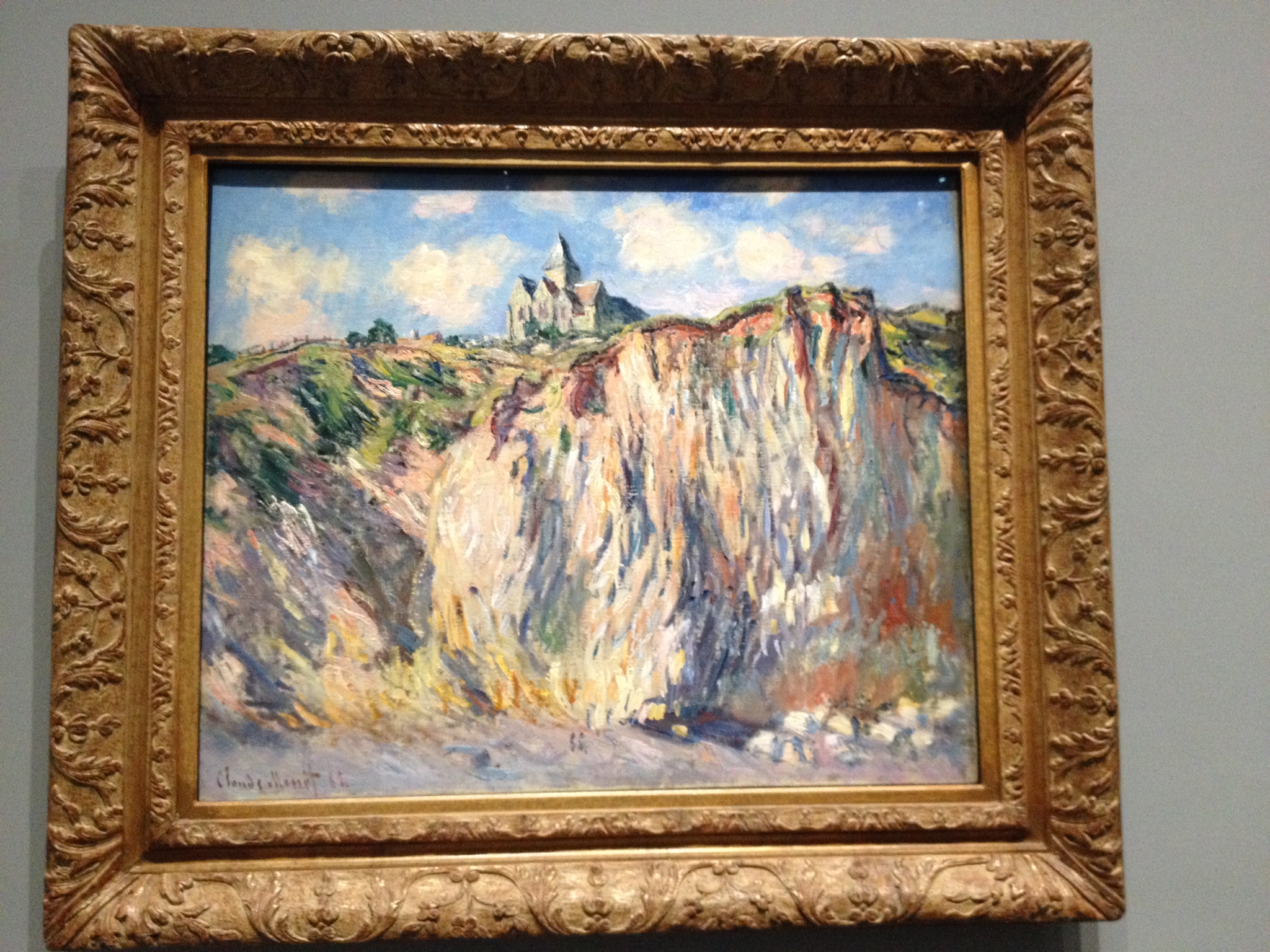
Effet du Matin

I’ve resisted the obvious, but in the end I’ve found it impossible, and so here is a short piece about Monet and Thoreau. There are many shared affinities – water, light, immediate Nature – but the catalyst for me has been a painting Monet did in 1882.

I first saw Église at Varengeville at a small museum during a recent sojourn in Paris. A few days earlier, we had, as seems appropriate for such a viewing, walked a number of miles to reach The Marmottan, another small museum not far from the Bois de Boulogne. There, we had eased through rooms of paintings Monet left to his son, who, in turn, left them to the French people. Unlike the crowded center-Paris museums with their famous Impressionist stock, this old house of a museum had only a few visitors. At one point I found myself alone in an oval room, surrounded by paintings of plants from Monet’s Walden in Giverny; no one else breathed; the air seemed to quiver with color and light.

All of this brought us to the Luxembourg Gardens museum, where I was again amid throngs. Perhaps you have this experience too, but I find myself distracted by people in museums – I often end up spending more time watching people looking at paintings than I do looking at the art itself. I think of it as the “ert” watching the inert, or the other way around.

Anyway, amid the crush, I reached three paintings labelled “Effet du Matin,” and the mention of morning and its effects rang, as it always does, the little Thoreau bell in my mind. I began to study Église at Vargengeville, and then, even given light jostling, I was alone in its colors and light.

image1

The church sits atop a high cliff that falls to what seems to be ocean, and it – the church – looks like a hat sizes too small for the cliff it tops. That stone is the painting’s real subject, I think, and it is alive with morning light, its streaks of color rising from what looks like kindled flame at the painting’s base. The eye is drawn to the cliff and lifted; the heart is uplifted too.

That seems the effect of light in this best season of the day, the time of awakening. Even after we left the museum, I kept returning to Effet du Matin, just as, given a morning mind and luck, we see fresh light each day.

Bluebird Birthday

By Corinne H. Smith

I eased through a birthday last week. I say it this way because I didn’t celebrate the occasion. This year didn’t carry a momentous number ending in 0 or 5. And once you hit the half-century mark, you have no need for fanfare. No reason to get dressed up and have a party with school friends, with a big birthday cake and candles and a rousing game of Pin the Tail on the Donkey, like we did way back when I turned seven. It’s now just a day like any other. I was determined not to play it up.

Then again, I allowed Facebook to out me. The quick online greetings started early. I ignored them as best as I could and logged off to go to my job at a used bookstore. One of my co-workers came in later with a strange expression on her face.

“Did Facebook lie to me this morning, or is today your birthday?” she asked.

I nodded. “Today is my birthday,” I admitted.

“Then I have a small birthday present for you,” she said. She handed me a candy bar. It was the exact brand and size that she has seen me nibble on every workday for a year and a half. It was the perfect present. I thanked her for this considerable generosity.

Truth be told, I had already gotten quiet birthday wishes at work the previous day. They came as I was cataloging a book. I opened the front cover and a card fell out. I’m used to this happening. People leave all sorts of items behind in donated or abandoned books: bookmarks, receipts, subway tickets, postcards and such. This greeting card had on its cover a painting of a bluebird in front of a forsythia bush. The scene was bright and almost too colorful and Spring-like for this all-brown November day. “Especially for You On Your Birthday,” it read. Coming into my hands within 24 hours of my own anniversary, this card seemed to be meant for me. Inside was written the name of the previous owner (who is now deceased, I know) as well as the signature of the friend who had sent him this card. I couldn’t return it to its original receiver. I didn’t know who the sender was. I felt only slight remorse at commandeering the card. I slipped it into my bottom drawer so that I could take it home.

At the end of the day, when I walked into my kitchen, I put the card on the table next to my two others. I had gotten these through the mail from long-distance friends. One was funny, and the other one was nice and heartfelt. Both reflected well the people who had sent them. They made me smile.

bcards2014

I looked at this third card and wondered if I should have just dropped it into a recycling bin. It was pretty enough. But it was too flowery for my style and too much like an old-person’s card. I am not an old person. I wouldn’t have given this card to anyone. And I would have shrugged it off as a mistake if one of my actual friends had seen fit to send me one like this.

To keep, or not to keep? I opened the card again. This time I saw a small paragraph on the bottom left that I had missed seeing earlier. It defined the picture on the cover. “Eastern Bluebird. The bluebird ‘carries the sky on its back,’ wrote Henry David Thoreau.” Now I laughed out loud. I didn’t have to read the rest of the description. I knew that this card had come directly to me from Henry. What other explanation could there be? It’s a keeper. Thanks, Henry.