
Category Archives: News and Events

Train of Thought

I Know, I Know…

I should be moving on, out into the glad day, on to what is immediate and away from the parsings of a small mind. It is, after all, October and the tints in all slants of sun are especially vivid after the season of many greens. Still, the recent piece in the New Yorker rankles, perhaps particularly because I so often respect its writers and their analyses of what’s afoot (or wheeling along) in the world.

So, just one more close look at one more of staff writer Kathryn Schulz’s weak readings, and then, I’ll move on. So.

In mid-essay, Schulz tries to work with her central accusation of hypocrisy by assailing Thoreau’s assessment of the railroad – newly put through in 1844 – that passes not far to the west of his Walden house. She finds Thoreau inconsistent, writing:

Nor was he interested in subjecting his claims to logical scrutiny. And that is the second problem with basing one’s beliefs on personal intuition and direct revelation: it justifies the substitution of anecdote and and authority for evidence and reason. The result, in Walden, is an unnavigable thicket of contradiction and caprice. At one moment, Thoreau fulminates against the railroad, ‘that devilish Iron Horse, whose ear-rending neigh is heard throughout the town’; in the next he claims that he is ‘refreshed and expanded when the freight train rattles past me.’

Here, Schulz chooses a contradiction and then scurries on to another, ignoring the context of the railroad passage in the chapter “Sounds.” That fine passage, pp. 114 – 122 in the Princeton Edition, turns on, resolves its apparent contradiction, by using the conditional mood, a mood that seems to escape the little eyes of Schulz’s notice. On pages 115 and 116, in rapid succession, Thoreau offers 5 “ifs,” conditions under which the project that is the railroad, and, by extension, inventive enterprise, might be “heroic”: “If all were as it seems, and men made the elements their servants for noble ends!”; “If the cloud that hangs over the engine were the perspiration of heroic deeds…then the elements and Nature herself would cheerfully accompany men on their errands and be their escort.”

Yes, Thoreau points out, it is possible to live an inventive life, to conjure trains (or, if we were to consider a modern analog, the Internet), in concert with Nature, IF one aligns one’s purpose and thinking with Nature. No stranger to mechanical aptitude and inventive capability, Thoreau knew that our inventions can be marvels. And, he knew also, we tend to make our inventions joust with Nature rather than fit with it. And we tend to apply them to their lowest purpose, accumulating riches, thereby squandering their potential. Thoreau is “refreshed and expanded” by that inventive potential, by the knowledge that we can win with our capabilities, not by the potential for accumulating capital. But he sees the devil in the uses to which we commonly put our inventions. Positive possibility twinned with clear-eyed criticism, with a good dollop of poetry added – that’s Thoreau’s take on the railroad. Schulz, however, misses that train of thought.

I know; I know…time to go outside, time to see the colors fly in the prismatic forest. Time to listen to the pileated woodpecker laugh; he has the right response.

What waits outside.
What waits outside.

A Reply to Pond Scum – a critique of Thoreau in the New Yorker

First a link to this long essay by New Yorker staff writer, Kathryn Schulz: http://www.newyorker.com/magazine/2015/10/19/pond-scum?intcid=mod-most-popular

Second a short response: That’s an amazing, it seems willful, misreading of Thoreau’s work. Where to begin? For starters, Schulz ignores Thoreau’s repeated purpose, awakening his neighbors, as opposed to trumpeting his own life. She also opens with a 21st-century awareness of the wreck of a famine ship as a way to cast Thoreau as coldhearted, a cheap writerly trick, I think, in that her opening anecdote is hardly from the core of Thoreau’s life and work. Then there is the tired charge of hypocrisy, even as Schulz tries to breathe new life into it. Here is a paragraph from late in the piece:

“But Thoreau did not live as he described, and no ethical principle is emptier than one that does not apply to its author. The hypocrisy is not that Thoreau aspired to solitude and self-sufficiency but kept going home for cookies and company. That’s just the gap between aspiration and execution, plus the variability in our needs and moods from one moment to the next—eminently human experiences, which, had Thoreau engaged with them, would have made for a far more interesting and useful book. The hypocrisy is that Thoreau lived a complicated life but pretended to live a simple one. Worse, he preached at others to live as he did not, while berating them for their own compromises and complexities.”

But really, did Thoreau claim to live a simple life? He aspired to simplify, to make good choices, but he never claimed that he led a simple life overall. His point that he had “other lives to live” after his Walden “experiment” aims in that direction. Thoreau was endlessly complex, and he knew it. He had a global awareness before it was fashionable to admit such. But he also knew that complexity must be balanced by the drive to simplify, to get at what’s meaningful in a world where we can be buried in drifts of information and yearning.

Just as Schulz accuses those who find wisdom or solace or guidance in Thoreau as cherry-pickers of the phrase, she too quotes liberally out of context. And she would have Walden be straight nonfiction, which it never claims to be, and surely isn’t.

I am in more sympathy with Schulz when it comes to T’s critique of government. We seem to be in the process and in the business of proving that narrow-minded principle and individualism lead to chaos; we’ll see. I’ve been long surprised that our radical right wing has made less use of Thoreau than they might have. Still, even in this area, Thoreau’s primary beef was with slavery, which, as Schulz acknowledges, was and remains our central national stain and shame.

Is the rescue of the world to be found in the individual? Thoreau would have it so; I’m not so sure. Especially when the number of individuals exceeds 7,000,000,000.

I am surprised that a magazine that says it features “the best writing anywhere” would go long with this piece. But provocation seems the name of the game in writing, and so there it is.

So much with which to take issue. So directly counter to what I’ve found as a teacher over long years of rereadings. And so missing in the spirit of joy that overflows from Walden and other writings, even in their sharp criticisms.

By chance I had just picked up Autumnal Tints for an annual rereading, and in his forward, Robert Richardson points to Thoreau’s early and sustained conviction voiced first in the Natural History of Massachusetts: “Surely joy is the condition of life. Think of the young fry that leap in the ponds, the myriads of insects ushered into being on a summer evening, the incessant note of the hyla with the woods ring in the spring, the nonchalance of the butterfly carrying accident and change painted in a thousand hues upon its wings, or the brook minnow stoutly stemming the current, the lustre of whose scales worn bright by attrition is reflected upon the bank.” That seems more in keeping with the writer I’ve read these many years.

Surely, however, Schulz has achieved what Thoreau sought in writing – even on a rainy and sleepy afternoon, she has provoked and awakened.

Life Book

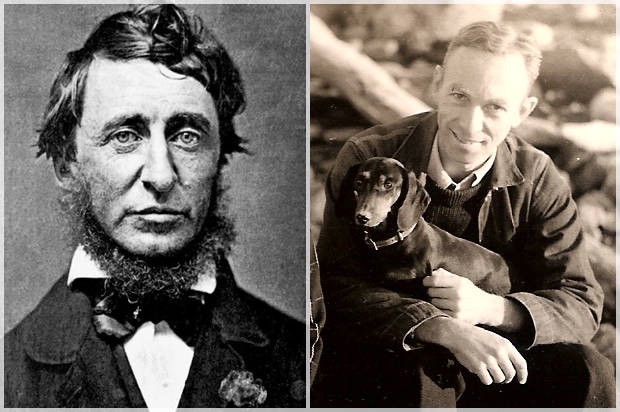
“Every man, I think, reads one book in his life, and this one is mine,” E.B. White wrote of “Walden” in a 1953 New Yorker piece. “It is not the best book I ever encountered, perhaps, but it is for me the handiest.”

The other day a Google alert that feeds me regular notice of Thoreau’s appearance in media across the web, offered me a link to a reflective piece that had just appeared on Salon.com. Benjamin Naddaff-Hafrey’s pleasureable essay opened at the end of E.B. White’s life and then rolled back through his long attachment to Walden and the many copies White owned, read and gave away, including a 1964 edition (complete with a rain-shedding duraflex cover) to which he wrote the introduction.

Thoreau and White Credit: Wikimedia

Thoreau and White
Credit: Wikimedia

The traced arc of White’s connection to Walden made me look back over my own, a mostly pleasant stroll through seasons of learning and teaching, and that, in turn, brought on reflections from over three years of writing for The Roost. How many books and writers could both sustain my interest and provide so many points of thinking and writing departure? Answer: one.

If one accepts White’s proposal, the question follows: how do you know when you’ve picked up and read your life-book? For me the answer arrived slowly. My first reading of Walden was hardly a reading at all. Assigned the book in a high school English class, I turned dutifully to it on evening one and fell promptly asleep. The pattern continued through the three weeks we considered sections of the book, and there was also an alarming transference to class time, where my chronic head-bobbing intensified, lowering my teacher’s already low estimation of me. I missed entirely Thoreau’s discontent with the sort of schooling I was sleeping through, and I missed his affection for the outdoor world where I felt truly animated. I did benefit from the cautionary message of this sleepy passage years later when I began to teach Walden, but my first meeting with Henry Thoreau was akin to passing someone of the street.

Jump to college and a reading with a touch more adhesive. I got – mostly by listening to lectures – some of Thoreau’s central critique of his (and, by extension, my) world, and I noted that the place he went for insight and wisdom was like mine, wooded and hilly. All good, but not exactly a scrivmance.

Then there was the long, oblique approach to my life’s work, teaching. By the time I landed in an English Department some 20 years along, I knew quite a bit about teaching and writing and a lot about being outside, but I’d not returned to Walden, though as a journal editor, I’d received any number of pieces to which it was important. Then, a year or two into my English career, my department chair said, “So here we are in Concord, and, since Phil retired, no one’s been teaching Walden. You spend too much time in the woods. How about you?”

Of such questions long affection is born. I arrived at my life-book late, much later, for instance than White did, but, after 25 years of readings, teachings, and any number of epiphanies, major and minor, I’m still turning its pages, still awake to its possibilities. I keep Walden handy.