Category Archives: Nature

The Art of Spying a Woodpecker

By Corinne H. Smith

“How far the woodpecker’s tapping is heard! And no wonder, for he taps very hard as well as fast, to make a hole, and the dead, dry wood is very resounding withal. Now he taps on one part of the tree, and it yields one note; then on that side, a few inches distant, and it yields another key; propped on its tail the while.” ~ Thoreau’s journal, May 10, 1853

On the last day of 2014, I went for a winter walk with a friend. It was intensely cold in southern Vermont – too cold for us to walk the long path we preferred, even though no snow covered the ground. Instead, we sauntered briskly around his neighborhood and came back around to stand in front of his home.

He introduced me to one of his neighbors, and the three of us chatted out in the middle of the street. All the while I was distracted by the soft tapping of a woodpecker on a nearby tree. My companions didn’t seem to be bothered by it. They did hear and acknowledge the sound when I mentioned it to them. While they talked on, I scrutinized the tree that I believed the sound was coming from. It was taller than a three-story house, so there was plenty of bark-covered territory to inspect. Still, I didn’t see the bird. Where could it be? I had to know.

Locating a woodpecker is a study in both acoustics and movement. You must both listen and look. I turned away from the human talk to sidle closer to one side of the tree. I examined every inch of its edges, looking for any small silhouetted and bobbing outline. No bird. But the tapping never stopped. It sounded as though someone was constantly worrying a baseball into a worn catcher’s mitt, over and over and over again. Our conversation hadn’t stopped it. And my quiet stalking around the trunk didn’t slow it down, either.

I made it to the other side of the tree and did another surface scan, beginning at the bottom. Finally I caught movement connected with sound, very close to the top. The woodpecker was hanging onto a cross branch that reached high over us. Unlike Thoreau’s bird, this one was focused on just one section of just one limb. It was digging deep for insect food on this cold day. All I could see from ground level was its white and mottled tummy, and the motion of its head and beak attacking the wood.
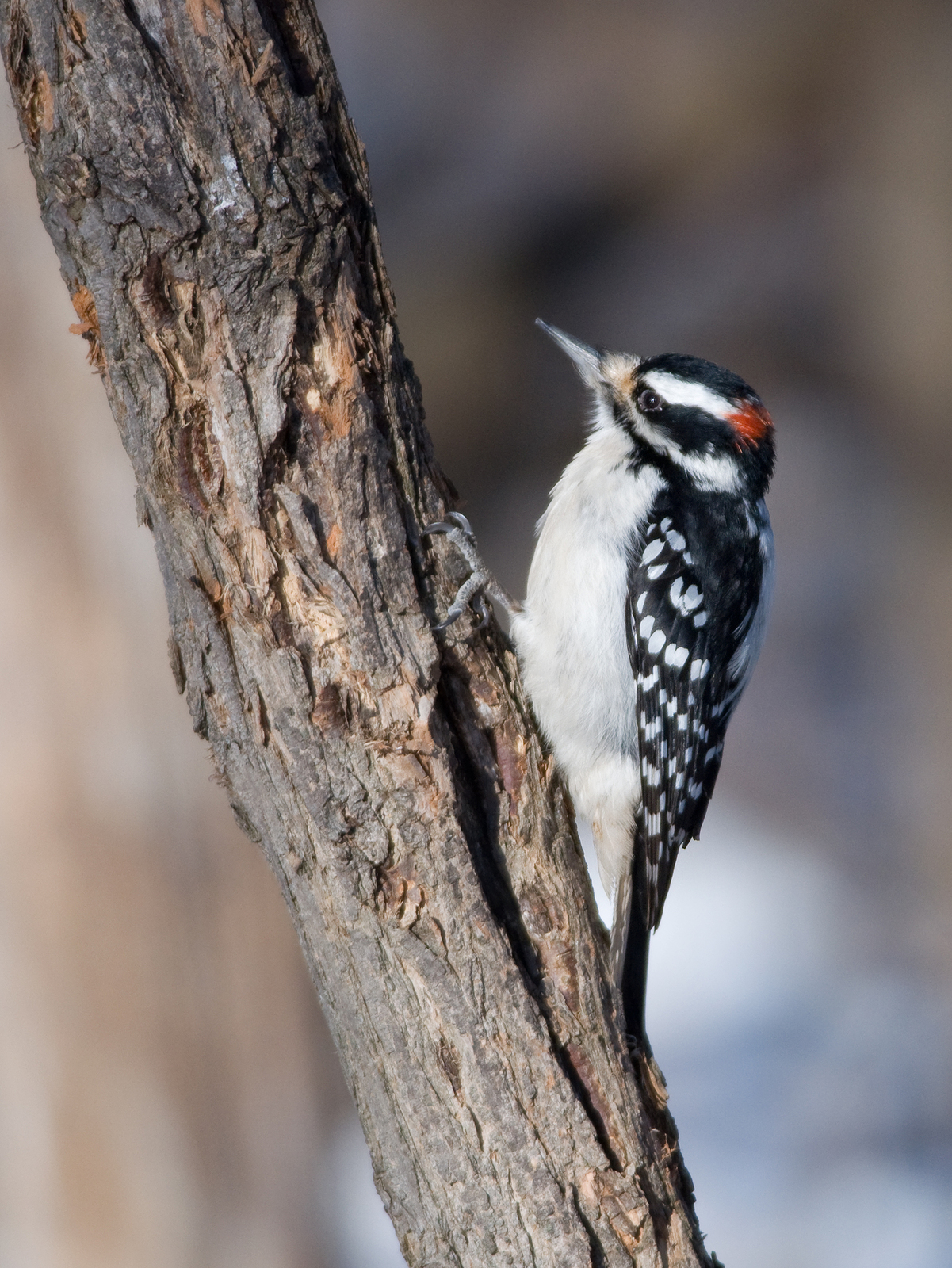
Male Hairy Woodpecker - these guys can be hard to spot.

Male Hairy Woodpecker – these guys can be hard to spot.

Now I could point it out to my friend. “Can you see red, or any other identifying marks?” he asked, squinting into the sun.

I didn’t have my binoculars or bird books with me. “No. Just his white tummy, from this angle and distance. Although there are people who could tell you what the species is just by listening to the pattern of the taps.”

“Wow.”

“Unfortunately, I am not one of them,” I admitted.

Another neighbor came out for a walk. When she saw that we were all looking up, she pulled her head back to do the same and asked, “What are we looking at?”

“A woodpecker,” I said. I raised my arm and described which branch he was on.

“Oh, yeah, I see it. Nice.” And she power-walked away.

Sure, this woodpecker was easy enough to spot when someone else showed you exactly where he was drilling. I had done all of the work to “find” this guy. I was frustrated at how casual this discovery was for everyone else around me. If the air had been warmer, I would have watched this bird for the better part of an hour. By myself, no doubt.

Maybe woodpecker-watching isn’t just a lesson for the eyes and for the ears. Maybe this little bird is a teacher of humility, too.
Commonality

“Each town should have a primitive forest where a stick should never be cut for fuel, a common possession forever, for instruction and recreation. All Walden Woods might have been preserved for our park forever, with Walden in its midst, and the Easterbrooks Country, an unoccupied area of some four square miles in the north of the town, might have been our huckleberry field. . . . Journal, 10/15, 1859.

Let’s begin the new year with praise for the Commons – what we hold in common, what we hope in common, what we walk in common.

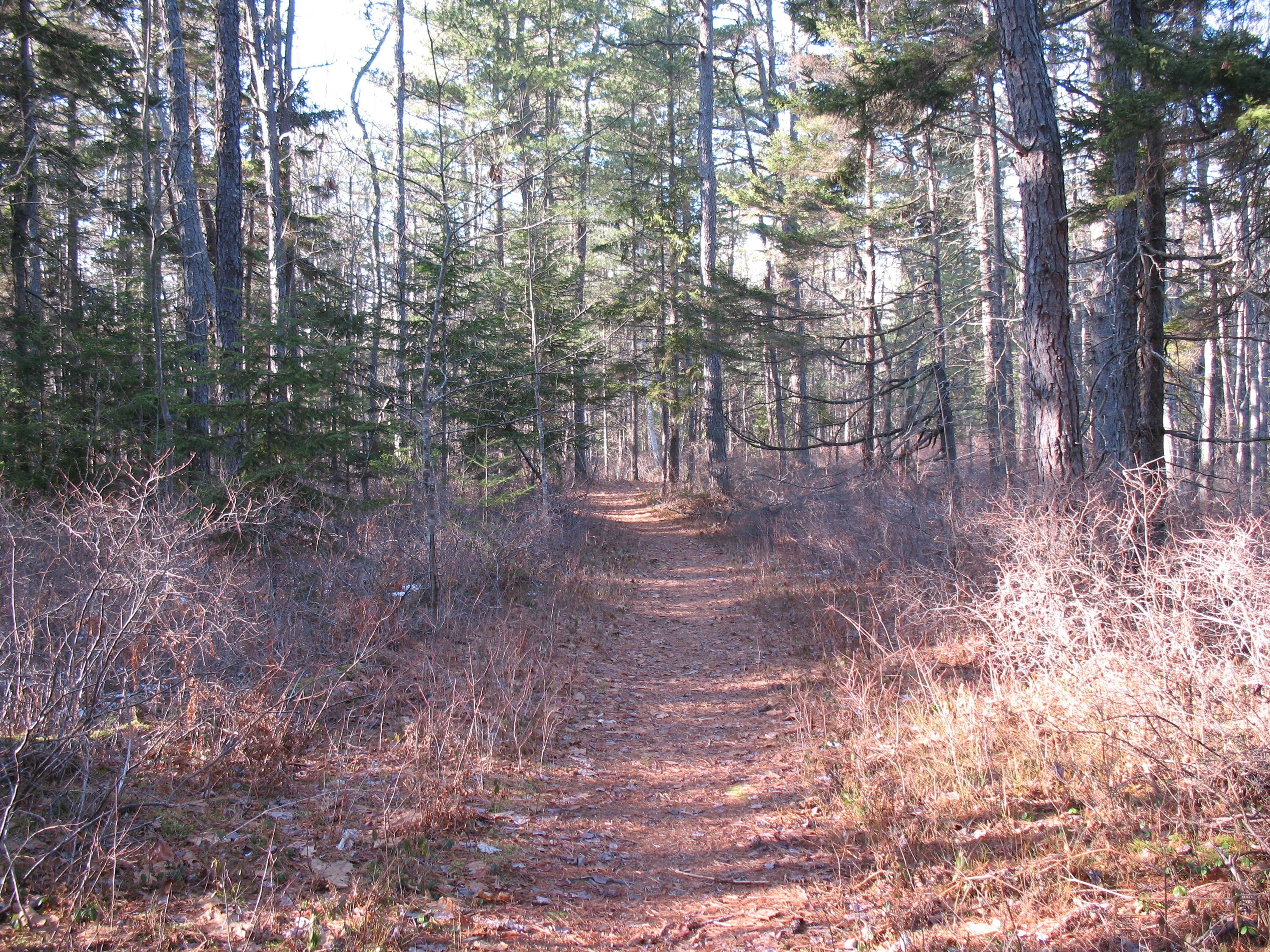
Commons Trail

Commons Trail

Five or so years ago, I took a walk into our town Commons, a two-hundred-acre stamp of wood- and wetland set aside for wanderings and recreation. Already, after a few years along these trails, I was growing attached to them and to the trees that always awaited me there. So the sound of saws snarling unsettled me; as I walked deeper into the woods, the saws grew louder. Near the heartland of the Commons lies a pitch pine barren, once a common finding in our area, now a rare one. The cutting was going on there, and, as I approached I heard the familiar crack followed by the gathering rush of toppling as a tree went down.

No little outrage quickened my pace. The saws of the world, even here? I said to myself. Even in the Commons?

Here is the moment to remind myself that it’s always good to get the full story before boarding the express to outrage. Here is compression of that story: the cutting in progress aimed at large white pines that had overshadowed their smaller pitch pine neighbors; the Commons were “in succession,” shifting into their next stage. But the pitch pines and their barren were now unusual, deemed worth preserving, and, with some thinning, they would thrive. Okay, I thought, let’s see.

Pitch Pine Friends

Pitch Pine Friends

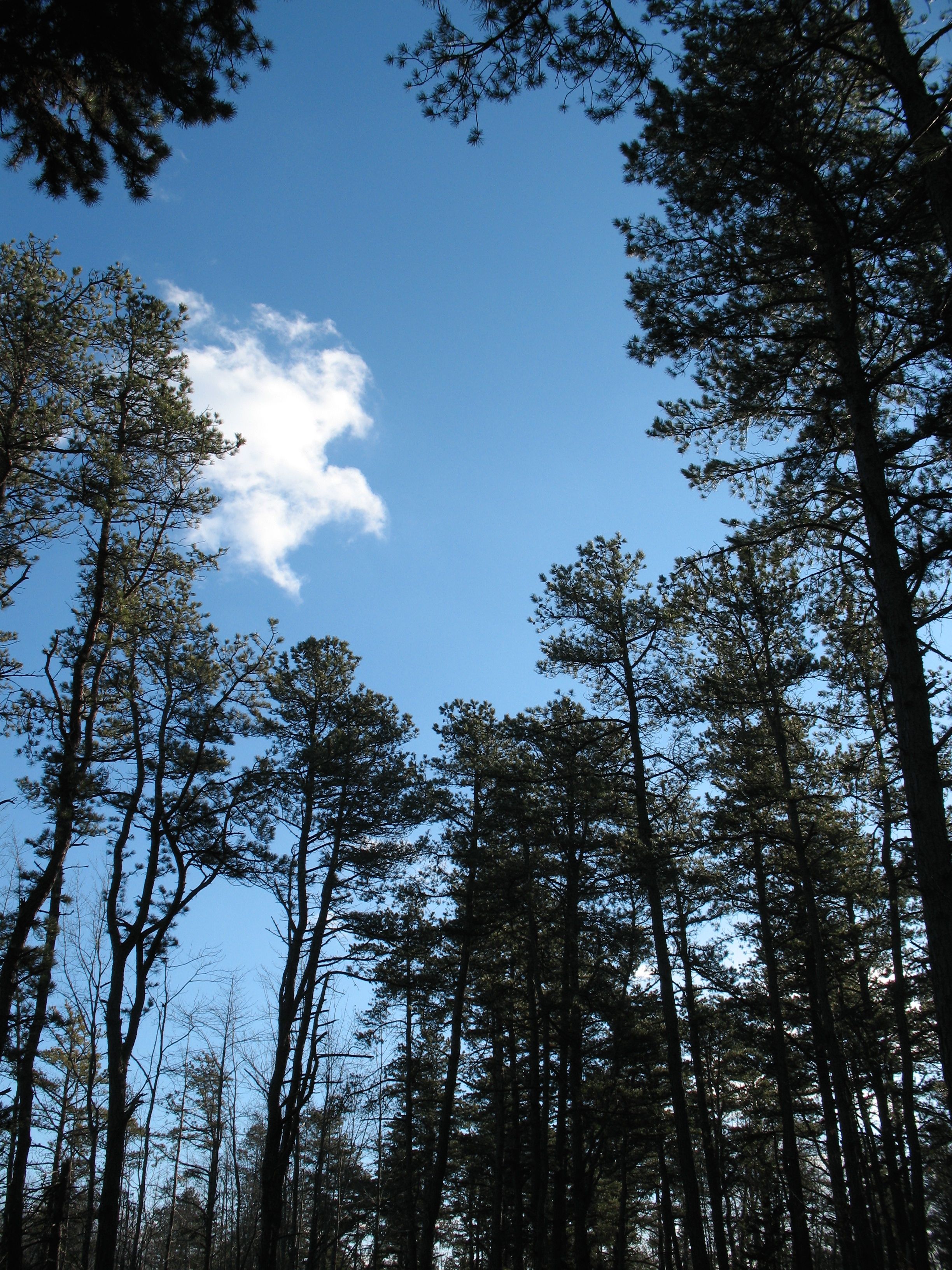
To ring in this new year and celebrate its possibility, I went for a walk in the Commons. The air was sharp, the sky open faced. And in the barrens heartland, the pitch pines rose from the general scrub like columns of gray smoke; then their thick needles poked the sky. The barrens had an expansive feel that infused me with hope for what’s ahead. Here and there, I could see the aging stump of a white pine, and from one I looked aloft, imagining the 80-foot tree that stood there and the way it would have obscured the sky.

Rising Column

Rising Column

The selective cutters had done well, I thought. In one tiny grove, more than 50 pitch pines aimed at becoming full trees; each had been given a chance; a few would become the grove’s dominant trees. And the barrens, with its wide spacing of trees would provide walking reminder of what once was usual in our area.

Our Commons now has its uncommon barren and its common paths, where I and others have a place to wander throughout the coming year. What we hold in common is a place both rare and usual; it is where we often walk to find ourselves.

Best wishes for the Commons of 2015.

Solstice Lights

Today is short work. That seems appropriate to Thoreau’s 12/21/54 entry on Americans’ love of jest. But what catches my eye as I read through the entry is the paragraph before it; it shines like a mirror of my own thoughts:

We are tempted to call these the finest days of the year. Take Fair Haven Pond, for instance, a perfectly level plain of white snow, untrodden as yet by any fisherman, surrounded by snow-clad hills, dark evergreen woods, and reddish oak leaves, so pure and still. The last rays of the sun falling on the Baker Farm reflect the clear pink color. I see the feathers of a partridge strewn along on the snow a long distance, the work of some hawk perhaps, for there is no track.

“So pure and still.” Yes, and there is also the strew of feathers to remind us of life’s action, of what may fall from the sky. Still, it is time for a walk in the woods.

Those of us who walk the woods prize the sense of solitude we find there, with its expansive chance to breathe and watch without speaking. And yet – also true, I think – we rarely feel alone, in part because we become keen in our tracings of other animals whose prints, feathers and tufts of fur are everywhere. And woods-walkers also develop a heightened sensitivity for movement, especially that on the periphery of vision, where once, (in the old world, and, perhaps, in the new) predators kept track of us. All of that is part of the everyday walking world.

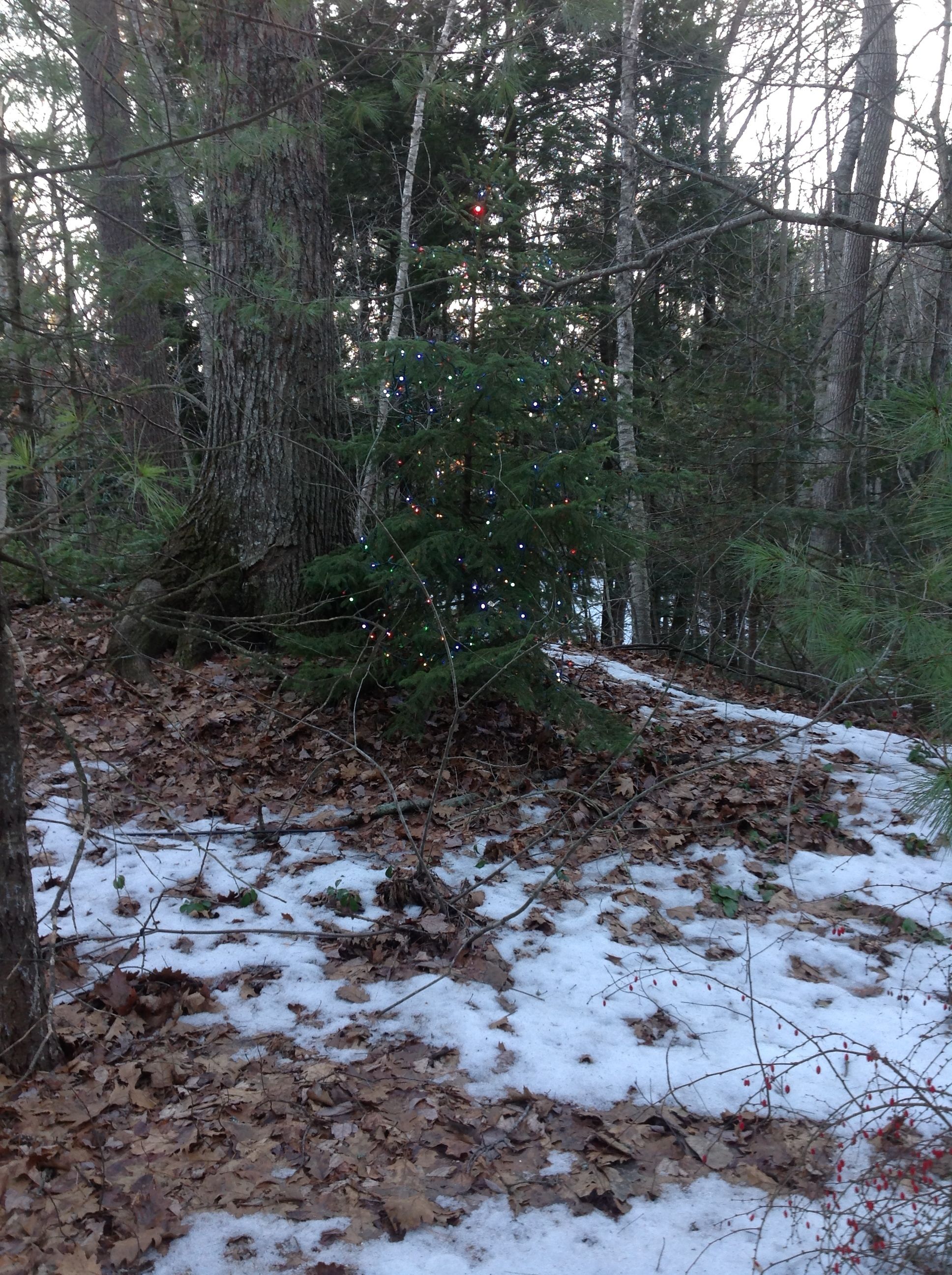
Here, on the other hand, is another sign of presence that is rare and random, yet common enough to make me wonder if you too find it on occasion. Yesterday on my way to local woods, I came upon a small balsam fir. Okay, not uncommon; this is, after all, Maine. But this one twinkled with strings of tiny colored lights, even though it was far enough into the woods to be unlinked with any particular house. And no extension cord ran long yards over the ground to point to such linkage. Easy enough then to conclude that the lights were battery-powered. But whose presence did this sudden holiday tree signal?

IMG_0295

The lights winked in the dark woods, growing brighter as the sun slid behind the trees and the early dusk came on. I felt a smile play across my face. Usually, I’m not wild about human announcement of presence in our common woodlands, but here at the winter solstice in diminutive form were reminders of the communal light we share; here were dots of color dressing the dark. They felt like tiny kin to the companionable yellow light cast from the window of a hut on a winter night.

Every once in a while – and that is as often as it should happen – I happen upon some little lights or other ornaments in the woods; they are kin to a quick smile from a stranger passing by in a crowd, reminder of the light side of who we are.

Best wishes to all for the solstice/holiday season.