Category Archives: Living Deliberately

How I Missed the Anniversary…of Thoreau’s Death…Again

May 6th. You’d think it would be embossed in my mind – all these years of reading and teaching Thoreau, and yet, it slipped by again.

On the evening of this slippage, while I supervised an impatient study hall, I wondered to myself: why is that?

Here’s what I answered: it sounds simple, hokey, even, but for me, Henry Thoreau lives on. It would be a cliche to point to Walden and other works and say, “see, all around the world people read these words and then look up and change; all around the world people read and develop or renew their faith in I.” True…but trite to write.

And I’ve been reading through his spring journal of 1855, even as I live my spring of 2014. We have shared hawks and peepers and redwing blackbirds, woodland meanderings. All good, but…

Here then is a more personal truth: years of living with Henry Thoreau’s writing have given me new eyes. Every day when I walk out the door, I look up, I scan the peripheries of each world I step into – yesterday the robin nesting in the dwarf pine was facing east as she sat atop her two blue eggs; today, she’s facing south. The copper beech in the yard is kicking finally last year’s dun leaves from a hold that endured quite a winter. The parking lot maple prepares a riot of seeds…so much faith.

It all begins…again.

A Visit to Two-boulder Hill

By Corinne H. Smith

“Went to what we called Two-Boulder Hill, behind the house where I was born. There the wind suddenly changed round 90° to northwest, and it became quite cold … Called a field on the east slope Crockery Field, there were so many bits in it.” ~ Henry Thoreau, Journal, January 31, 1860

One morning at the end of March, six people accompanied me on a nature writing walk to Two-Boulder Hill, behind Thoreau Farm. We were armed with our journals and open eyes, ears, and minds. We were awake and alive. We wanted to see what we could see, on this muddy day that happened to overlap both winter and spring. The sun was shining and the robins were bobbing for worms in the front yard when we started out. We hoped to beat the expected heavy rain, which we had heard would arrive by afternoon. Off we went.

Following Thoreau’s advice, we were also determined to leave behind all of the big concerns of the day, including the unrest in Ukraine, the search for the Malaysian jetliner, and the devastation left by that massive mudslide on the opposite coast. “I am alarmed when it happens that I have walked a mile into the woods bodily, without getting there in spirit,” Henry wrote in the essay called “Walking.” “It sometimes happens that I cannot easily shake off the village. The thought of some work will run in my head and I am not where my body is – I am out of my senses. In my walks I would fain return to my senses. What business have I in the woods, if I am thinking of something out of the woods?” Yes, for at least a few hours today, we wanted to shake off the village and return to our senses. If we each found something nifty to write about, so much the better.

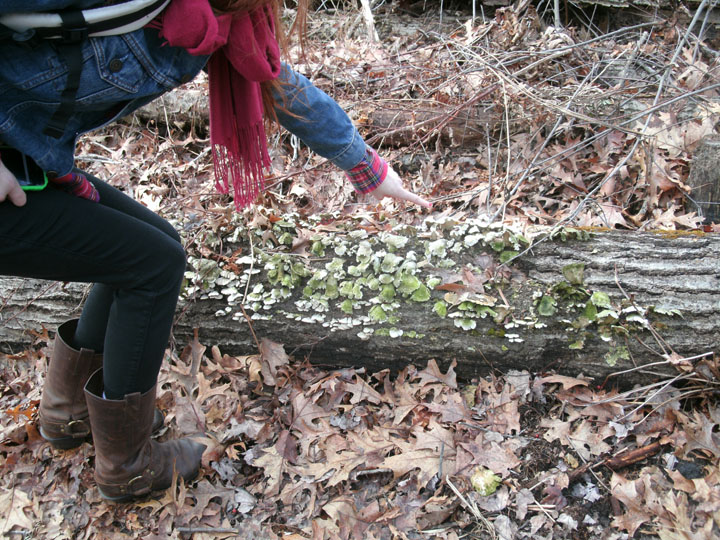
We stepped carefully around a few remnants of winter: some random patches of snow that had hardened into thick, slick ice. And we considered with wonder this landscape that had been covered for months with more layers of white. We found spots where we could only suspect that something tragic had happened. The sight of several piles of gray fur with no visible skeletons raised more questions than it answered. Several scat deposits lay in the middle of our path as well: one from a rabbit (perhaps), and another from a coyote (perhaps). (Note to self: Next time, bring along an animal tracking book that identifies such droppings.) The green fungi on a fallen log caught our interest, too.

Green Fungi en Route

Green Fungi en Route

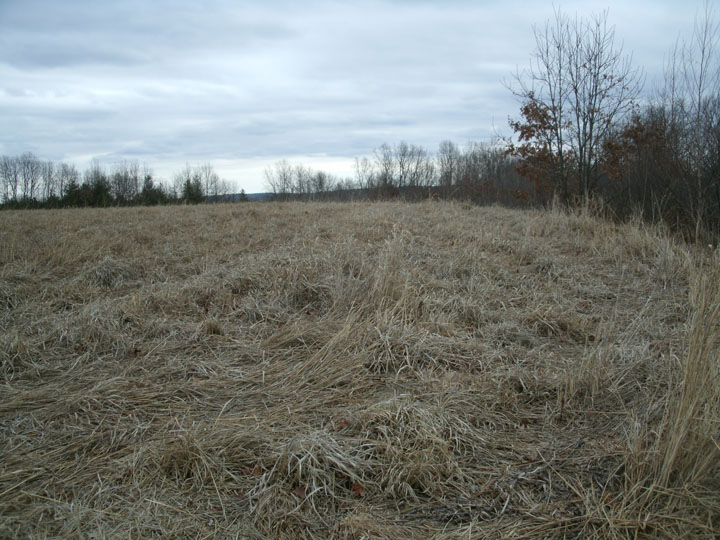
We crossed what Thoreau called “Crockery Field.” Its tall grass from last summer had been flattened by the snow. If you looked closer, though, you could see bits of green moss peeking out from underneath the sharp tan blades. The story goes that before Thoreau’s day, this place was owned by a man who worked at the Middlesex Hotel on Monument Square in Concord. He brought home the slop bucket from the hotel kitchen in order to feed his hogs. That’s why Henry found bits of the hotel china in the dirt. More pieces may still be here.

Crockery Field

Crockery Field

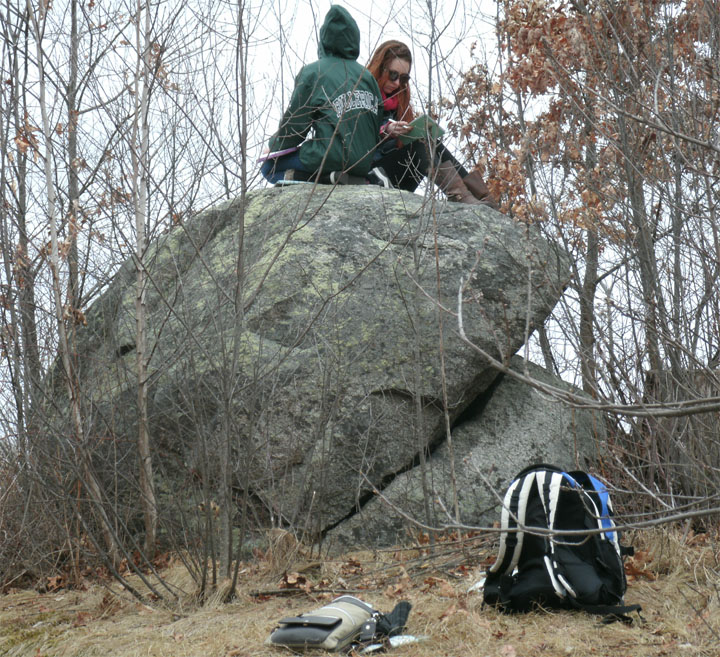
We spent a good long while at Two-Boulder Hill. Each one of us found a sitting space where we were inspired to write in our journals. Some climbed up onto the actual boulders. From the nearby woods, we could hear the sounds of occasional birds, like cardinals, chickadees, crows, and woodpeckers. Sitting as we were in the direct line of Hanscom Field’s east-west runway, we also had low planes flying over us, on their way home. Each one of them had a different voice, too.

Atop Two-boulder Hill

Atop Two-boulder Hill

I scribbled some of my own thoughts into my notebook. Then I began to notice a growing rustling. The sunlight had faded, and the air had chilled. The shrub oaks on this hillside were still holding on to their brown leaves from last fall. A sudden wind was now blowing through them. I turned back to see what Thoreau had written in 1860. “There the wind suddenly changed round 90° to northwest, and it became quite cold.” I tried to orient myself and imagine the compass directions. Was this wind coming from the northwest? Maybe. I smiled and shook my head. We had wanted to follow in Henry’s footsteps. We sure had. We were experiencing something very similar to what he had felt at this very spot, 154 years ago. Wow!

When our group came back together for the return trip, I wasn’t the only one smiling. The others had felt and heard the wind change too. We all got the Thoreau connection. We couldn’t have planned our adventure any better.

The clouds were really rolling in when we got back to the house Henry was born in. Sure enough, the rain began soon afterward. Our timing was perfect.

We shared a few of our own impressions with the others. The fifth-grader had picked up a cool rock that she deemed as being “igneous,’ having just learned the three categories of minerals. We encouraged her to take it to school the next week. Then we parted our temporary and pleasant company. Each one of us left with a lot to think about. And none of it would be broadcast on the evening news.

Up to My Eyes in Walden

It’s not often that free time and a jewel of a day coincide. Typically, we watch a limitless blue sky and its windless, late summer light from behind the smeared glass of work. One of the most common fantasies I hear as colleagues siphon off coffee on such a morning begins like this: “I can’t wait to have a day like this off, so…” And then he or she trundles off to one of work’s rectangles.

Thursday, September 19th sets up this way: it’s cool and windless in the morning; the humidity is low and the trees and river look sharp edged in the clear, slanting light. I wonder, wonder I do – what’s my day looks like once my late-morning class is through? A few reshuffled appointments and a pile of abandoned papers later the afternoon looks as clear as that slat of sky between the high pines.

And so, a little after noon, I step between two trees onto the Wright Forest trails behind Walden Pond with an eye on a long ramble whose route I’ll make up as I go. A quarter of an hour in, I reach the unmarked turn-off for the old race course whose crooked oval persists these hundred-plus years after the amusement park on Walden’s west end faded. I decide to canter a circuit of the old course, where I am the slowest horse; still, I am also the only horse, and so I finish first. My prize is more trail-time.

I’m soon at the pond, where I amble along its north shore and climb over its uptics before easing through the growing congestion on the east-beach side. A few school-groups note the pond dutifully in journals, while their tech-addicted peers hide from teacher-eyes in the shadows and expect from their screens. An assortment of other refugees from work and other obligations loll pondside. Almost everyone is looking out over the water. Along the old esker that leads me away, I see flashes of pond through the trees, and then I reach the slope leading up to Emerson’s Cliff, a small crag at suitable remove from the nearby bustle.

As ever, no one’s here, but a breeze stirs and the air is cooler atop this mini-mountain. Down its rocky backside, the trail enters an absent world; the worn track says others walk here, but I’ve never seen anyone. How quickly we leave a crowd behind when we deviate from the usual rounds. I near the beaver lodge in the swampy dell below the railroad tracks and see the old gnawed trees tipped into the water. Then, across the tracks again and into the big pines of Lincoln. “Why not,” a wandering voice asks, “visit Misery?”

Ten minutes bring me to the left to Mt. Misery. Misery’s backstory has eluded me, but the name seems inapt, even inept, for such a fine cone of stone in big woods.

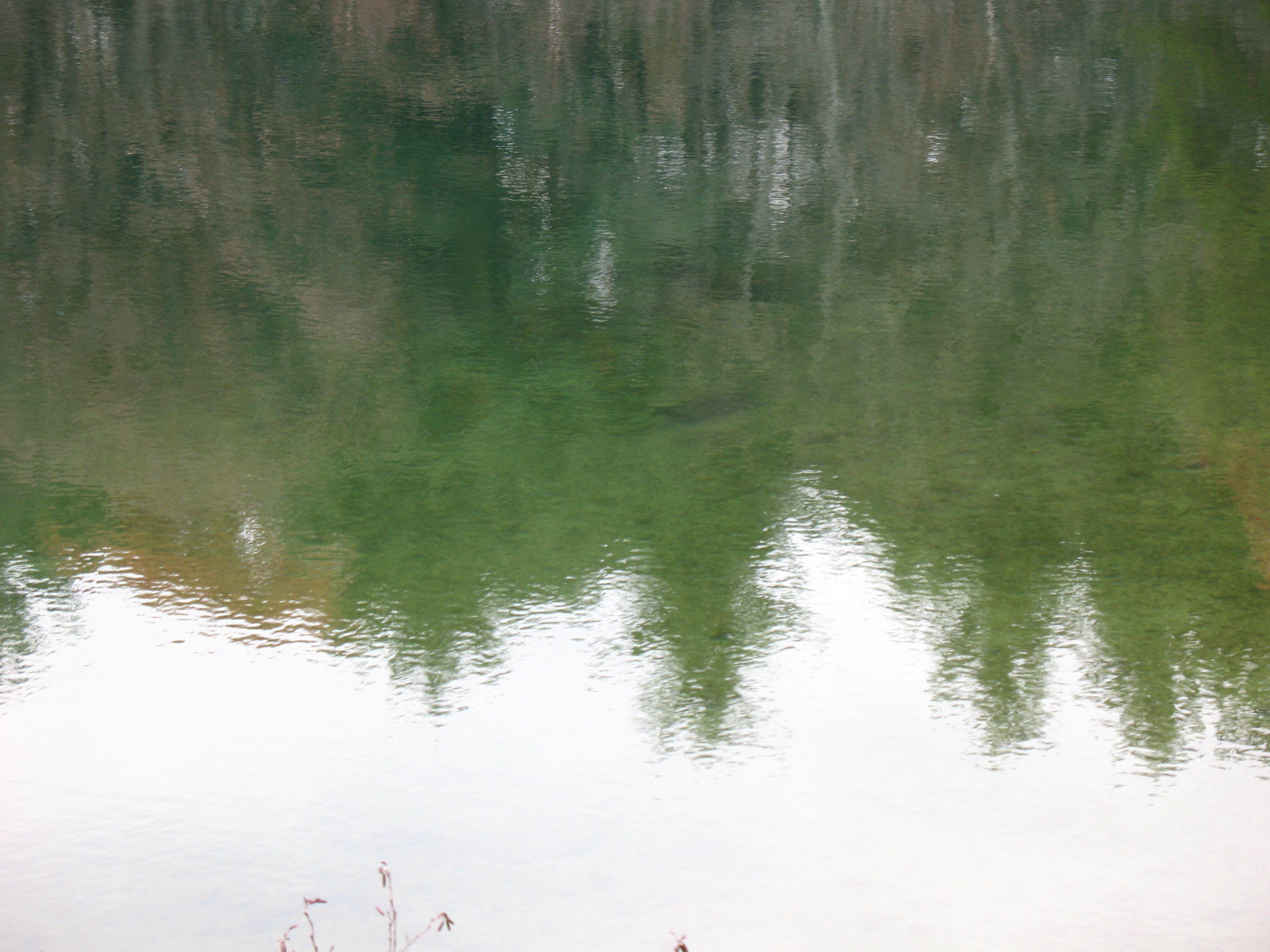
I’m retracing part of my route and sweat rolls from my running; “the pond, repeat after me, the pond,” says some interior voice, and I repeat, “the pond.” Fifteen minutes later I’ve reached a sliver of beach on the southwest shore. The water level is low, but, as ever, the greeny water is clear, even after a summer of sloshing by the lotion-slathered leviathan that is Walden’s daily beach crowd. What resistant purity. Shoes off, shirt too. Step, step, step, plunge – pale critter submerging. I swim a few strokes, let my feet fall and note that the drop-off is already over my head. My toes tread in water five degrees cooler than the surface. Belly to the sky, I float and let the land’s heat and the step step of minutes wash away.
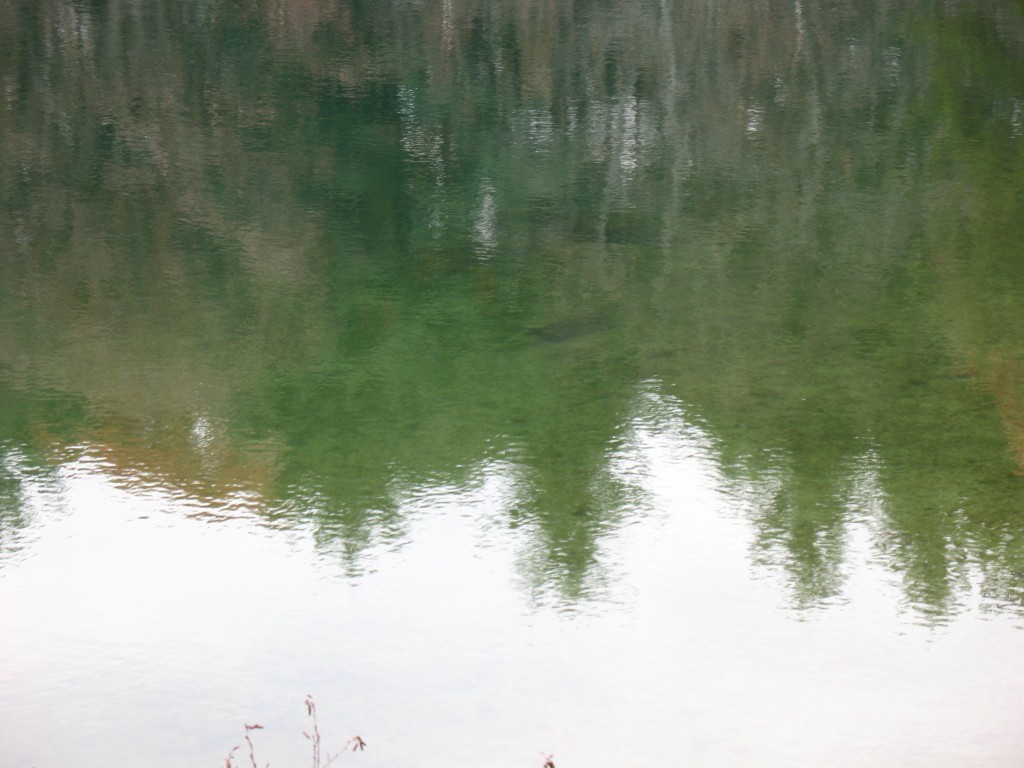
Walden Water

Some time later, I am in four feet of water with my eyes a few inches above the skin of the surface. Across from me is Thoreau’s Cove, its guardian sandbar speckled with waders; distant kayaks glide forward like swans; the pines point to the sky, which looks immense. A rogue duck disturbs this reverie, paddling a few feet from my nose. Perhaps I look like a pale stone with a token scrap of  moss on top. The duck pays me no notice. Instead, he is avid for something on the unrippled surface; he keeps stabbing his bill right and left, paddling back and forth in front of me. Am I being taunted? I begin to wonder. Perhaps this is simply a quest for some duck-truth. I look more closely and see finally that he is hoovering up tiny flies from the surface. This warm day has called up a new hatch, I suppose, and those that break the surface-tension are mired in the water. Perfect picking for my duck. A tiny fly drops lightly onto the water an inch before me and doesn’t dent the water; he lifts off again. The duck gathers his less light-footed brethren.

As I’ve watched, the water-envelope around me has warmed. I stir, and a little cool brushes me. In my crouched stance, in my clear water with its skin stretching out and out, I am effortlessly calm. The day seems paused. Soon, I’ll emerge, drip dry, towel sand from my feet with my shirt and put on my shoes for the Fairhaven trail back to my car. I will find that I’ve been out for the Thoreau-approved four hours.

But for now, let’s leave me here duck lucky and up to my eyes in Walden.


Note: for a superb history of the pond see Walden Pond – a History by Barksdale Maynard.