
Category Archives: Literature

That Hum and Buzz

Insect Sounds

by Ashton Nichols

Think of an insect three inches long that makes a sound so loud it keeps you awake at night. When we traveled to a beautiful spot on the Delaware Bay recently, that is what we encountered. Think of another insect, half that size, which has inspired poets and painters the world over. Many of us have this first creature in the trees near our homes, and this second small animal near our hearths, along the flowered edges of our homes and our gardens. Cicadas and crickets–the singers of the bug world.

The cicada makes the loudest sound of any insect on earth; not one louder insect sound has ever been recorded. A cicada can reach 120dBs, which is equivalent according to the experts to: a riveter, a wood chipper, thunder in a summer storm, a diesel engine room, and a Fourth of July fireworks display. That’s loud! The female cicada makes no sounds whatsoever, and of all of these loud males, the Australian cicada buzzes louder than any other cicada…bububuuuuuzzzzzzzzzz! An astonishing sound.
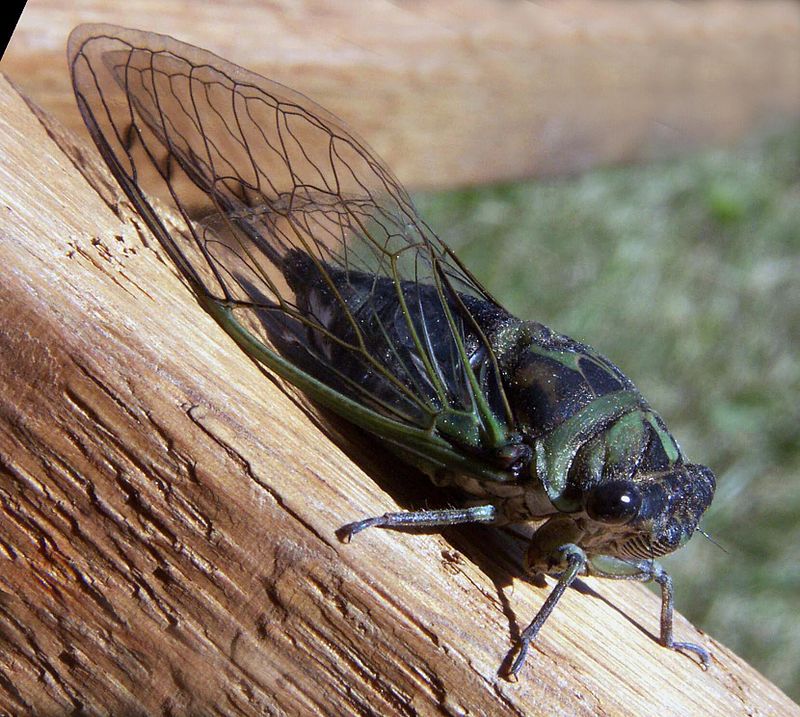
Cicada photo by Bruce Marlin

Cicada
photo by Bruce Marlin

Here is what John Keats said about the warm sound of the crickets by his hearth: “from the stove there shrills / The Cricket’s song, in warmth increasing ever.” Keats wrote these lines in a beautiful poem entitled “The Poetry of Earth is Never Dead.”  So the poet, who is perhaps the greatest wordsmith of our language since Shakespeare, finds this tiny black bug to be a creature that can make a sound that warms us, even in the cold and dead days of winter.

The level 130dBs of sound is described by the experts as “deafening” and also as the “threshold of pain.” We all know what it is like to hear a sound so loud that our ears literally hurt. We have all turned up the stereo headphones too loud, or we have stood too close to dad when he was firing up the chainsaw right next to us, or we have been in the fifth row of a Led Zeppelin Concert in 1969–right in front of that bank of Fender amps–and, although we said we loved it, it really did hurt our ears. So imagine a little insect that can make a sound only 10dBs below this “threshold of pain” and then imagine dozens of these, or even hundreds of these, in the trees and shrubs around you on a late summer night.
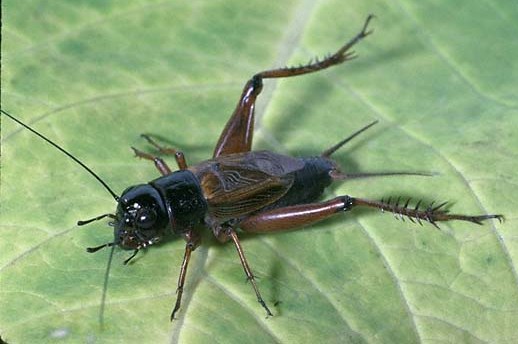
Field Cricket

Field Cricket

Of course, there are other insects that make memorable sounds: grasshoppers, bees and wasps and mosquitoes and midges all buzz, and some buzz loudly. But I say that crickets and cicadas carry the day. They have the voices that do not die and, as Keats said two centuries ago, they are still “increasing ever.” We hope so. Although climate change may expand the range and population density of certain species, it will also upset the balance of many insects and most of their sound-making fellow species. Like the poet, I want to hear my nearby cicadas and crickets for years to come.

Grab Those Number Twos!

By Corinne H. Smith

Last month I gave a talk about Henry Thoreau at a public library. More than a dozen people were in the room. I opened the gathering as I always do: by asking the audience members what they remember about the man. Whatever they come up with helps to drive the rest of the presentation. Typical responses are these:

“Didn’t he live at Walden Pond?” (Yes.)

“He followed The Road Less Traveled.” (Well, no, that was Robert Frost. But Henry probably would have liked that poem.)

“Civil Disobedience!” (Yes! What is it? “Uh …”)

“He was friends with Emerson.” (Yes.)

“Didn’t he spend a night in jail for not paying his taxes?” (Yes. That’s where Civil Disobedience comes in.)

“He went home for dinner every night and took his laundry home to his mother.” (What 19th-century man would have done differently?)

Actually, most people know at least something true and authentic about Thoreau. And I can tell when I meet someone who knows more details than the others do. This was the case at this particular talk. The first person who raised her hand asked, “Didn’t he make pencils?”

Yes!

I try to remember to bring up the Thoreau pencils later, if no one mentions it earlier. Sometimes I forget and am distracted by other Thoreau stories. I’m always grateful when someone prompts me for it. Perhaps the topic of pencils came up this time because we all had back-to-school days on our minds.

The Thoreau family came into the pencil-making business through Charles Dunbar, Henry’s uncle on his mother’s side. Eventually Henry’s father took over the firm, and it became John Thoreau & Co. Henry himself figured out a way to get the right clay that would bind well with graphite and produce a better pencil. He then labeled them with numbers 1-4, according to their hardness. The number 2 pencil was about average when it came to hardness and darkness. It didn’t smear as much as heavier pencils did.

pencils

The connection between Henry Thoreau and the pencil-making business is a fun one to think about and to talk about. Maybe this is because it’s something that’s slightly unexpected. We connect Henry Thoreau so closely with nature, philosophy, and social justice that such a small and practical matter like the act of making or using a pencil gets overlooked.

The next time you’re holding a number 2 pencil in your hand – even if it’s just to shade in a few tiny circles on a standardized form — you can thank Henry David Thoreau for the opportunity to do so.

Class dismissed!

Living Space – Henry Thoreau

What square-footing did he have
in the world, living little
indoors, large
outside – anachronism
another way of saying
timeless which some
see as eternal – lair
fitting nicely the proportions
of his human animal
five foot seven and
let’s say 140 pounds
there he is “rapt”
in his doorway on
his limen “in revery.”

It’s deep summer nothing
lasts; he knows autumn
tints are on the way
the tubercular seed will
flare and droop the
scarlet oak will hold its
red a long time,
but today he is exactly
between worlds so
at home that even the birds
flit “noiselessly through
the house” suspended
above its 150
footprint.

“I grew in these seasons
like corn in the night,”
he will write
effectively closing
the loop of a day
encircling a lifetime
squaring its effect
again and again –
it ripples out still
reaching me in my slat
of sun by an open window
far from the pond
these 160 summers later.