Category Archives: Henry David Thoreau

Summer Reading – Walden’s Shore

In Search of Bedrock at Walden

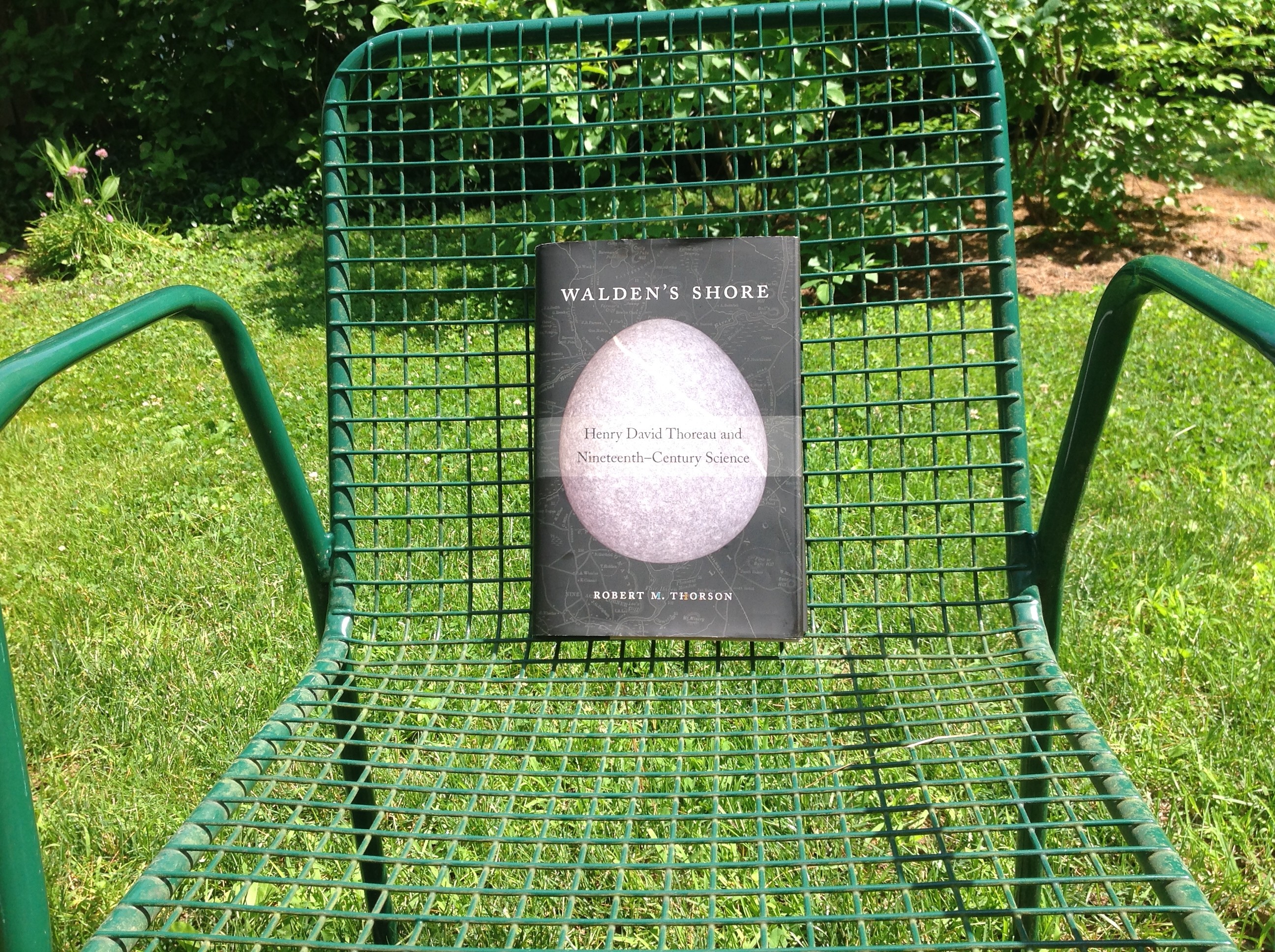
Part of summer’s joy lies in its liberal stretches of reading time. And so the gift of a book often offers immediate rather than delayed pleasure. The other day I received such a gift: Robert Thorson’s Walden’s Shore is a detailed examination of Thoreau and 19th-century geo-science. Thorson is a geology professor at University of Connecticut, and he brings an earth scientist’s deep knowledge of what we walk upon to the work of watching and walking with Henry Thoreau throughout his lifetime.
photo

Noted Thoreau scholar, Jeffrey Cramer, offers a book blurb saying, “Walden’s Shore has no predecessor in the field of Thoreau studies. It is a welcome addition and needed reassessment of an iconic figure.” I’ve found this true. Part of the difficulty of reading Thoreau lies in his transcendence of time – he speaks across ages with insights that lift him from the context of his own time, and a reader can end up looking up to him in a way that leaves that reader ungrounded. There is irony in this of course, because Thoreau’s vision is rooted in his ability to stay very much on the ground, to see in fact into it and take the measure of whatever moves on and through his days in Concord.

Thorson’s gift is also to see beyond the immediate and into what’s often called “deep time” and the shaping of the world we walk. We learn how the surface features at and around Walden tell stories remarkably similar to those intuited by Thoreau during his intense examination of those features. And, from Thorson’s particular reading of Thoreau’s journals, we see a tracery of Thoreau’s deepening tendency toward scientific measurement and thinking as he writes Walden. Thorson keeps track of “every entry where Thoreau seemed to be mensurating or thinking spatially beyond what would have been expected of a competent naturalist of his day.” Before 11/23/50, Thorson finds 
no cases; from that date forward to the close of the Walden period on 4/27/54,” Thorson counts 62 cases. This reading makes a nice summary of Thoreau’s evolving scientific mind.

“Let us settle ourselves, and work and wedge our feet downward through the mud and slush of opinion, and prejudice, and tradition, and delusion, and appearance, that alluvion which covers the globe…till we come to a hard bottom and rocks in place, which we can call reality,” Thoreau writes in Walden. And Thorson then endeavors to show his readers just where that bedrock bottom is and how Thoreau, ever prescient, apprehended it, well before modern sensing and imaging devices confirmed many of his views.

Thorson also sums up scientific thinking before and up to Thoreau’s writing of Walden, and limns Thoreau’s place in the scientific ferment of his day, when that era’s creationists first felt the swelling power of Darwin’s theories. This is useful, necessary context for a deeper appreciation of Thoreau’s work and intelligence. But, if that were all Walden’s Shore offered I would have stalled in mid book.

For me, a reader (and sometimes writer) of stories, Walden’s Shore’s gifts and appeal are deepened by the interlacing of imagined narratives throughout the book. Just when geologic theory threatens to deaden or swamp my mind, Thorson cuts to narrative – there, then, is Thoreau out walking and recording and opining about what he sees. Here then is the living character in real time, and the drift of continents and clash of tectonics becomes – as it is in our lives – backdrop for our fascination with people.

As Thorson writes in his introduction, “This book is heavily biased toward presenting Thoreau as a competent, pioneering geoscientist. With few exceptions, I emphasize what he got right and overlook what he got wrong or didn’t notice. Mine is not a fair and balanced treatment.” Yes…and because this is at root a narrative of human exploration that seems just fine.

Added note: Thorson writes with clear sentences and an understanding of narrative’s lures and power. That may sound like usual praise; it is not.

Solstice Dance

Solstice – In The Long Light of the Journals

The light woke me before five this morning. Often, these days, it’s the birds, whose singing begins with a single fluted call just after four; that call garners response. Then, the avian neighborhood joins in. But today, appropriately, it was the light, which seemed intent on my living the fullness of this “longest” day of the year. I got up, brewed some coffee and went to a morning chair to read.

Through these days in 1855, Henry Thoreau was also making the most of the long light, spending hours out and about, and, for the most part, recording only the nests he observed in short journal entries. These days form a skein of regeneration: as the light peaks the whole world seems to be rising and chirping from its many cupped circles. Young birds break from their eggs, squall for food, fledge finally, and Henry, as he walked, must always have been looking up. A whole sky alight suggested as much.

But one day, the 18th, on his way to or from The Hemlocks, Henry catches motion on the ground. First one, then another, painted tortoise appears: “I saw a painted tortoise just beginning its hole; then another a dozen rods from the river on the bare barren field near some pitch pines…I stooped down over it, and, to my surprise, after a slight pause it proceeded in its work, directly under and within eighteen inches of my face.” For long minutes Henry stays still in this “constrained position,” watching, as the turtle digs her hole and lays five “wet, flesh-colored” eggs. His description is typically precise, satisfying, and now, this reader thinks, it’s time to rise from this cramping crouch and move on. Perhaps to the next local miracle.

From Henry's Point of View

From Henry’s Point of View

Henry, however, stays; I stay too. And I am rewarded with a recovered favorite image, a dance of completion that seems just right for the days of maximum light:

After these ten minutes or more, it without pause or turning began to scrape the moist earth into the whole with its hind legs, and, when it had half filled it, it carefully pressed it down with the edges of its hind feet, dancing on them alternately, for some time, as on its knees, tilting from side to side, pressing by the whole weight of the rear of its shell…The thoroughness with which the covering was done was remarkable. It persevered in drawing in and dancing on the dry surface which had never been disturbed long after you thought it had done its duty, but it never moved its forefeet, nor once looked round, nor saw the eggs it had laid.

Painted Turtle Laying Eggs

I put the journal down. I have seen such dancing, for me snapping turtles crawled up from a nearby bog. Now the image is fresh again, a dance of the solstice lit by the long day of Henry Thoreau’s writing.

Heat, Humidity & Henry (Or: In Touch with the Past, Part II)

By Corinne H. Smith

Yesterday we had one of those hot and humid days. Ick. You know the kind. Not only was it darn uncomfortable just to sit around and breathe, but it also caused every hair on my head to curl in a different direction. Neither cap-wearing nor combing could remedy the situation. And the hot and humid day turned into a hot and sticky night. The occasional whiffs of air from an open window didn’t do much to cool off the bedroom. I couldn’t get to sleep.

After two hours of just lying there, I decided to get up and to get some work done instead. I might as well be productive, as long as I was awake. I fired up the computer and got out some of my Thoreau books. I wanted to scan his journal for references to a plant I had found in our yard. I hoped Thoreau had seen and felt the same way about it that I did. I had hoped to write a post here in response to whatever he had written.

I opened the first of my two-volume Dover set: a reprint of the 1906 journal volumes that Sandy Stott mentioned in his recent post, “In Touch with the Past” (https://thoreaufarm.org/2014/06/in-touch-with-the-past/). These books are slightly more portable, take up less room, and contain the same text as the ones Sandy uses. But all I found were Henry’s glimpses of the plant, and some of the dates when he saw that it had blossomed. I wanted more details, more substance. This time, he wasn’t forthcoming. I sighed. This particular subject wasn’t going to work. What was I going to write about instead?

Then I stumbled upon this entry:

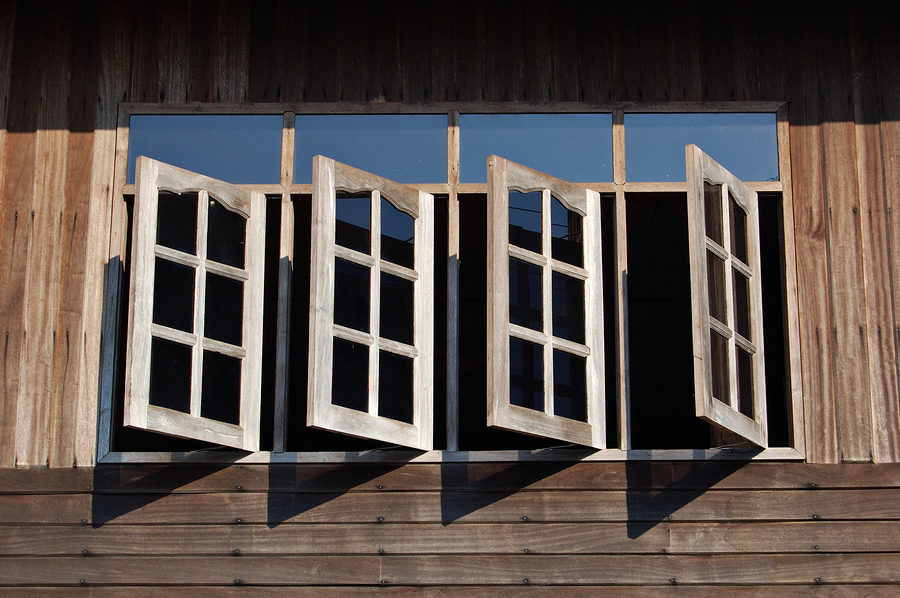
“June 21. … The warmest day yet. For the last two days I have worn nothing around my neck. This change or putting off of clothing is, methinks, as good an evidence of the increasing warmth of the weather as meteorological instruments. I thought it was hot weather, perchance, when, a month ago, I slept with a window wide open and laid aside [it] a[s] comfortable, but by and by I found that I had got two windows open, and to-night two windows and the door are far from enough.” ~ June 21, 1853

No Matter How Many Windows Open...

No Matter How Many Windows Open…

I shook my head. Here we were, sharing the same discomfort, across the span of 161 years. No matter how many bedroom windows we’ve opened, they’ve done nothing to bring us relief. The times, they are not a-changing. This painted a picture of Henry Thoreau that I had not thought of before. The naturalist, the writer, the surveyor, the saunterer, the philosopher? Sure. Someone who lies awake on a steamy summer night and considers the relationship between the rising temperatures and how much clothing a person is wearing? No. But it’s certainly an interesting image. Then again, what else could he do under the circumstances? He didn’t have a computer for entertainment, where he could check his e-mail and what his Facebook friends were doing at midnight.

Alas, Henry. I suspect we will have more of these unbearable and sleepless nights in the next three months. I’ll think of you again whenever the act of opening two windows and a door isn’t enough to cool the bedroom.