Author Archives: Sandy Stott

May the Forsythia Be With You

Okay, cheap the title may be. But spring begins in the mind, takes hold as attitude, enabled, of course, by the rising light.

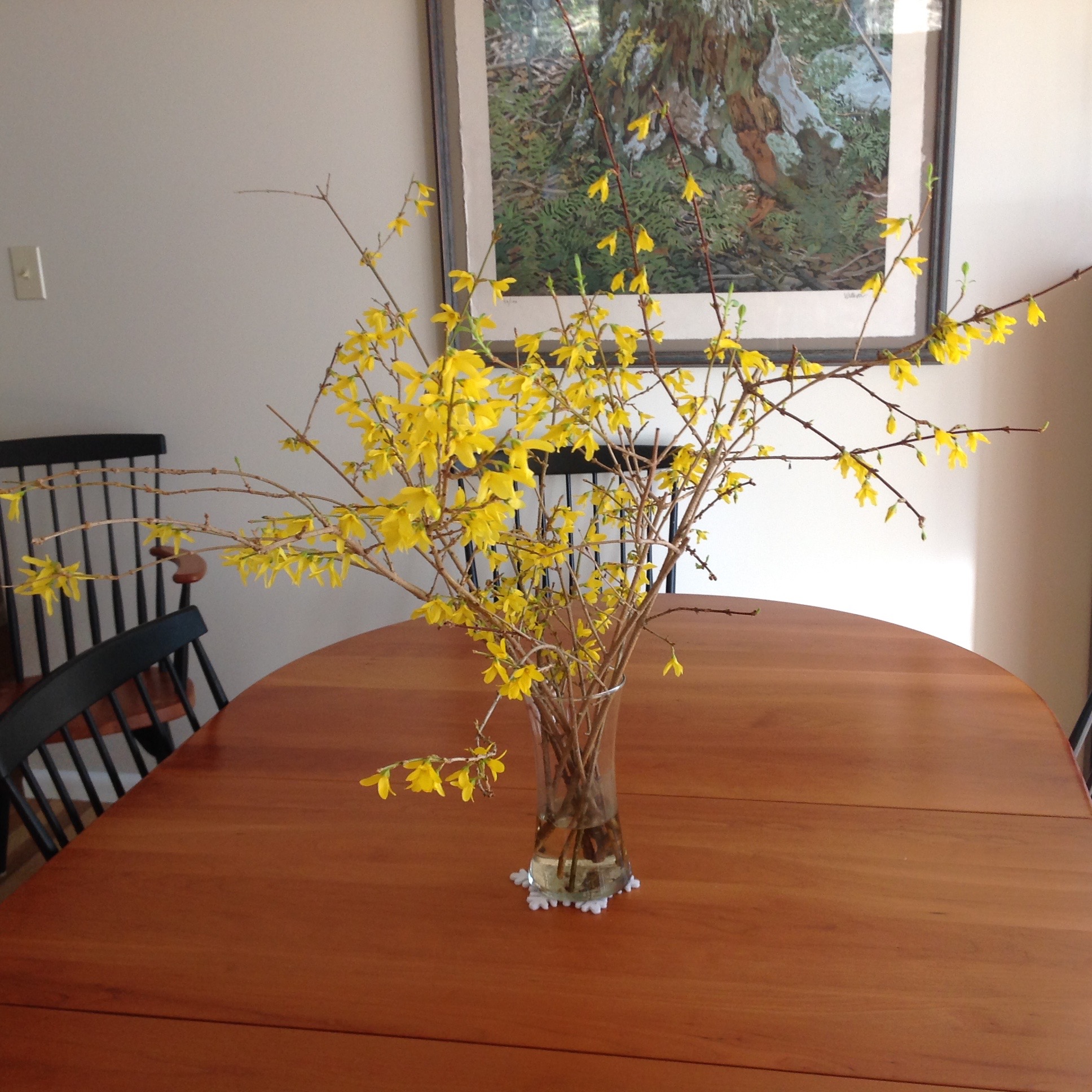
During the past few days, the temperature hasn’t reached thirty, and much of the time, its cold nose has found a way through any opening. Still, the first forsythia have bloomed. Yes, these yellow sprays are really forced-sythia, a rite of spring learned from my father, and one that in many years (last, for example) has had me hip deep in snow, cutting sprigs with my clippers.

IMG_1054

This year, I strolled right up to the wiry branches and took my time choosing those that showed a good number of buds. Then, I set them in a vase of warm water, and along with the rest of the watching world, began to wait. Even in their spare winter form, the branches are handsome, describing curves in the air, reaching for what’s next.

And in their incremental, daily swelling, the buds offer reminder of rebirth. This year, the light joins them; it falls in streaks across the dun colors and lifts the heads of a few winter-flattened ferns in pockets of woods. The glare of reflected, eye-squinting white is absent – last winter was so bright, I had often had to look away. And, by this time in March last year, many of us were trying also to get away.

But here, gift of El Nino, or warning from climate, or simply, gift, comes spring and its varied arrivals. For me true spring will arrive with the scratchy song of the redwing blackbirds, as they celebrate every wetland, little and large, with announcement.

But, for now, I’ll take these little, yellow blossoms. Sure I am with me the force-sythia is.

Seeding the Breeze

Their gray stalks stand still at attention. Even after winter’s varied batterings, many of them are intact, though closer inspection finds the ground littered with remnants too. On this sunny, early March morning when winter seems to have given up on itself, the southwest breeze brings scent of ocean, and it stirs also these milkweeds. As I watch, a finger of air finds one brown seed suspended beneath its silky white parachute, and the whole ensemble lifts off; at eye-level, it sways in place, seems to hesitate, then it flies upfield, with the wind.

All across this small forest-girt meadow, this flight happens again and again, and sometimes the air seems seeded with a snow that rises, that aims to ascend again to the sky. I am mesmerized by the flight of seeds. Also by their promise.

I let one go, and it rises slowly and uncertainly at first, now driven this way, then that, by invisible currents, and I fear it will make shipwreck against the neighboring wood. But no; as it approaches it, it surely rise above it, and then feeling the strong north wind, it is borne off rapidly in the opposite direction, over Deacon Farrar’s woods, ever rising higher and higher, and tossing and heaved about with every fluctuation of the air, till at fifty rods off and one hundred feet above the earth, steering south — I lose sight of it. Thoreau, Faith in a Seed

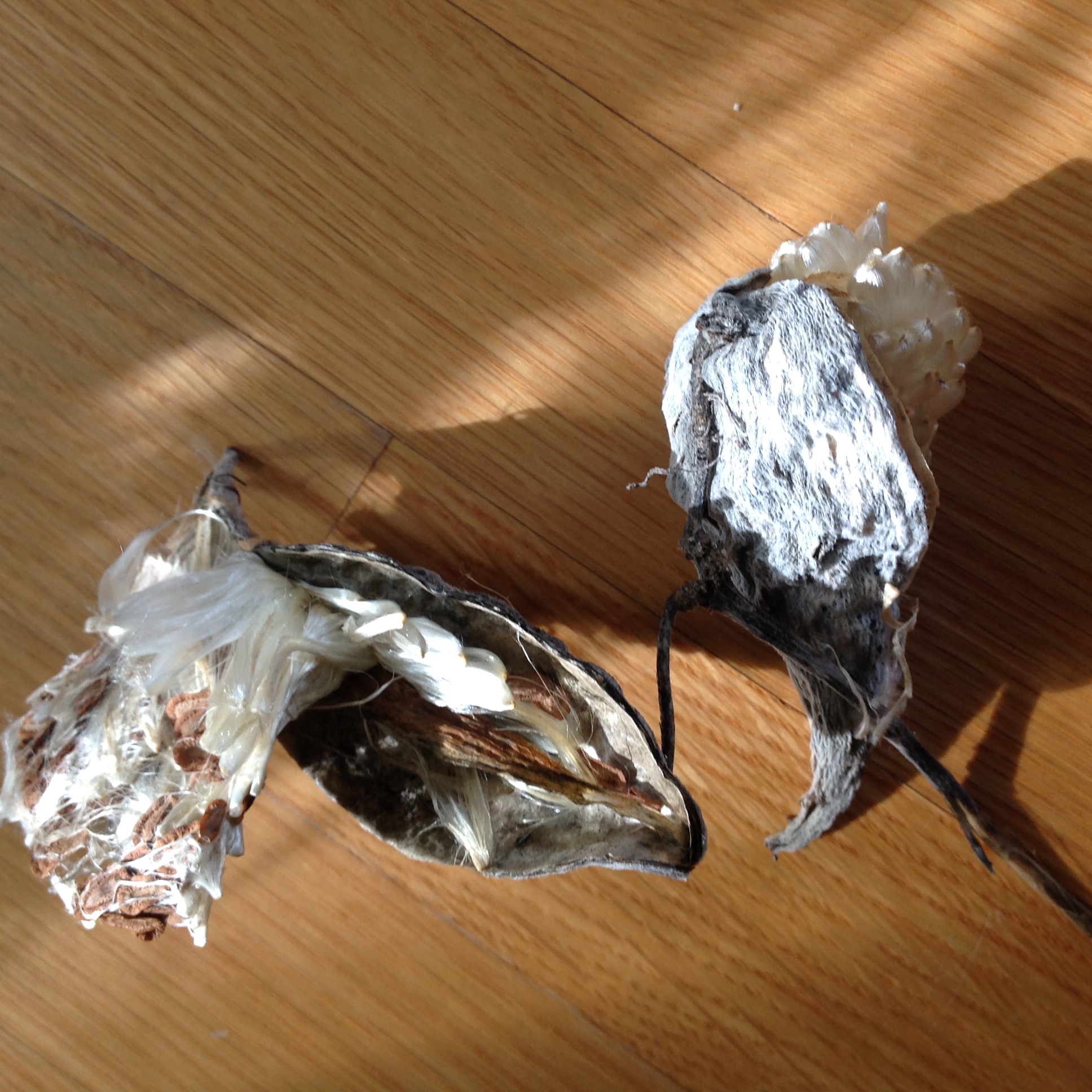
When I left for home, I took with me two pods, one with its silky seed-strands matted by winter snow and water, the other seemingly just burst. Along the way a few seeds floated away – I was, intentionally for a while, one of Nature’s dispersers. I was also drawn by the colors of the pods, a driftwood-pale-gray, against which the white seed strands glowed, and the dark brown heart of seed suspended below. A perfect composite of earth and sky.

Thoreau observed milkweed seeds closely, and, of course, counted them too, finding 134 in one pod and 270 in another.

Thoreau observed milkweed seeds closely, and, of course, counted them too, finding 134 in one pod and 270 in another.

Despite its weedy surname, milkweed is no throwaway plant. Not, anyway, if you like the monarch butterfly. Preferred food and nursing-station for the larvae of these remarkable migrant butterflies, milkweeds have long been under human attack for their seeming uselessness. They are no “crop,” goes the reasoning, so why cede field-space to them?

But if your crop is beauty and miracle, if, in short, your crop is life, then you will admire the milkweed. Not only do its seeds fly finely on the wind, but they enable also the multinational life of the monarch. Reason enough to praise rather than poison the milkweed.

And as often happens with sightings while I walk, these milkweeds have sent me back to readings, both on line and in Faith in a Seed, Brad Dean’s remarkable “first publication of Thoreau’s last manuscript” in 1993. It is the finest kind of spring reading.

Here’s an excellent University of Minnesota website for Monarch Questions: http://monarchlab.org/biology-and-research/ask-the-expert/faq/

On Edge – Little Mysteries in Thoreau’s Journal

The knife I use to open the still-joined pages in my edition of Thoreau’s journal comes from Durango, Colorado; more precisely, it comes from a trail that winds above the town into the mountains. There, one morning as we walked up, finding our way eventually to a 12,000’ high point, I noticed anomaly packed into the reddish dirt; a flat, black stone, I thought. As I bent to look, I saw patterning, which resolved as the incised side of a 5-inch buck-knife. I dug it out, looked instinctively around for the owner, and, seeing no one, pocketed my find. No one else had been there for weeks.

That evening, I cleaned the knife, washing away the grit, scrubbing the blade, which soon shone dully, even as it held a fine edge. It became my trail-knife, both in the hills, and along the long reach of Thoreau’s uncut journals. If I look closely, I can still see the red dirt from that long-ago trail lining the cross-hatchings on the knife’s side.

Over time, I’ve come across a few other incisions as I’ve dropped like some small, literary paratrooper into this journal or that. A few whole pages have been sliced from this 1906 edition, and, of course, that has made me curious. The writer from whom I received these books struck me – though I knew her only a little – as a preserver. She had been a local newspaper editor and historian, and, when people wanted an answer to a town question from the past, they were likely to hear, “Go ask Eleanor. She’ll know.”

Each week, Eleanor would write a column about some local evolution, and each week, my wife, who edited the paper, would stop by to collect that column. Eleanor seemed to lead an interior life at that time, and most often the column, typed with the old Courier font, would be in a basket in the entryway to her house. Still, some connection must have formed, because one spring, books in boxes began to accompany the columns. And one of those boxes – two actually – held the 1906 edition on Thoreau’s journal and published works.

Some of the books that contributed to Thoreau's journals. Henry's Walden Pond library.

Some of the books that contributed to Thoreau’s journals. Henry’s Walden Pond library, as on display in the Special Collections at the Middlebury College Library.

Some years passed before I noticed the first missing page; its cut was straight and clean. It had been careful work. I had, by that time, devised my own cutting ritual, using my found buck-knife for the joined pages in sections Eleanor and whoever had owned these books before hadn’t opened. If I took care and drew the blade steadily toward me and down the seam, the paper parted so each page matched. If I hurried or even turned my head a little toward distraction, the paper would tear into ragged edges, though most of the time the generous margins left the writing intact. Still, each poor cut felt like injury.

But this excised page puzzled, and I looked into it. Research brought a few fantastic moments: might I have, as gift, one of the 600 Manuscript Editions, the 1906 printing that bound in a page of Thoreau’s original journal to each 20 volume set? I sat back in a little dream of discovery’s edge.

Well, no. Those editions were numbered; mine was not. A quick search on line shows that copies of the Manuscript Edition are still out there for sale…if you have roughly $20,000 to spare. My edition, the Walden Edition, clearly issued from a usual print run, part of a broader stream of publication, and a pencil notation suggested that Eleanor had acquired it in 1987, for the meager sum of $25. What then had been cut cleanly out? I would have to find out when I next met this set of books in some other library.

Still, this gift edition carries forward, offering affirmation and surprise. And, as further reward, during my sleuthing, I’ve reread Emerson’s unadorned and adoring introductory pages, his eulogy for Thoreau; its simple sentences pointed simply, admiringly, to genius in the pages ahead. To someone a cut above.

Link to Atlantic Monthly archive of the original publication of Emerson’s eulogy in 1862: http://www.theatlantic.com/magazine/archive/1862/08/thoreau/306418/