Category Archives: News and Events

On Edge – Little Mysteries in Thoreau’s Journal

The knife I use to open the still-joined pages in my edition of Thoreau’s journal comes from Durango, Colorado; more precisely, it comes from a trail that winds above the town into the mountains. There, one morning as we walked up, finding our way eventually to a 12,000’ high point, I noticed anomaly packed into the reddish dirt; a flat, black stone, I thought. As I bent to look, I saw patterning, which resolved as the incised side of a 5-inch buck-knife. I dug it out, looked instinctively around for the owner, and, seeing no one, pocketed my find. No one else had been there for weeks.

That evening, I cleaned the knife, washing away the grit, scrubbing the blade, which soon shone dully, even as it held a fine edge. It became my trail-knife, both in the hills, and along the long reach of Thoreau’s uncut journals. If I look closely, I can still see the red dirt from that long-ago trail lining the cross-hatchings on the knife’s side.

Over time, I’ve come across a few other incisions as I’ve dropped like some small, literary paratrooper into this journal or that. A few whole pages have been sliced from this 1906 edition, and, of course, that has made me curious. The writer from whom I received these books struck me – though I knew her only a little – as a preserver. She had been a local newspaper editor and historian, and, when people wanted an answer to a town question from the past, they were likely to hear, “Go ask Eleanor. She’ll know.”

Each week, Eleanor would write a column about some local evolution, and each week, my wife, who edited the paper, would stop by to collect that column. Eleanor seemed to lead an interior life at that time, and most often the column, typed with the old Courier font, would be in a basket in the entryway to her house. Still, some connection must have formed, because one spring, books in boxes began to accompany the columns. And one of those boxes – two actually – held the 1906 edition on Thoreau’s journal and published works.

Some of the books that contributed to Thoreau's journals. Henry's Walden Pond library.

Some of the books that contributed to Thoreau’s journals. Henry’s Walden Pond library, as on display in the Special Collections at the Middlebury College Library.

Some years passed before I noticed the first missing page; its cut was straight and clean. It had been careful work. I had, by that time, devised my own cutting ritual, using my found buck-knife for the joined pages in sections Eleanor and whoever had owned these books before hadn’t opened. If I took care and drew the blade steadily toward me and down the seam, the paper parted so each page matched. If I hurried or even turned my head a little toward distraction, the paper would tear into ragged edges, though most of the time the generous margins left the writing intact. Still, each poor cut felt like injury.

But this excised page puzzled, and I looked into it. Research brought a few fantastic moments: might I have, as gift, one of the 600 Manuscript Editions, the 1906 printing that bound in a page of Thoreau’s original journal to each 20 volume set? I sat back in a little dream of discovery’s edge.

Well, no. Those editions were numbered; mine was not. A quick search on line shows that copies of the Manuscript Edition are still out there for sale…if you have roughly $20,000 to spare. My edition, the Walden Edition, clearly issued from a usual print run, part of a broader stream of publication, and a pencil notation suggested that Eleanor had acquired it in 1987, for the meager sum of $25. What then had been cut cleanly out? I would have to find out when I next met this set of books in some other library.

Still, this gift edition carries forward, offering affirmation and surprise. And, as further reward, during my sleuthing, I’ve reread Emerson’s unadorned and adoring introductory pages, his eulogy for Thoreau; its simple sentences pointed simply, admiringly, to genius in the pages ahead. To someone a cut above.

Link to Atlantic Monthly archive of the original publication of Emerson’s eulogy in 1862: http://www.theatlantic.com/magazine/archive/1862/08/thoreau/306418/
How (Now) We Vote

“Cast your whole vote, not a strip of paper merely, but your whole influence.” Thoreau, Civil Disobedience

Here in Maine, we near caucus, even as others across the country turn to (or look away from) their primaries. The long, at times, colorful, overflight of hot-air balloons that precedes this actual choosing of balloonists is over. Now, which to pick? How to give that choice a semblance of weight?

Whenever I vote, Henry Thoreau comes to mind, in part because the approach to voting, if one cares, seems to me infinitely complex. But then it simplifies to a “strip of paper.” I must choose one name.

In Maine we express primary choice via that awkward verb, “to caucus,” which the little meaning-checker in my mind invariably switches to “carcass.” Which connects again with Thoreau, who advises that we do more than scratch an X on paper, that we “cast [our] whole vote,” throwing some weight of action and effort behind that vote. Thoreau asks then that we vote with our bodies or…yes, you see it coming…we caucus with our carcasses.

All right, I have had my little fun with the little trickster of language, but what about the weight of voting? Is there a weight and weightiness that surrounds voting, even in this era when the average citizen with her or his average voice feels diminished? Are we making any mark when we vote?

My mind leaps to another weighty moment, and I am reminded of another being (of sorts; also familiar to Thoreau) that scratched its mark across the landscape, leaving sign of its passage and preferred direction.

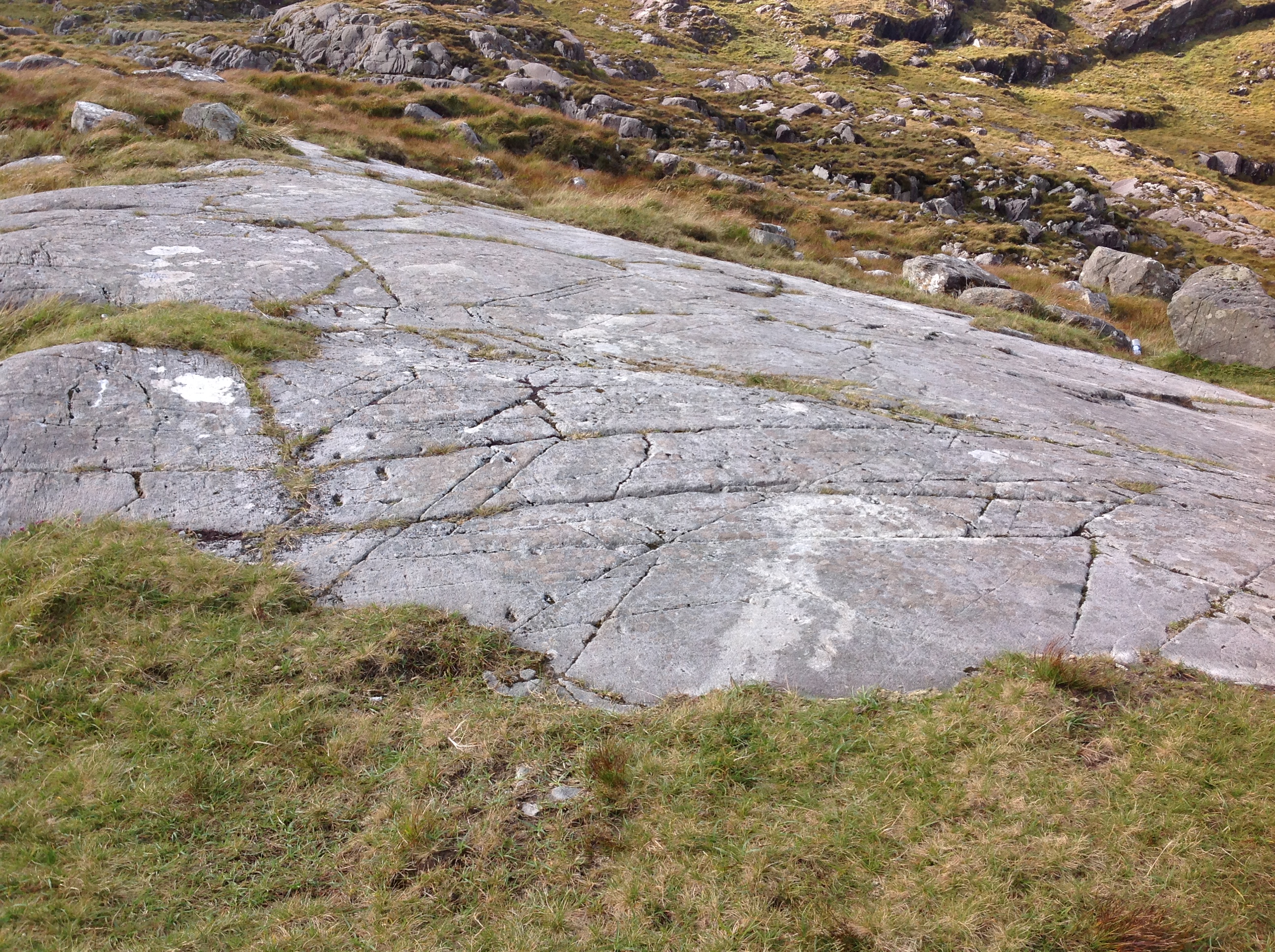
Long before we began making our marks on this land, the glacier scraped over our region, and, where bedrock’s exposed, we find its signs. How did they get there? The ice, in places thousands of feet thick, carried within it innumerable stones, and those on the bottom surface acted as little gouges on the bedrock that stayed put. Each stone that made its mark was a voice of sorts: “I was here and went this way.”

And, as I vote, I imagine myself as a little stone too, one for now at the place where the body politic grinds over bedrock; I make my mark. And then the glacier politic moves on.

Ice votes

Ice votes

I know Thoreau had in mind much more agency than that; his heroic “I” could, in his mind, throw his weight about in ways that made voting on a “strip of paper” seem trifling. That is the argument of being Civilly Disobedient.

But for this post, I’m wondering about the Xs of voting, and whether this – “Cast your whole vote, not a strip of paper merely, but your whole influence” – still feels possible, whether you or I, the average Jo or Joe today, is more than a little scratching stone? That seems a voting season’s question.

Looncast

One of the wired life’s pleasures lies in suddenly being taken elsewhere, or, at least, reminded of it. Just so the other day when my inbox brought news from Yellowstone; it promised loon news to boot.

As the poet Gary Lawless notes in these perfect lines from his poem, Listening for Loons,

“like loons we dive under
dive under and
come up somewhere else.’”

And so I leaned forward to see where this loon might rise, where I might come up. The indicator-ripple was one line: “Click on To Catch a Loon when you have 11 minutes.”

Can loons hold their breath for 11 minutes, I wondered as I checked my watch, where I found that I didn’t have 11 immediate moments. “Later,” I said…and worried vaguely that the note might not be there when I returned – that both is and isn’t the way with loons, I’ve found.

In the warmer seasons, when yearlings are along the summer coast, or, in the fall, when parent-loons show up too, I often find gatherings, 4s or 7s of them at predictable sites along my kayak-trails. Then again, every third time, there’s no one there, and I’ve stopped counting the times when, out in the middle of absence, I hear a floating call. For which I always stop and begin scanning the wavelets and reflections until I spot the loon.

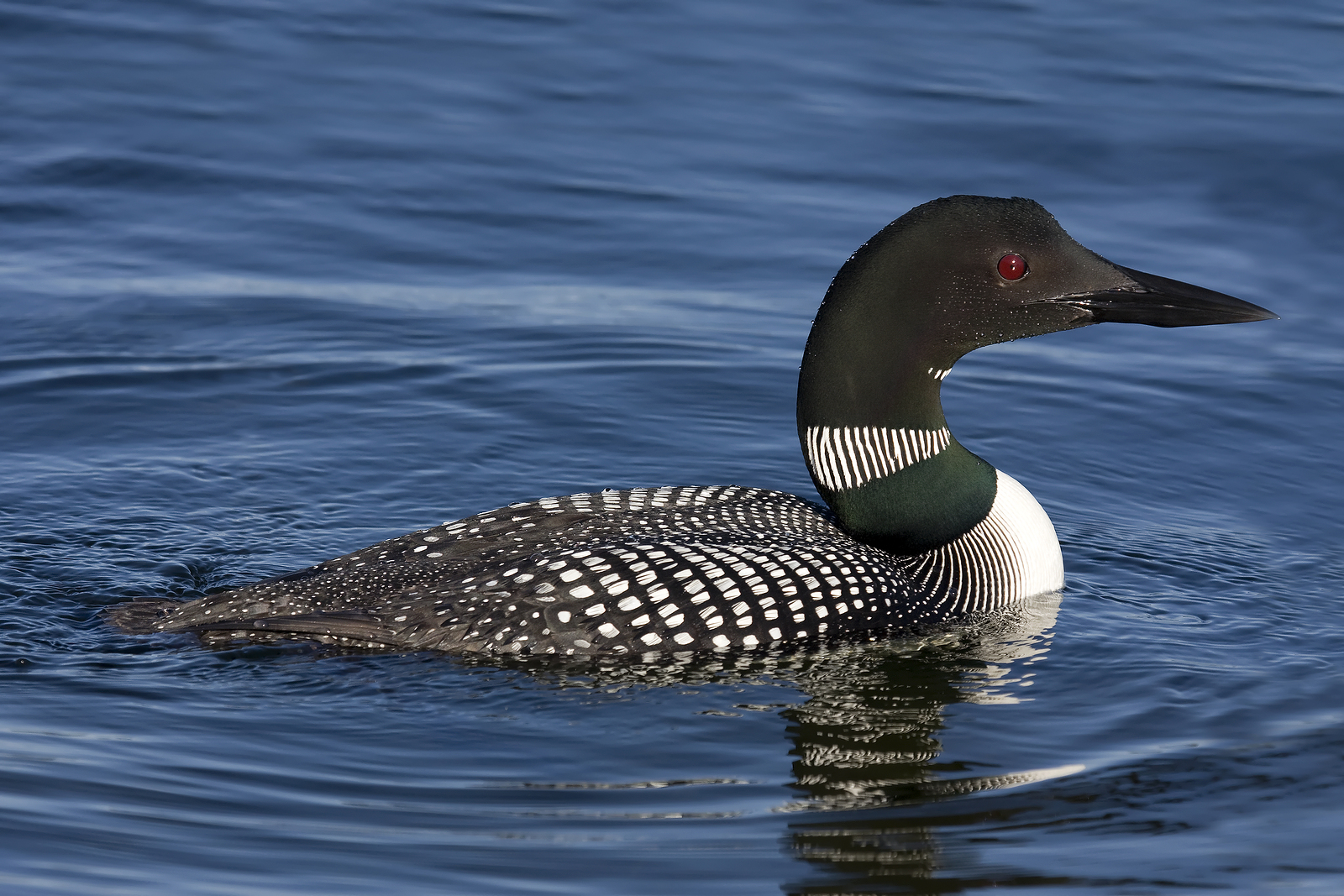
In a warmer season.

In a warmer season.

Eleven unspoken-for minutes appeared yesterday, and I clicked the link, feeling the imagined Gs warp me some as I was drawn toward Yellowstone. A call/howl greeted me; a voice intoned that I was hearing a “top predator.” Okay, wolf, I was sure. Then, the podcast morphed to the call of another “top predator”: ah, loon, of course. Boss bird of the lake.

A little rock music followed, to remind me that all life has a soundtrack, and then the narrator’s voice took me into the nights: specifically into the night woods trekking toward the night lake, where loon biologists would attempt the night capture and banding of a mother loon, one of only a dozen loons living in the park.

One of the biologists was loon-notable, Jeff Fair, a friend whose 40+ years of fieldwork form an important part of our loon-knowing. Fair would also be the night-paddler, who would steer the canoe to the loon-catching point – who paddles so precisely and quietly, arriving alongside a bird that Henry Thoreau (famously) could only laugh with from an always-different distance during his loon-games on Walden? Loon-master Fair.

Well, if you’ve read this far, it’s clear that you have 11 minutes to spare; what about another 11? Click this link for a little travel and some looning; send it on to the varied birds of your life. They will like you for it.

http://www.nps.gov/yell/learn/photosmultimedia/telemetry.htm

Best news: these 11 minutes contain a little audio-tutorial on making baby loon calls, which are central to the strategy of capturing a loon at night. Those calls lure the loon, and they will be a rich replacement for the poor imitation of Loonish that I have so far voiced when trying (repeatedly, I confess) to strike up conversations. When no one else is here, I have begun practicing already.

Already, I sense summer answer.

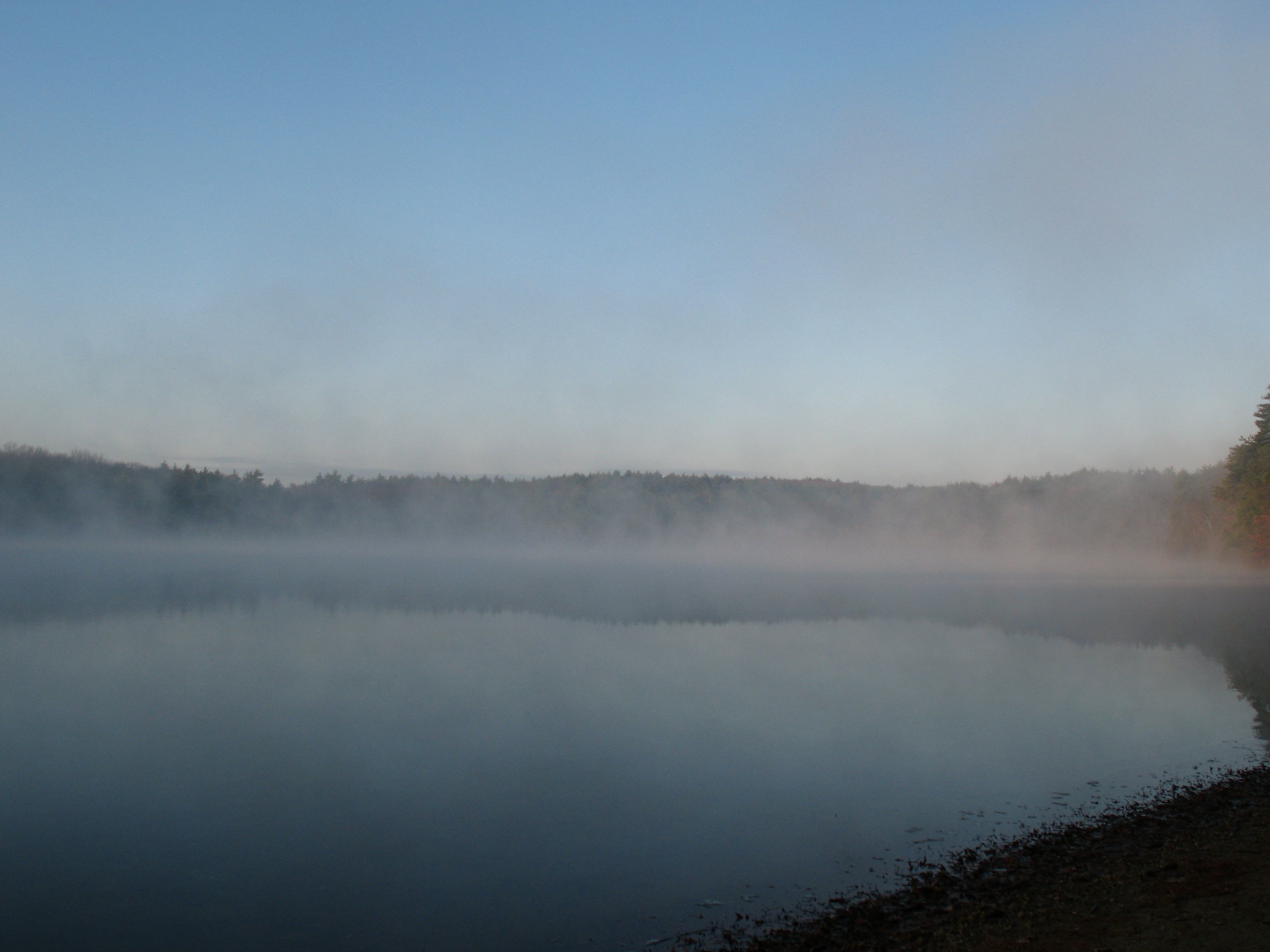
A loon out there in the Walden mist?

A loon out there in the Walden mist?