
Category Archives: Literature

Noticing Nests

By Corinne H. Smith

“Mr. Stewart tells me that he has found a gray squirrel’s nest up the Assabet, in a maple tree. I resolve that I too will find it. I do not know within less than a quarter of a mile where to look, nor whether it is in a hollow tree, or in a nest of leaves. I examine the shore first and find where he landed. I then examine the maples in that neighborhood to see what one has been climbed. I soon find one the bark of which has been lately rubbed by the boots of a climber, and, looking up, see a nest. It was a large nest made of maple twigs, with a centre of leaves, lined with fiber, about twenty feet from the ground, against the leading stem of a large red maple. … There was quite a depth of loose sticks, maple twigs, piled on the top of the nest. No wonder that they become skillful climbers who are born high above the ground and begin their lives in a tree, having first of all to descend to reach the earth. They are cradled in a tree-top, in but a loose basket, in helpless infancy, and there slumber when their mother is away. No wonder that they are never made dizzy by high climbing, that were born in the top of a tree, and learn to cling fast to the tree before their eyes are open.” ~ Thoreau’s journal, April 22, 1860

Gosh, Henry. I guess early spring would be a decent time to search for nests, especially if you hope to find brand-new offspring. But I prefer mid-winter, when the nests are empty. In fact, I think this is one of the joys of the season. Right before our eyes, Nature has unveiled evidence of random spring and summer residences. Months ago everything was hidden by leaves and shrubbery. Now the curtain has been lifted and we can see back stage. The sight reminds me of a better known Thoreau quote: “The Universe is wider than our views of it.”

These days, I delight in walking and driving around the countryside. I scrutinize each lacy silhouette against the white winter sky, looking for a clump or knot. The first one I noticed was the robin’s nest in our front yard. It lay next to the utility lines, a few branches away from the place where they had built one the previous year. They may have even taken some of the material from the old nest to make the new. But how did it ever stay in place, wedged between only a few young cross shoots? Their engineering skills amaze me.

nest1

This cup of interwoven twigs and grasses was vital when it once held a parent bird, eggs, and then nestlings. But it was only necessary for raising the kids. When everyone could fly, they left. Now that architectural marvels like this are open to the wind and to all kinds of precipitation, they’re beginning to fall apart. Eventually they’ll just disappear into the fabric of our local habitat. This is Life. This is Nature.

I spied a tiny nest in my neighbor’s bushy roadside border. Who had lived in it? I wondered. Many of us had walked within inches of it on our way to the grocery store up the block. No one saw it then. Sadly, I suspect that not many of the passers-by see it today, either.

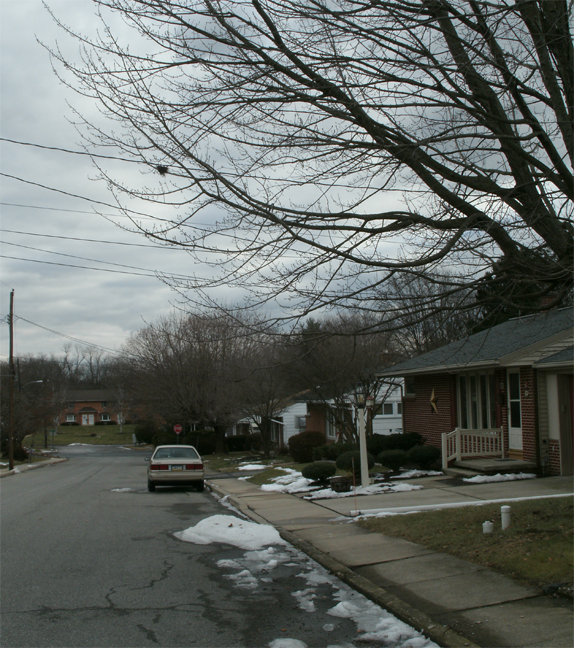
A tall sugar maple down the street stretches itself high across our road. Now we can spot a small nest sitting on one of those overhanging limbs. Every one of us drove beneath a bird family every day without realizing it. What a wonderful sight it is now! But how did those guys ever hang on in a storm?
nest3

Then there was my major discovery while raking up leaves in the backyard. Pausing in my task to look up, I saw a large and leafy squirrel nest perched near the top of our white pine. (Unfortunately, it doesn’t photograph well, even though it is clear enough to the naked eye.) These critters sure are smart, building their condo right next to an oak tree that can supply them with an almost endless supply of acorns. Now I know why I’ve seen so many fuzzy gray bodies bounding across our back yard lately. We are co-boarders of this property.

Seeing these nests has led me to consider minimalism. These animals need only a few basic resources to survive. Compare their homes to our own, filled with clutter and crap. Do we really need so much stuff? Probably not.

I suppose we could learn a lot from the birds and the squirrels, and from the other feather- and fur-bearers we share this planet with. All is takes is the sight of an old nest in a tree to get me thinking.
Borne Along

“Skated to Baker Farm with a rapidity which astonished myself, before the wind, feeling the rise and fall – the water having settled in the suddenly cold night – which I had not time to see…a man feels like a new creature, a deer, perhaps, moving at this rate…I judged that in a quarter of an hour I was three and a half miles from home without having made any particular exertion, – à la volaille.” Journal 1/14/1855

And that seems just the expansive note to counter winter’s deepness, where often we read and feed our way from afternoon’s light and evening’s dark. Today that deepness burrows in as cold of the nose-webbing, frost-feathery sort. At first light it was 10 below zero, and the rhododendron leaves were curled in tightly on themselves like so many little cigars; the birds were boisterous at the feeder: fill it again, they seemed to say. The snow looked confident in its new blue shadows.

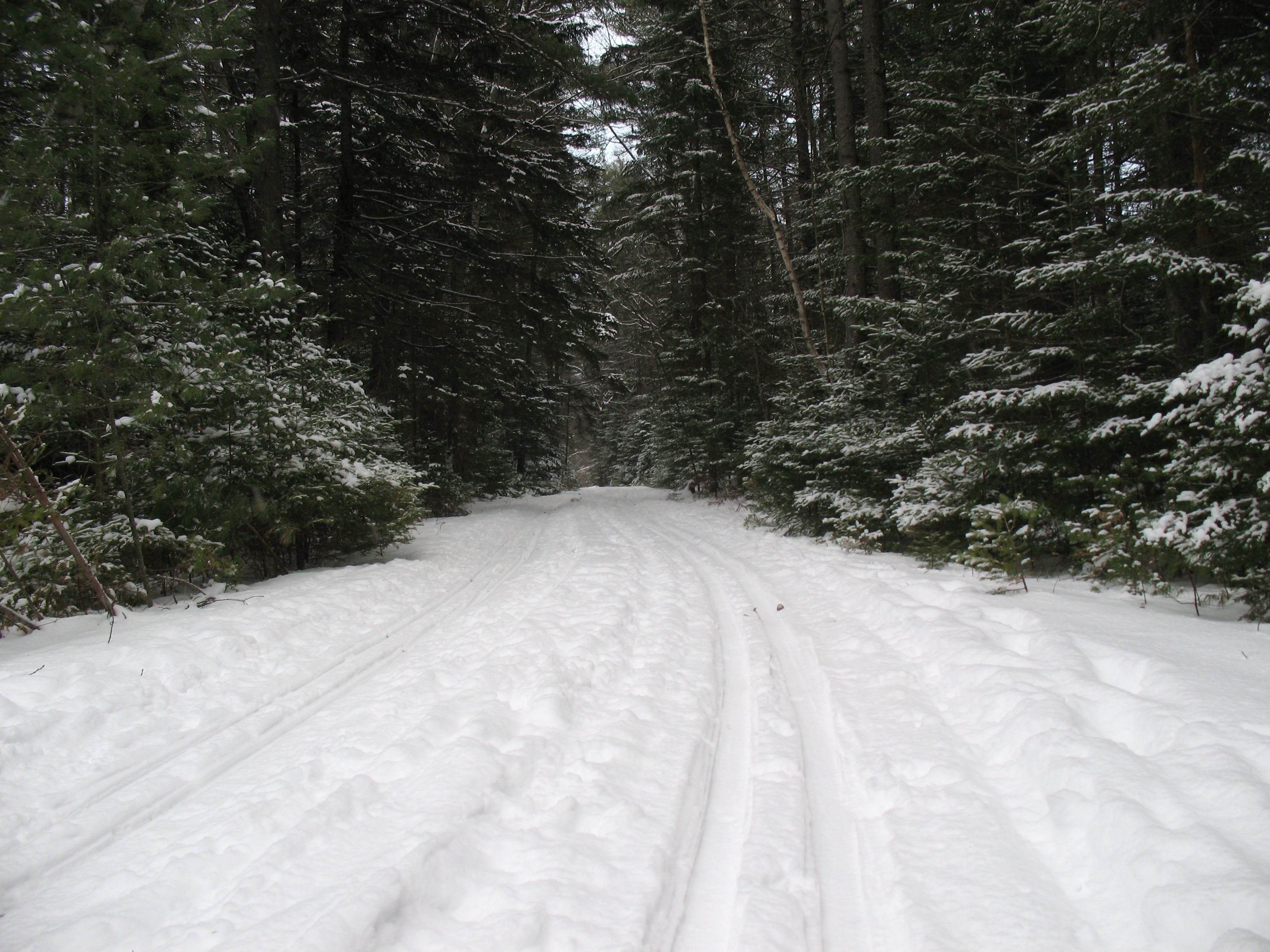
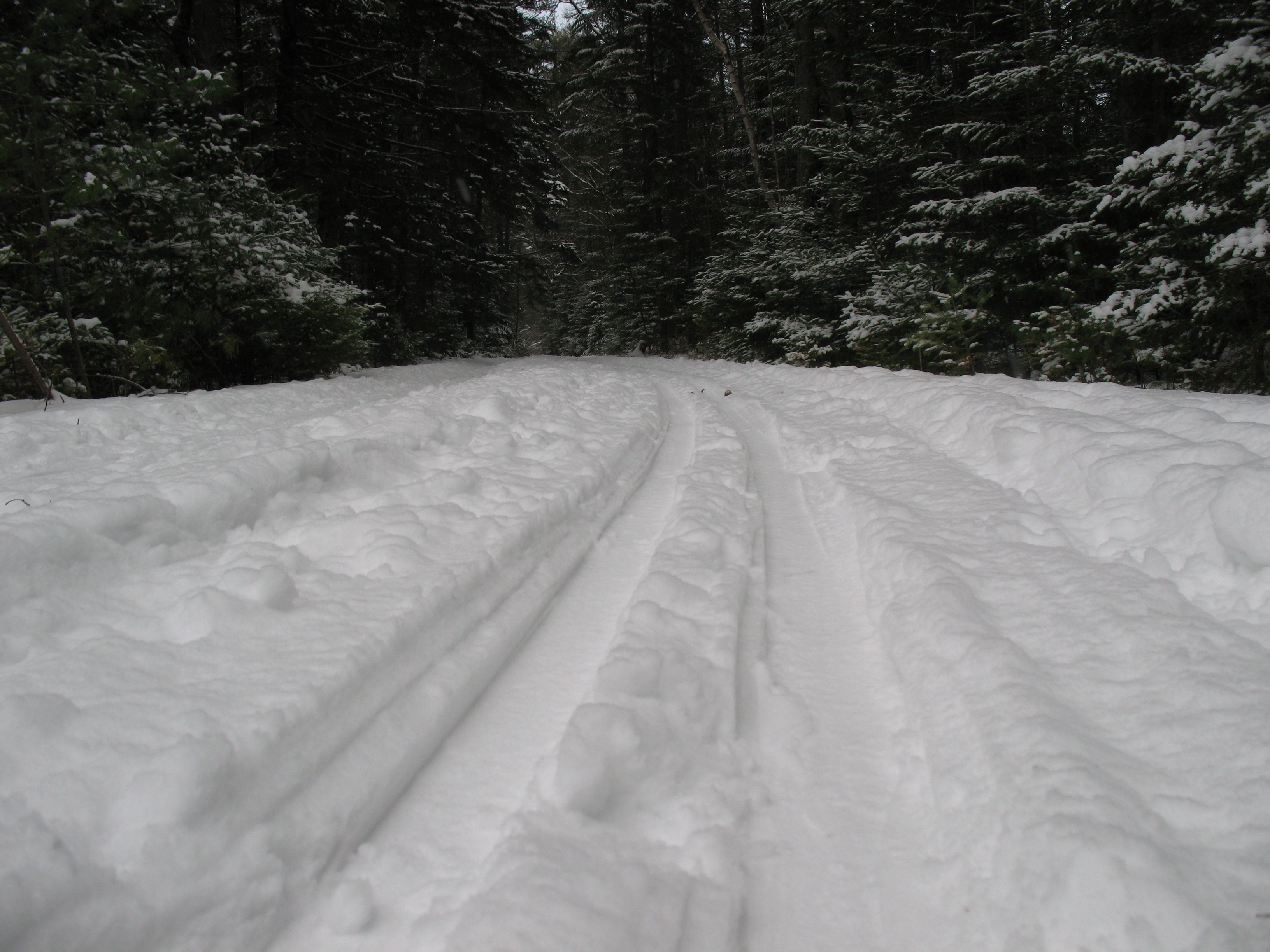
By noon, however, a gray lid had slipped over the sky, and, as I streaked wax on my x-c skis, the light was flat. I would ski down a narrow woods road to the edge of a tidal marsh, and then run along its flank to the tundra of a local golf course, where I would loop back to my start-point. Cross-country skiing, like its cousin, skating, depends upon a mix of traction and slipperiness. On a good day the way the snow crystals impress themselves upon your skis’ waxed bottoms creates just enough bond to allow you to push off; then your ski glides forward over the glassy crystals. And then you press down your ski and kick off a next stride. And a next. When all is well with this subtle bond-and-glide between wax and snow, you fairly float along the surface, warmed by the effort and aware only of the cold by way of the wind you generate in passage.

So too the edged grab then glide of skating (which has, or course, become its own form of x-c skiing, though my skis are the classic sort).

The Way Out

The Way Out

There are, of course, other days, ones of slippery labor, when there’s no bond and you flounder in place. Or there’s so much bond that the snow clumps to your skis and you are reduced to lumpen-footed walking of the most awkward kind – imagine no toes on your six-foot feet.

But let’s live in today’s ease of flotation over snow, traverse this bit of winter borne up on a surface that must be as close as we ever get to walking across the tops of clouds.

“Without having made any particular exertion, – à la volaille,” as Henry said.

Atop clouds of snow

Atop clouds of snow

Listening Along the Way

Every so often, events, or words, fall and align themselves just so. You may be muddling along amid the little collisions of a day, making a mess of this or that, when you are taken over by a moment of grace, when, after a moment, you look out and say, “that is, or sounds, as it should be.” Part of what has kept me attending to Henry Thoreau over time is his habit of finding and recording such moments; he teaches me to be alert for the same.

And so it was that during a recent holiday drive from family to family, we slipped a disc into the car’s audio system and began to listen to a recorded essay sent my way by a teacher-friend some months before. The silvered disc had been in the car all that time, but I am slow to change habits, and I’d never adopted the one of listening to prose on tape or disc. Slow study, I know. Let’s just say that the delay in listening to Franklin Burroughs read his essay Compression Wood made it all the more pleasurable.

Summarizing Burrough’s essay – 52 minutes in reading – is beyond the scope of this post, but I want to both recommend it and think a bit about a moment early in the piece. Here’s the moment:

“It probably doesn’t make much difference whether you stay home or light out for the territories. Even Thoreau, who strove to shrink the gap between vocation and location to the disappearing point, often felt, as he said, ‘a certain doubleness, by which I stand as remote from myself as from another,’ and that enabled him to see Concord as though it were a distant land from which he was writing home to a kinsman. Something about writing, or even about the committed kind of reading that is a vicarious form of writing, takes you well away from your life and makes you homesick for it.” – Franklin Burroughs, Compression Wood (first published in The American Scholar, Vol.67, No. 2, Spring, 1998)

Here, of course, is Henry Thoreau, whose spirit runs through the essay even as his name does not reappear. And there is the beauty of the phrased summary of Thoreau’s effort “to shrink the gap between vocation and location to the disappearing point.” But what compelled me was a full-body feeling of assent that to write or read well, to find your way to some truth, requires moving “well away from your life,” where you can then be “homesick for it.”

Yearning, it struck me, is a fine way to be awake to your life, which vibrates then like a plucked string. Every day when we write or read or walk, we create this distance. And then, with some luck and commitment, we find our way home. This seems a good way to aim toward the new year.

Added note: I’ve provided a link to a podcast of Burroughs essay, which contains a territory expansive and wonderful. It is a perfect companion when you are going somewhere.

Podcast link: http://www.bowdoin.edu/podcasts/audio/franklin-burroughs-compression-wood.mp3