
Category Archives: Henry David Thoreau

Songbirds at Creekside

By Ashton Nichols

The songbirds here are like nothing I have ever seen or heard, not when I lived in Virginia, or West Virginia, Maryland, Alabama, or London, England, or even at other locations in Pennsylvania. Bluebirds, scarlet tanagers, goldfinches, orioles, and more: the colors bust out like tiny sprays of rainbow, as bright as the sun, as clear as the sky. The songs are trilling and cool, thrilling and crackling, burbling and cackling. It must be that the wooded two-acre forest edge of our small Creekside farm creates a much-needed roosting and feeding spot in the middle of the wide-open swath of cultivated farmland that surrounds us here.
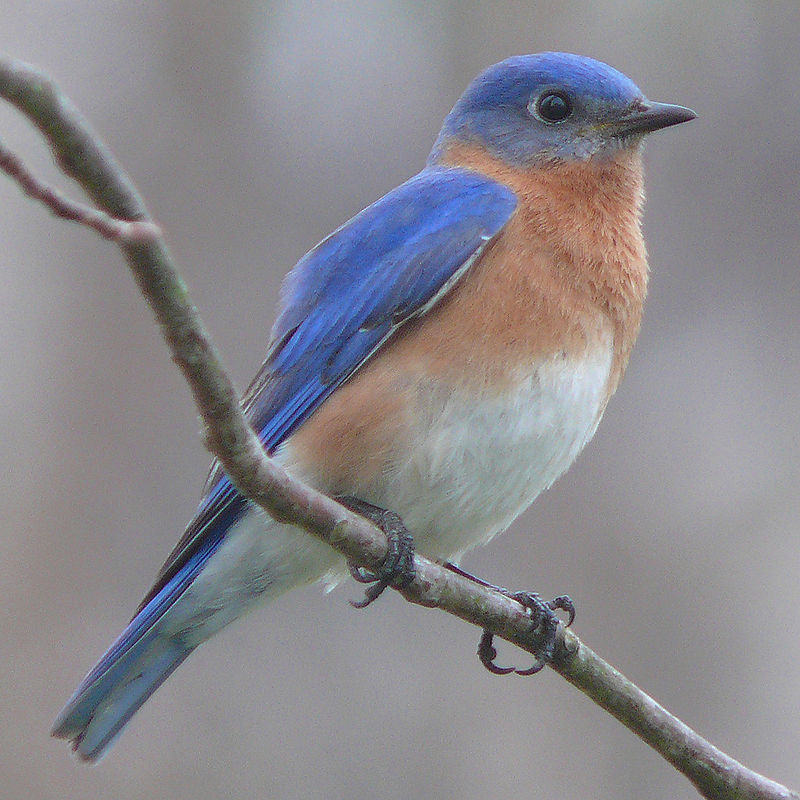
Bluebird

Bluebird

In his chapter in Walden entitled “Sounds,” Thoreau speaks of the birds close by on numerous occasions: of the birds who “sing around or flitted noiseless through the house,” while Henry sits in his “sunny doorway from sunrise till noon, rapt in a reverie, amidst the pines and hickories and sumacs.” Or he tells of the nearby tree branch that is “bending under the weight of the reed-birds flitting hither and thither,” of the sad sounds of the screech owl that remind him “sometimes of
music and singing birds; as if it were the dark and tearful side of
music, the regrets and sighs that would fain be sung,” and finally of the cockerel, our common rooster, which was once a wild pheasant–“This foreign bird’s note is celebrated by the poets of all countries along with the notes of their native songsters.” Thoreau is often wondering at birds of Walden Pond.

Here at Creekside, we are in the midst of several thousand acres of open space that stretch out to the east and to the west along the center of the Great Valley, with the North Mountain off in one direction and the much older South Mountain off in the other. This South Mountain, which rises near Mount Holly Springs, is renamed the Blue Ridge when it reaches West Virginia and Virginia. According to my geologist colleagues, it is one of the oldest mountain ridges in the world, almost three-quarters of a billion (750,000,000) years old. There were once mountain peaks here that rivaled the five-mile-high Himalayas, but they have been eroded and worn down over millennia to their current 2,000-2,500 foot height.

The wide-spreading oxbow of the Conodoguinet Creek twists its way through the valley here, with huge tree-filled circles, open plowed spaces, and scrub brush fencerows. There are lots of wide spaces of land with few trees at all, no trees for roosting or food spotting, no nesting holes or tree-close clearings for wild mating dances. So the songbirds come to our exceptional and unusual two-acres of Creekside trees; these birds come in their dozens: no, in their hundreds. On some mornings there are too many separate songs to count, too many different body styles to keep track of, and too many various feeding habits to follow.
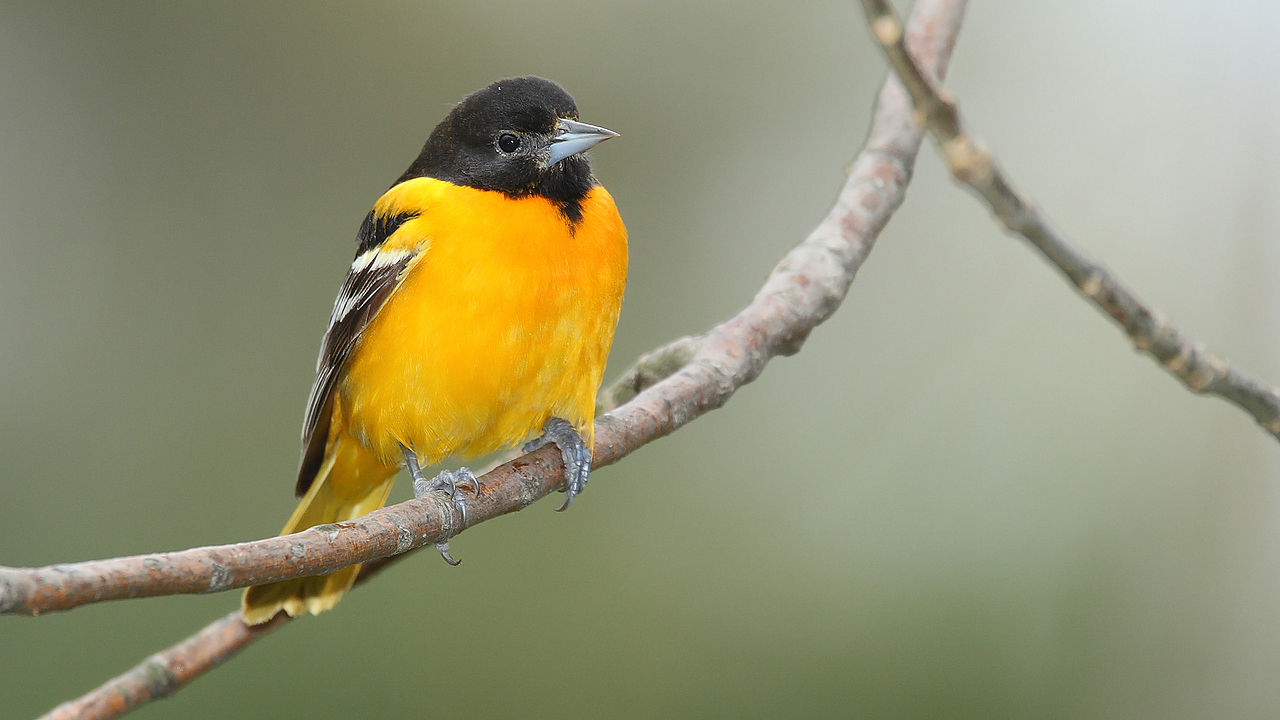
Oriole

Oriole

The oriole is by far the most startling of these songbirds, a veritable clown-bird, with a bright orange-yellow color that is just as bright as the brightest of Halloween pumpkins, then suddenly saturated with black stripes and splotches spread between the yellow-orange outbursts. Next come the bluebirds, not so much sky-blue as some secret Mediterranean blue or ocean blue–known only to world travelers–always one pair of these bluebirds at least, nesting in the small bark-sided bluebird nest tacked to the northwest side of the house. The male bluebird always perches out alone on a stalk of paradise tree that rises out of the abandoned fire circle, an overgrown scrub spot in the middle of the lawn.
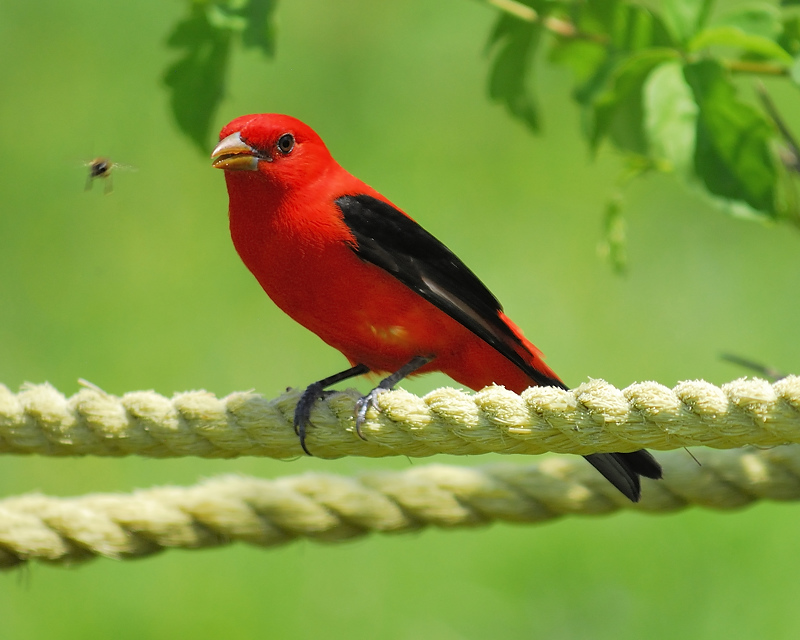
Tanager

Tanager

Then suddenly, the scarlet tanager flashes brightly, so brightly it is hard to believe this is a natural color, and then a third bluebird, and just as quickly comes a songbird’s call that I have never heard any version of, a new sound: fluty and liquid, delicately musical and very wild at the same time. And always, of course, there are swifts and starlings, blackbirds and sparrows, flycatchers, mockingbirds, and blue-jays, and even a massive red-tailed hawk roosting and hunting small mammals from the tall locust trees in the small woodlot behind us.
In Touch with the Past

Many of us read Henry Thoreau for the way he reaches forward from his world and touches our lives. In his journals, he often seems a conversant, albeit deeply learned, neighbor who has come over to tell us of his newest sighting or thought. But in his particularity, in the fine grains of his writing, Thoreau also enables his readers to touch the past, and thereby span more than just a lifetime.

A number of years back, we received a gift from an acquaintance who had reviewed books for the local paper my wife, Lucille, edited: the book-heavy box contained culls from an octogenarian’s library, but it was also clear that Eleanor Parkhurst was looking for a home for these particular books. I unpacked and found the central tenant of the box was a set of blue, hardcovers with lettering only on their spines. Thoreau’s Writings, it read, and my heart fluttered; they were twenty in total, and the title page gave me their provenance: this was Houghton Mifflin’s set of Thoreau’s writings, edited by Bradford Torrey, published in 1906.

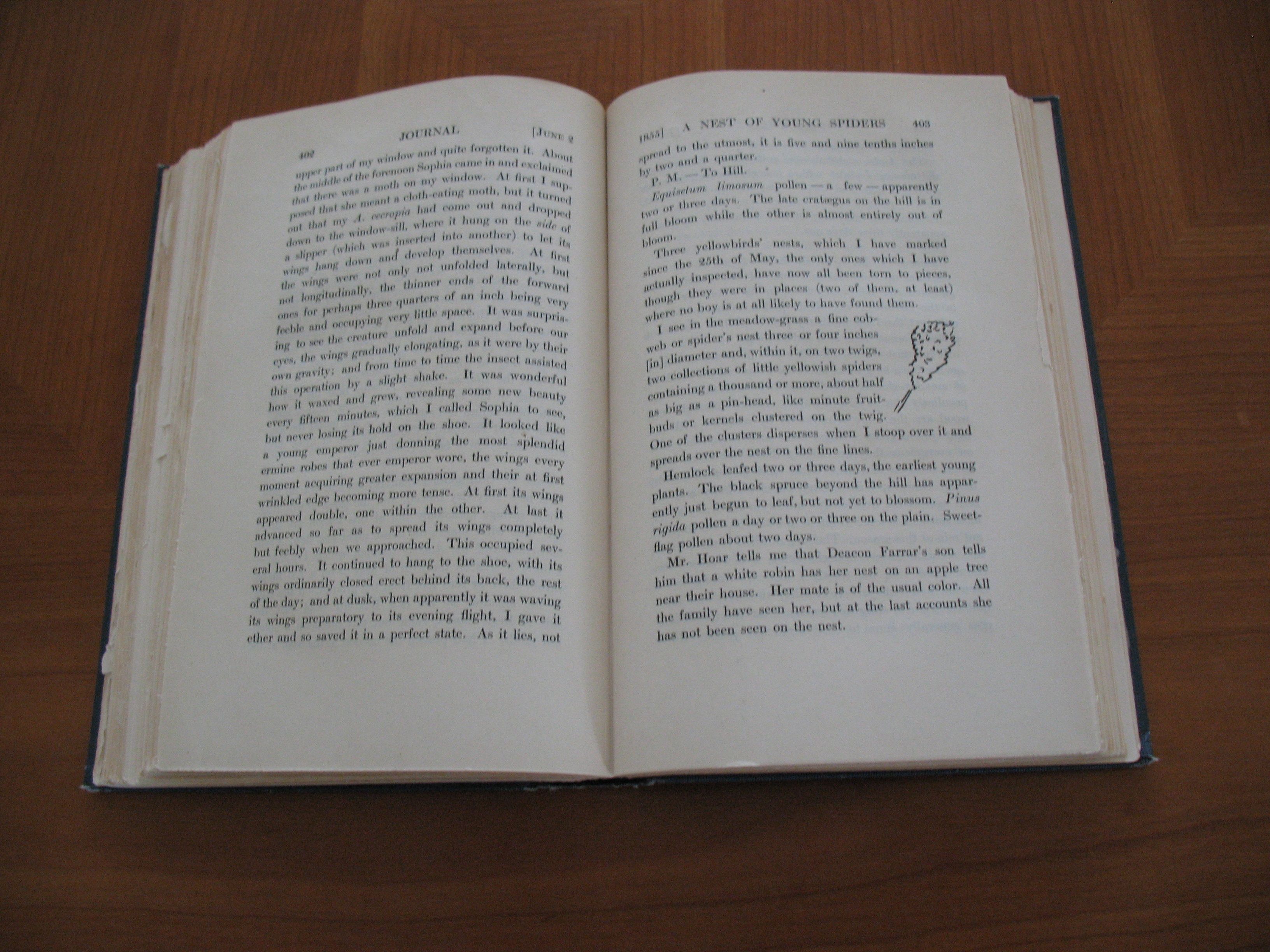
I was put in mind of all of this the other day while reading my copy of Thoreau’s Journal from 1855, and it was the volume itself that did the prompting. Part way through the June 2nd entry, I turned the page…and lost my way; I’d turned two pages, and the rest of that day was hidden between two joined sheets. I reached for the sharp buck-knife I now keep beside me when reading these volumes, slipped it between the pages and drew it carefully outward and down, releasing these two pages 108 years after their printing for the first time. I was their first reader. And that seemed to clear my sightline to that day.

IMG_1463

On the newly-free page, “About the middle of the forenoon Sophia came in and exclaimed that there was a moth on my window. At first, I supposed that she meant a cloth-eating moth, but it turned out that my A. cecropia had come out and dropped down to the window-sill, where it hung on the side of a slipper (which was inserted into another) to let its wings hang down and develop themselves.”

Thoreau goes on, predictably, to precise description of “how it waxed and grew, revealing some new beauty every fifteen minutes, which I called Sophia to see…”

In the wonder of the moment, in the brother calling his sister to come see, I had slipped into the room, and they had materialized in mine; there is something about cutting your own pages that brings this migration about.

Narcissus and Henry

Reflective Writing Near the Water’s Edge

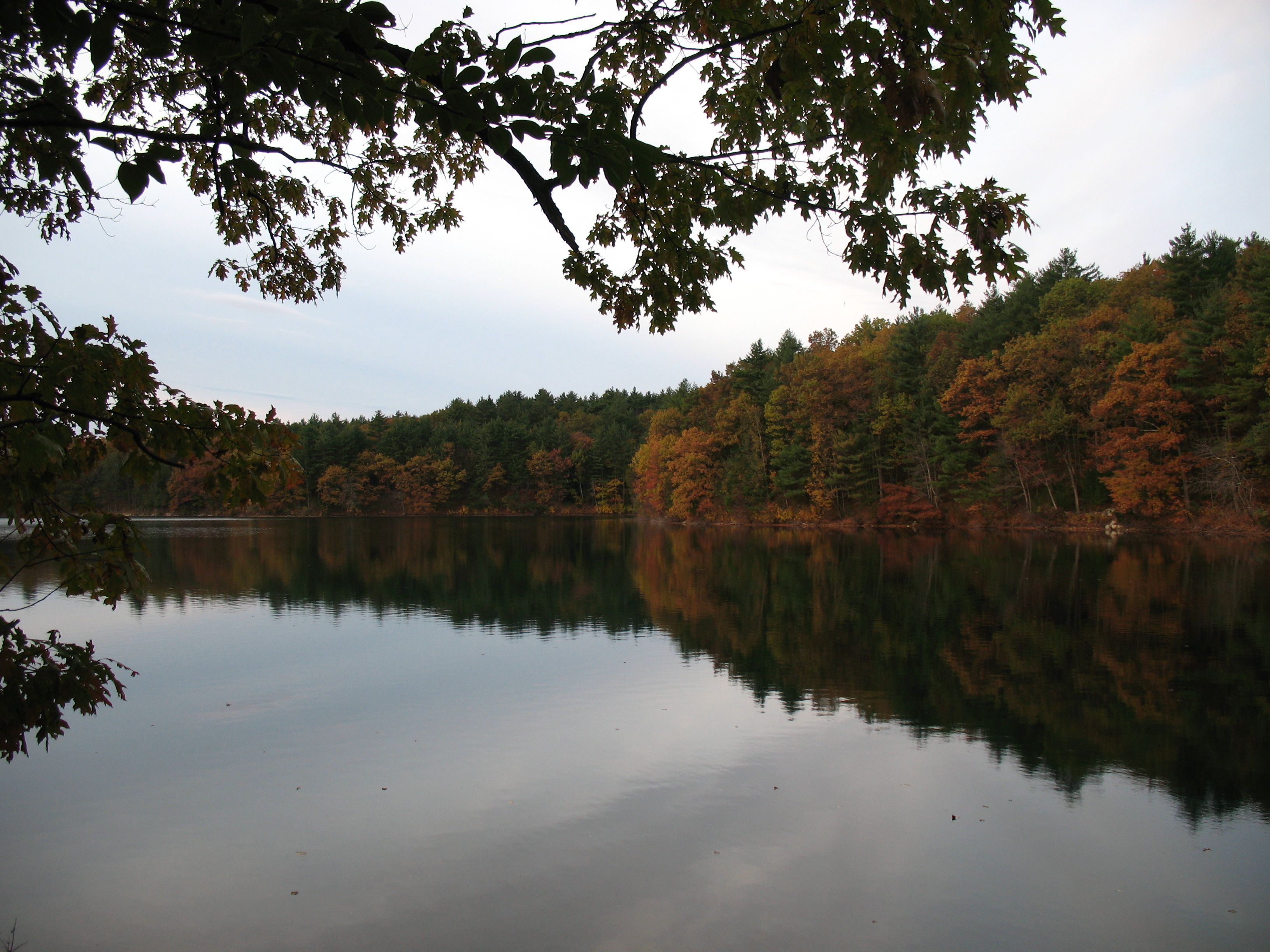
Walden Pond is alive again with wind and light. I’ve been there often during the past month, admiring its blues and greens (depending upon where I am in elevation and the day’s light) and wondering at its still-clear waters. One day soon I’ll wade in. But for now, as the water warms a bit each day, I’ve only been looking, and, as looking often does, this pond-gazing has triggered memory.

Walden's Reflective Waters, (albeit in a different season)

Walden’s Reflective Waters, (albeit in a different season)

Last spring, a student sat down to describe a dilemma she’d encountered while writing about her reading of Walden. “As I write, in part about myself, I don’t want it to seem narcissistic,” she said. This worry followed a description of the expansive pleasures of meeting with friends to talk about whatever ideas were current in the air of school, to talk about something other than the self.

As we talked over her concern, a thought grew. First we looked up the legend of Narcissus and reread the story of his falling in love with his reflection, which he took to be real. Before he saw himself, Narcissus was puzzled and harried because the local nymphs simply wouldn’t leave him alone. “I’m just me, just a man,” he seemed to be thinking as he wandered and pondered this unwanted attention. Then, he came to a pool of water and looked down. All that attention seemed merited now; Narcissus couldn’t bear to leave the pool in which his beautiful image floated, and so he wasted away there.

Then we began to talk about Henry Thoreau and water.

Henry too looked into the waters of Walden often, she noted, but, when he did so, he saw something other than himself; he saw, in fact, another being, perhaps a companion-self – the pond.

All of this got me to thinking that what we were really talking about was the difference between Thoreau’s faith in “I” and our society’s fascination with “I.” At the beginning of Walden, Thoreau points out that he will write about himself, about “I,” in no small measure because he knows no one else so well. But this writing will not celebrate the trivial “I,” the “I” of gossip and small affairs. It will, instead, follow the questing “I,” the one who would learn of the world and send that learning on to others…with the admonition, finally, that they learn for themselves, that they learn the “I’s” they are.

So, to see yourself in a pond, not because it looks like you, but because it lives like you seems the right distinction. As we emerged from our conversation, my student went off to write, and I thought about my faith in the “I” she is and will be.