Category Archives: Environment

Totem Moments

The telltale chips litter the snow; I look, then reach, up. The hole in the white pine swallows my finger; it bores all the way into the heartwood. A thumbnail gouge appears just above – the next boring, perhaps to be pursued when I leave. How powerful must a bird be to dig so in live wood? Later, I go in search of testimony that will detail this scatter of wood chips at the feet of this newly-opened tree.
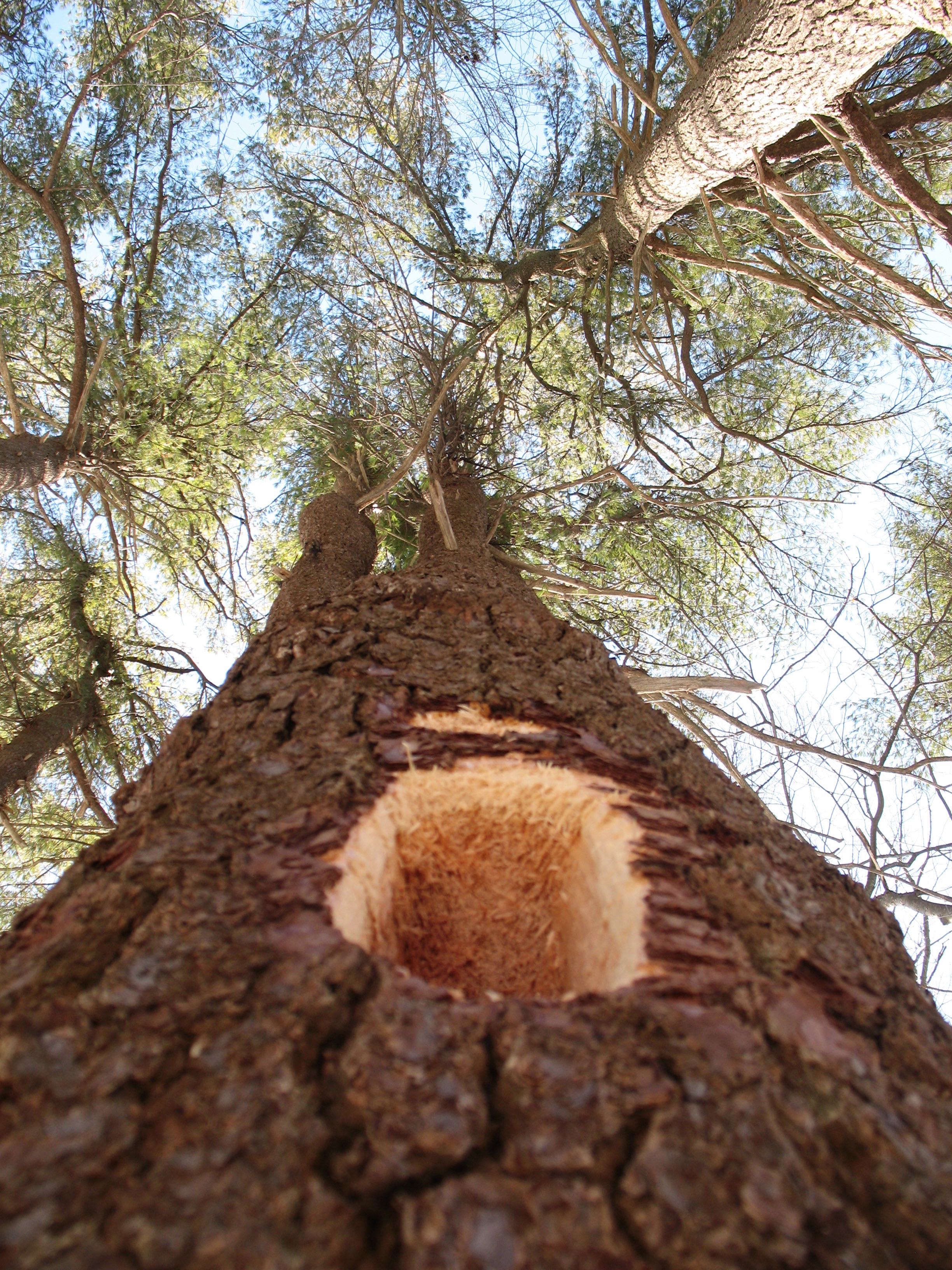
IMG_1590

The always-useful Cornell University Lab of Ornithology website http://www.allaboutbirds.org/guide/pileated_woodpecker/lifehistory offers satisfying summary of this large, colorful bird, who is also my neighbor. Masters of broad territory, every so often one or two pileated woodpeckers visit the small grove of white and pitch pines behind our house, though they don’t drill much into them. Instead, they laugh and leave. Our woodpeckers need deeper woods (more cover, I suspect) for their diggings. But not far off, on the trail to the Town Commons, it’s clear that they put in their hours uncovering the tunnels of carpenter ants, their favored food. What a long (and terrifying) knocking at the door the ants must hear when the pileated woodpecker comes calling.
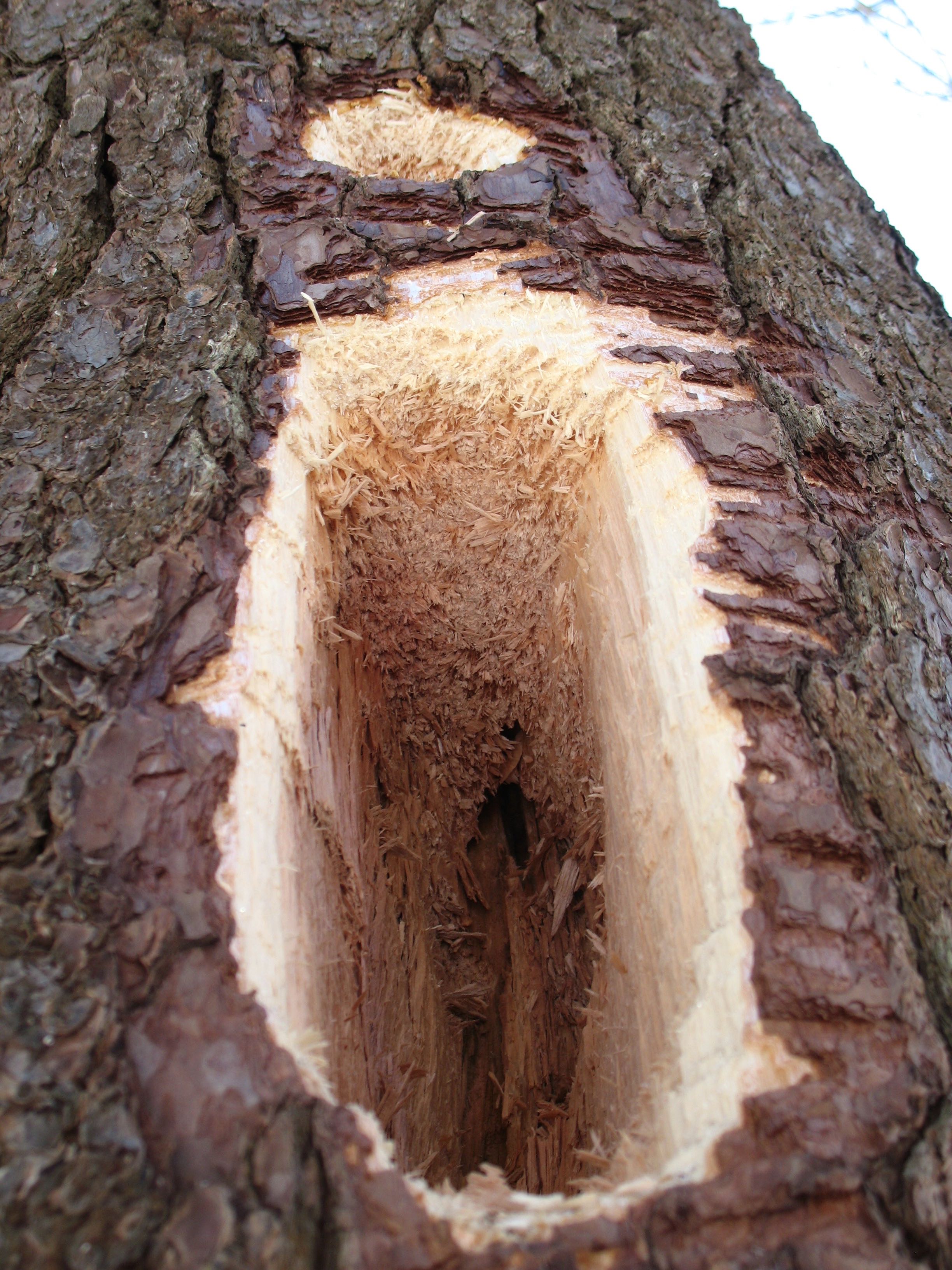
Close-up; note the insect-tunnel in the deep recess.

Close-up; note the insect-tunnel in the deep recess.

All forests (and people?) need a totem bird. For me, the pileated woodpecker answers that need. Unlike our talky crows, who seem always and everywhere, our pileated appears at odd hours, though he or she tends toward morning. Weeks will pass without a visit, however; then, in space of a few days, I’ll hear his or her distinctive voice, a stuttering laugh of sorts, or see a flash of largeness with its thrill of bright red. The day looks up.
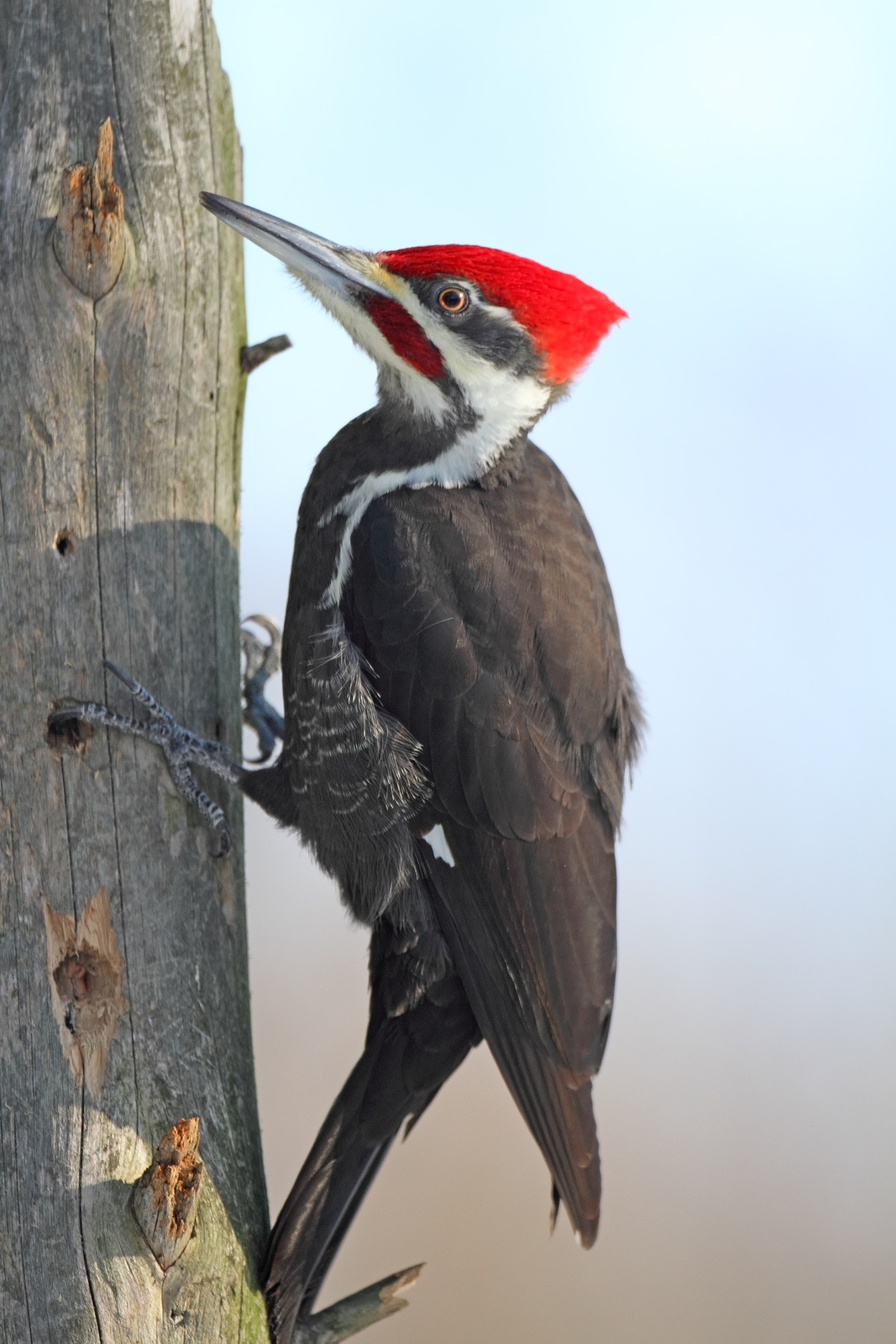
Totem bird. Photo: Bigstock

Totem bird. Photo: Bigstock

The Cornell website also points out that “the birds also use their long, barbed tongues to extract woodboring beetle larvae (which can be more than an inch long) or termites lying deep in the wood.” Who, aside from figuratively, has a barbed tongue, I think, as I add a little more wonder to my watching.

A little later on this day, and half-mile or so deeper into the woods, we see quick movement in my upper left periphery; we stop crunching along the snow and wait. Twenty seconds later, this large woodpecker flashes away, deeper into the trees. We see the dark wings and a glimpse of red. If we were to wait for some minutes, we might hear our bird resume knocking on a tree’s door. It is a hungry season. But we have our own appointments, our own knockings ahead, and we walk on deeper into our own days.
Thermal Being: a little winter walking, or “an adventure on life”

“When he has obtained those things that are necessary to life, there is another alternative than to obtain the superfluities; and that is to adventure on life now, his vacation from humbler toil having commenced.” “Economy,” Walden

Scene from a few days ago: The short-long month dwindles to a day, even as the morning temperature (ten below zero) offers reminder of its power. I’ve just returned from some days in the White Mountains, where, true to their name, winter’s grip endures. Each day, I climbed out of night’s valley toward the ridge-tops, feeling the cold sharpen as I got higher, and heeding its insistent reminder that winter climbing is all about carefully managing temperature, a lesson in essential heat that Thoreau considers at the outset of Walden.

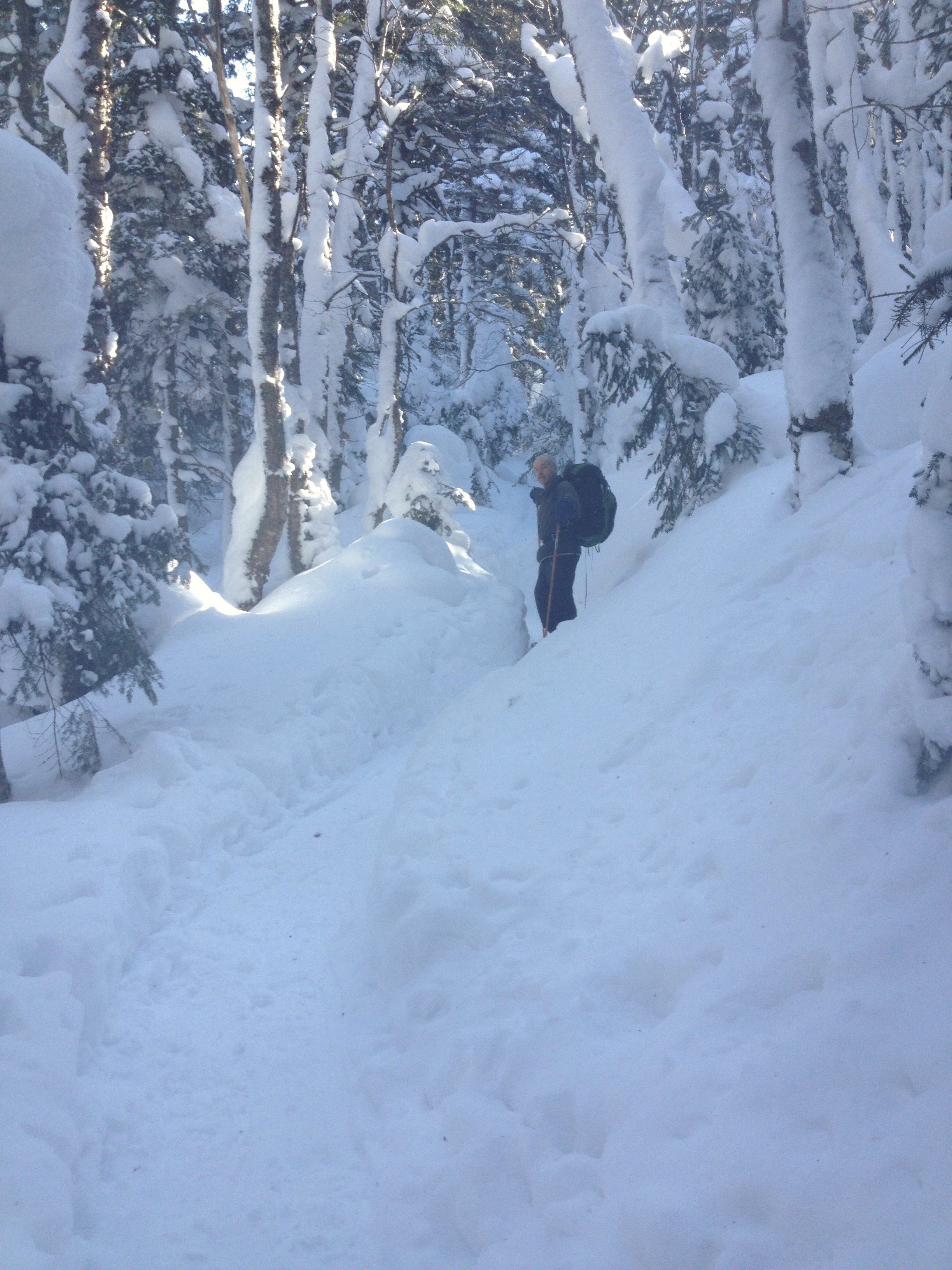
Walking up on snowshoes also gives you ample time to think- it is the slowest form of walking I know – and I spent some of that time considering my little island of heat on the way up. The counterintuitive trick in deep cold is to avoid overheating and its bath of sweat, which, if generated, tends quickly toward ice when you stop and cool. As all winter walkers know, this focus leads to a parsing of layers of clothing that is different for each walker. I spent considerable steps debating 3 versus 4 layers, adding in consideration of a tucked versus an untucked underlayer.

Deep Snow along the Crawford Path (hat off to shed heat). Photo by Paul Ness

Deep Snow along the Crawford Path (hat off to shed heat). Photo by Paul Ness

Then, there was our adaptability to cold to figure – in short the longer your exposure to cold, the more you acclimate to it. Even my three days of climbing pointed this out. By day three, I was down a layer, even as the temperature stayed stubbornly near zero. And, as further example, I recalled a few years ago being out on Zealand Mountain on a zero-degree day, when the caretaker for the nearby hut passed us wearing only shorts and a halter top as she cruised up the trail. Yes, she did admit to “layering up” once she reached the open ledges near 4000 feet, but her winter of living in an unheated hut had given her impressive resistance to cold.

Finally, there was the feeding of my “firebox,” a practice nearly identical to that of keeping a wood stove going throughout the day. (Thoreau notes this analogy as well.) I learned stoves during a winter in a wood-heated cabin when I was in my early 20s. By March, I could mix woods of varying density and dryness to get the consistent heat of a slow burn day and night. And, having become inured to the cold, I kept the cabin at around 50 degrees. So too with the burn of the body’s fuel during winter walking – mixed feedings, often while still walking, keep you warmer. And here is happiness: enduring cold asks for calories of fat. You like cream cheese or butter? Bring (or layer) it on. It’s not unusual for someone out in deep cold to burn 5000 calories in a day. Falling short of that intake can bring on insistent chill.

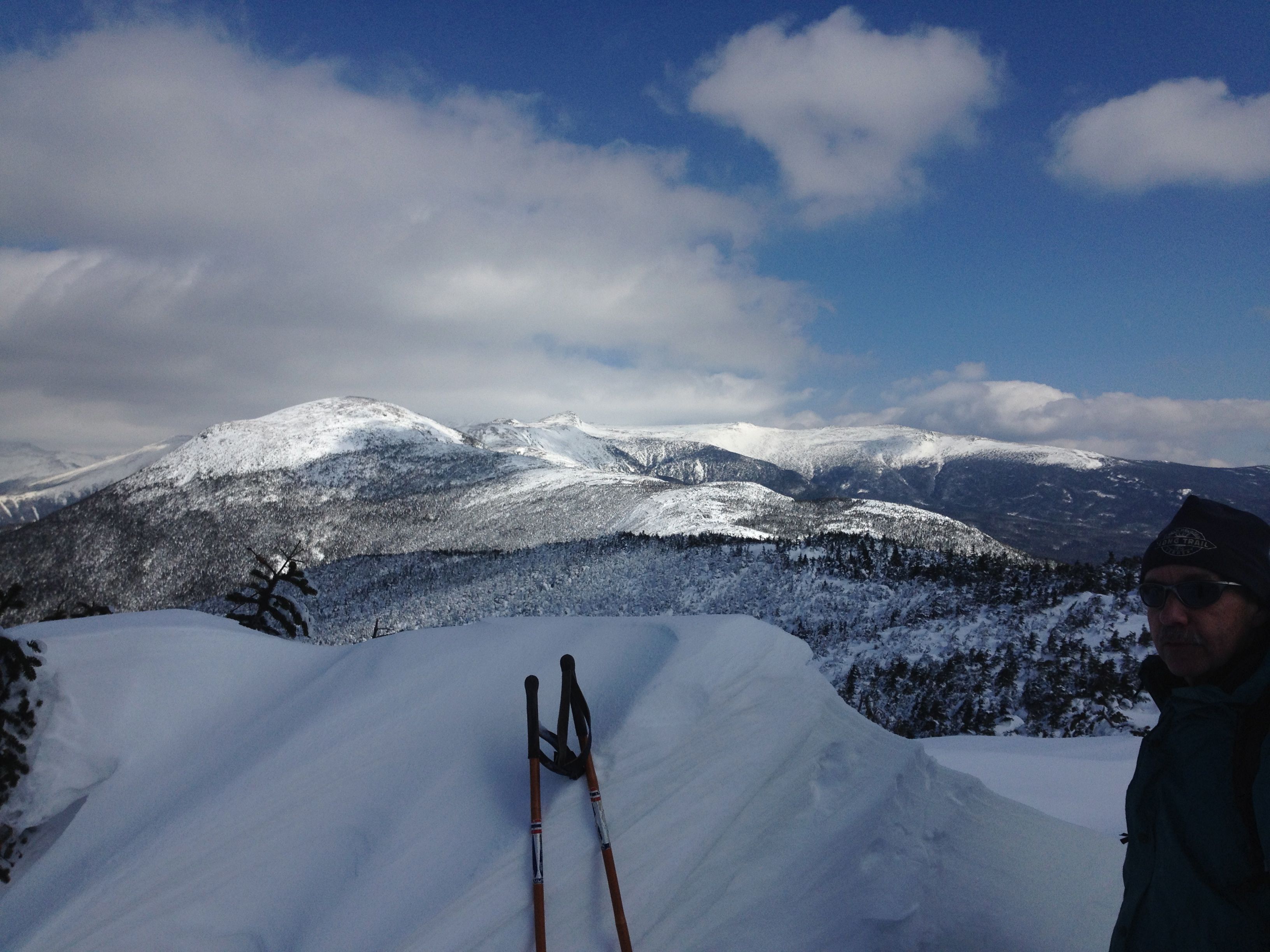
Zero and Windy - a look at Mt. Washington. photo by Paul Ness

Zero and Windy – a look at Mt. Eisenhower.
photo by Paul Ness

I know too Henry Thoreau set out on snowshoes when winter was deep – I saw his snowshoes at last year’s exhibit of Thoreauvia at the Concord Museum – and surely he left a record of sensitivity to temperature – both his and that of the Walden world. Thoreau understood that we are truly thermal beings; sometimes it takes winter drive home our dependence.

Postscript: for 24 hours after returning from days outdoors in the cold mountains, I got thermal reminder: indoors, even with central heating set low, I burned with heat. Then, the fat worked through my firebox, and I returned to the temperate feedings and feelings of the lowlands.

Blue Sign

“We go listening for bluebirds, but only hear crows and chickadees.” Journal, 3/1/55

The light suggests it. It peers in-house before 6:00 a.m., and even amid the ongoing cold, it has crusted the snowbanks that angle toward the south. And also even as more snow filters in, the drifts have begun to shrink. The growing light is sublime. Also literally, as the shrinkage of snow comes of sublimation.

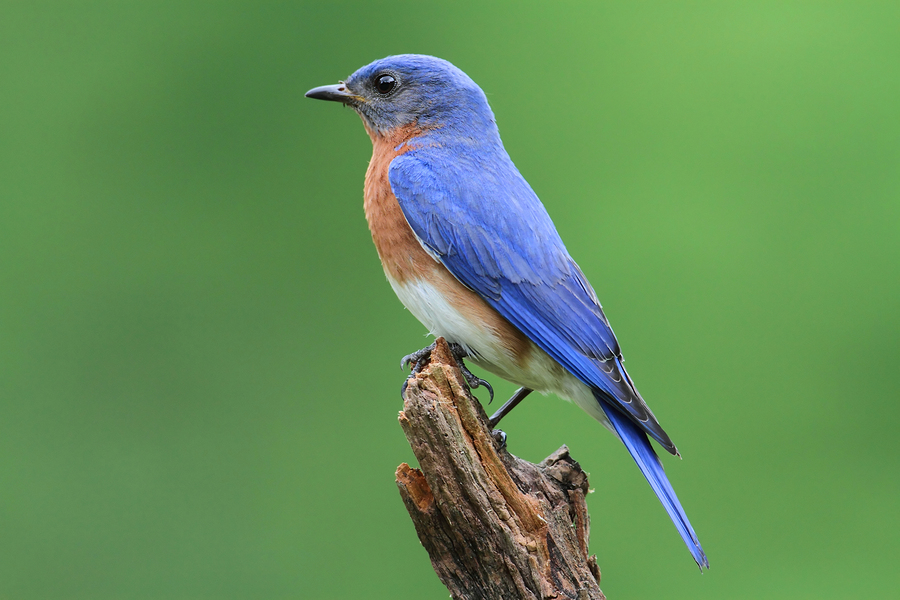
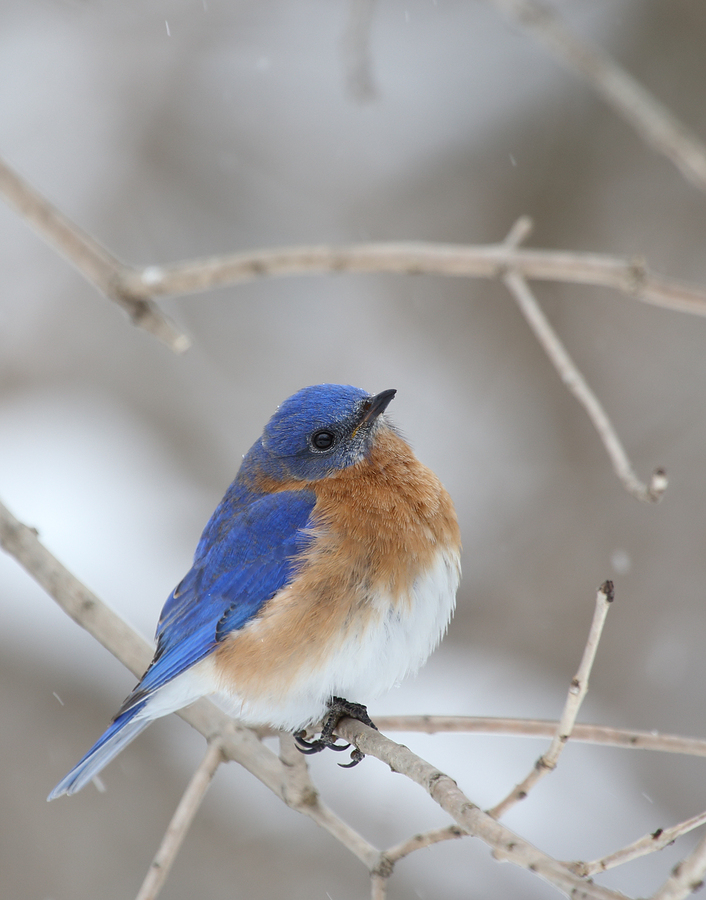
Like Henry Thoreau, I think there must be bluebirds about. And I know where to look. Back in January, when our winter looked to be a humdrum sort of thin cover and open fields, I noticed that an old relic apple tree on one of my walking routes flashed often with chips of blue color. A whole crew of bluebirds – what is the word for a gathering of bluebirds? An azure of birds? A sky of them? – favored this dense, spiky tree. Clearly, they were intent on weathering and wintering here.

Eastern Bluebird

And a quick trip to my bird book showed a sliver of purple riding the nearby coast, sign of possible year-round range, even as the rest of northern New England is usually summer range only.

What about now, I wondered. Were the bluebirds, after this month of snowy onslaught, still here? Or had they, like many of us, been “innived?”

I went to look, and there along the border of snowfield and hard by an old track that promises sometime a walk into the woods, they were. Even more blue against the always white of the day. Leave aside the sobering thought that these bluebirds may winter here now because warming is on the rise. Today they are blue relief against the deep white.

Puffed against the Cold

Puffed against the Cold

I like the little riot of chickadees always at the birdfeeder, and surely the crows are our most talkative neighbor. But the bluebird’s a sign I’m happy to go walking and listening for. Welcome to March.