
Category Archives: Environment

Footsong

“To come down to my own experience, my companion and I, for I sometimes have a companion, take pleasure in fancying ourselves knights of a new, or rather an old, order, — not Equestrians or Chevaliers, not Ritters or Riders, but Walkers, a still more ancient and honorable class, I trust. The chivalric and heroic spirit which once belonged to the Rider seems now to reside in , or perchance to have subsided into, the Walker, — not the Knight, but Walker Errant. He is a sort of fourth estate, outside of Church and State and People.” Thoreau, Walking

These familiar words lead us into Thoreau’s famous essay, continuing a run of hyperbole designed, I think, to alert us to the possibilities in the pedestrian, and also in the local. Two feet and a bit of “fancy” are all it takes to slip from the usual into the mythic. Again and again, I’ve found that to be true, as recently as yesterday, when September’s angled light, a windless warmth and the drowsy insect-hum of late afternoon transformed our local woods into another land from which I emerged dazzled at walk’s end.

Today, however, we do leave for another land, traveling for the first time to Ireland, surely a place of mist and myth. How will we make our way there? Thoreau’s essay seems the right guide, supplementing some of our research reading in usual guidebooks with guidance for our spirits. In fact I know of few better ways to find the local particulars of a place, the moments and markets that become memories, than to visit as a Walker Errant.

Both parts of my new/old title count, I think. The foot by foot parsing of way and place bring us to each new sight and corner at the pace of perception. And, as we learn and relearn over time, just as losing our ways can make can make the local foreign, it can also make the foreign familiar.
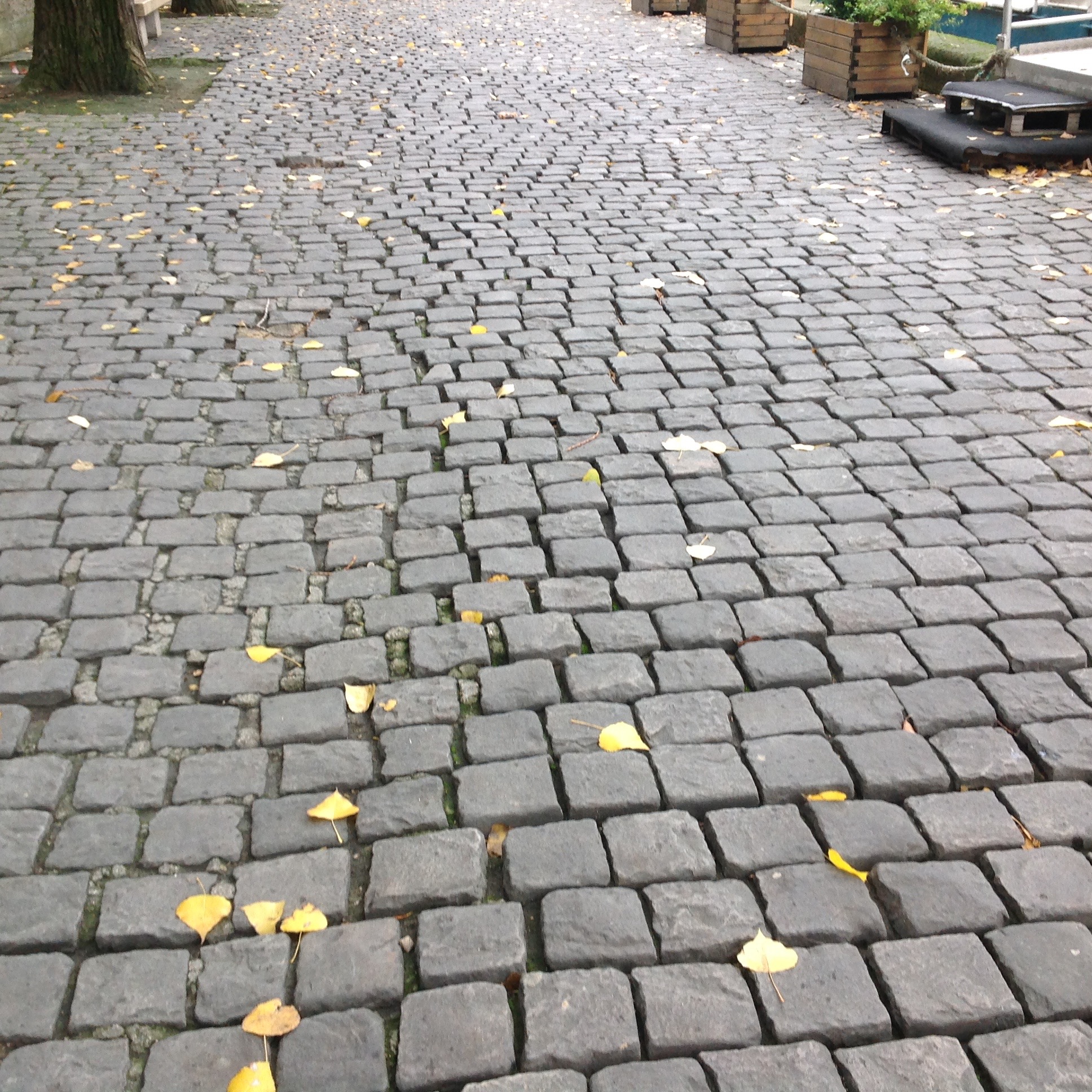
Step by step along the cobbled way.

Step by step along the cobbled way.

Travel note: with luck, I’ll be able to check in on The Roost and post an Irish thought or three from time to time. But, if errant wanderings or links prevent that, I’ll look forward to rejoining you in a few weeks.
Seeing in the Dark

…I frequently had to look up at the opening between the trees above the path in order to learn my route, and, where there was no cart-path, to feel with my feet the faint track which I had worn or steer by the known relation of particular trees which I felt with my hands, passing between two pines for instance, not more than eighteen inches apart, in the midst of the woods, invariably, in the darkest night. Thoreau, Walden

It’s evening, and we’ve gone inside. The day’s colors are damped down; the visual world shows in soft tones tending toward gray. I sit in a pool of lamplight and open a book, reach over and crank the window once to admit a trickle of coolish air and the woods-smell from the pines. The scented air slips in, and with it comes night’s announcement from our resident tree frogs: “TTHHRRRRIILLING,” they seem to trill. “TTHHRRRIILLING!”

The frogs’ call doesn’t exactly invite you out, but it wonders; so now do I. I tend to tuck my days in at dusk, favoring the armchair to the evening amble, favoring, as do many, the light to the dark. There are, of course, reasons for this, among them, post-dinner torpor, accumulated fatigue, and, at times, the bright, visual fire of the screen.

Recently, in high daylight, a fox ran through the yard; it appeared from beneath the rhododendrons and made a linear track across the grass, disappearing by the corner of the garage. I got a good look: this fox was a scruffy affair, with clots of fur hanging off a too-thin body in this season of plenty. His appearance, physical and temporal, suggested some sickness. Foxes are crepuscular in habit, night creatures really, when they are suggestions of motion bearing teeth amid shadows. What was night doing out in the light?

Neighbors immediately thought, disease, and they were probably right; I began to think about daytime visits from visions of the night, and then about my own visits with the night, times when the usual became strange and new, and I was awake to it.

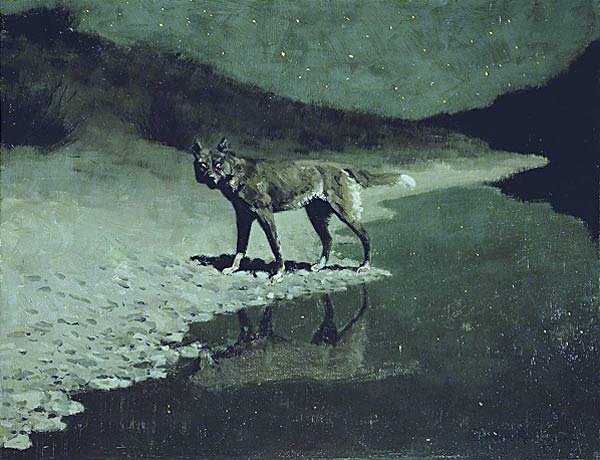
As companion in this wondering, I had also my visits to a local exhibition at the Bowdoin College Museum of Art. Night Visions (ongoing until October 18th) is an inspired idea and collection that looks at American paintings at and of night from the mid-19th to mid-20th centuries, the time of transition from old-style darkness to our illuminated contest with night.

Frederic Remington painting. Note the way the wolf's eyes are kin to the stars.

Frederic Remington painting. Note the way the wolf’s eyes are kin to the stars.

A walk through the exhibition is a walk back into another kind of darkness and then back into our own attempts to light the night. Both are, as the tree frogs remind me, “TTHHRRRRIILLING”; they reminded me also of Thoreau’s meditation on walking at night, which deepens to praise of getting lost, as a way awakening and being, finally, found in his Walden chapter, The Village (see passage at this post’s outset). Notably, I think, this meditation also immediately precedes his story of being jailed for nonpayment of taxes – another awakening venture into a form of darkness.

When you adopt a mind of night as you read, you may find that there’s also a fair amount of night-wandering and night-musing in and at Walden. In pursuit of being awake, Thoreau did not confine himself to the day.

And even now, Walden night-swimmers walk in from the west side woods to the little coves near the railroad tracks…not that I have ever done so…to make their acquaintance with the night.

Here’s a link to the Bowdoin College Museum of Art’s exhibition:http://www.bowdoin.edu/art-museum/exhibitions/2015/nv/


The Real Work – Labor (of love?) Day Nears

Labor Day’s approach joins morning’s slanting light to make me think of work. Centerpiece of many days and visitor to all, work comes in various guises; still, what each of us identifies as her or his real work, what we embrace rather than what we are assigned, can be hard to suss out and even harder to explain.

As a seventeen-year-old, I recall wondering about this question as I wallowed in schoolwork’s many-disciplined demands after a summer of construction work. What would I do for work, eventually, when I left behind the aptly-named homework and summer’s temporary jobs? In the years that followed, I, like many, made my decisions somewhat randomly, and later fell into a form of teaching, which, in time, became my life’s work. It was a work with which I became smitten.

But, throughout a lifetime’s work, the phrase, “real work,” kept appearing with a question mark attached. What was my real work? What should it be? And, as also often happens for me, it took a poet to help this question take fuller shape. Such shape-taking precedes any answer.

Gary Snyder led me into a bar in Texas in pursuit of answer. Snyder, who emerged from the Beat movement and became his own Zen-inflected voice for the wild that Thoreau celebrates in Walking and throughout his other writings, wrote one of the greatest American poems I know, “I Went into the Maverick Bar.” In it a young Snyder, in Farmington, New Mexico to protest despoliation of land and abuse of Indian sovereignty by energy companies, enters a redneck bar, which depends on the very work he’s there to protest. In a quick few lines and images, Snyder limns the curious American admixture of despoiling work and exuberant innocence and remembers his own:

And with the next song,
a couple began to dance.

They held each other like in High School dances
in the fifties;
I recalled when I worked in the woods
and the bars of Madras, Oregon.
That short-haired joy and roughness—
America—your stupidity.
I could almost love you again.

(Note: Try as I might, I cannot get my program to allow proper formatting for this excerpt; apologies. Please follow the link at the end of this piece to read the full poem, properly formatted; it’s worth the click…and more.)

But Snyder resolves that instead of cutting (or mining) a life from the wilderness, he must commit himself to what he calls “the real work” of finding and understanding a home. To do so, he must learn his place (two meanings intended) and relations, or as he put it in an interview with Bill Moyers:

The real work is becoming native in your heart, coming to understand we really live here, that this is really the continent we’re on and that our loyalties are here, to these mountains and rivers, to these plant zones, to these creatures. The real work involves developing a loyalty that goes back before the formation of any nation state, back billions of years and thousands of years into the future. The real work is accepting citizenship in the continent itself.

IMG_1686

Snyder’s writing prepared the ground for my later work with Henry Thoreau and the real work he recorded in his journals. Yes, I learned, if ever anyone became “native in [his] heart,” it was Henry Thoreau. His was a daily labor worth celebrating.

And here too, as Labor Day nears, is to your real work, wherever and however you find it.

Links: Here’s a link to Snyder’s poem, I Went into a Maverick Bar: http://www.poetryfoundation.org/poem/177249; and here’s a link to his interview with Moyers: http://billmoyers.com/content/here-in-the-mind-daisy-zamora-and-gary-snyder/