Category Archives: Thoreau Quote

Duck Talk

For hours, on fall days, I watched the ducks cunningly tack and veer and hold the middle of the pond, far from the sportsman…but what beside safety they got by sailing in the middle of Walden I do not know, unless they love its water for the same reason that I do. Thoreau, Walden

Even before I crest the small rise I can hear them: the ducks are talking. Their conversation sounds easy, easeful, the sort your hear at the outset of a party before everyone’s in full voice and all subtlety drops away. Recently, they have clustered on this little pond on the way to the Commons in a density brought on, perhaps, by hunting season – how do they know this residential water is off limits? – and perhaps by recent nights’ icings. It has dropped to 19 degrees, and the skim is still firm in the shade this afternoon. And there’s a hint of snow in the little dells beside the trail. I think they should get a migratory move on, but they seem unhurried.

As my head appears, the low muttering morphs to notice, each duck-voice distinct. “Do you see that?” they quack. “Over there, That, That, That…Quack, Quack, Quack.” I half-expect them to point with their bills. And those near the pond’s edge paddle from it toward their brethren in the middle or along a farther fringe. A few beat their wings, as if to show that they can fly…and will…but then they drop to paddling too. Perhaps they know I have no gun; perhaps they know that this neighborhood is sanctuary; perhaps, as I bend away along the trail, I have stepped beyond their necessary duck-space.
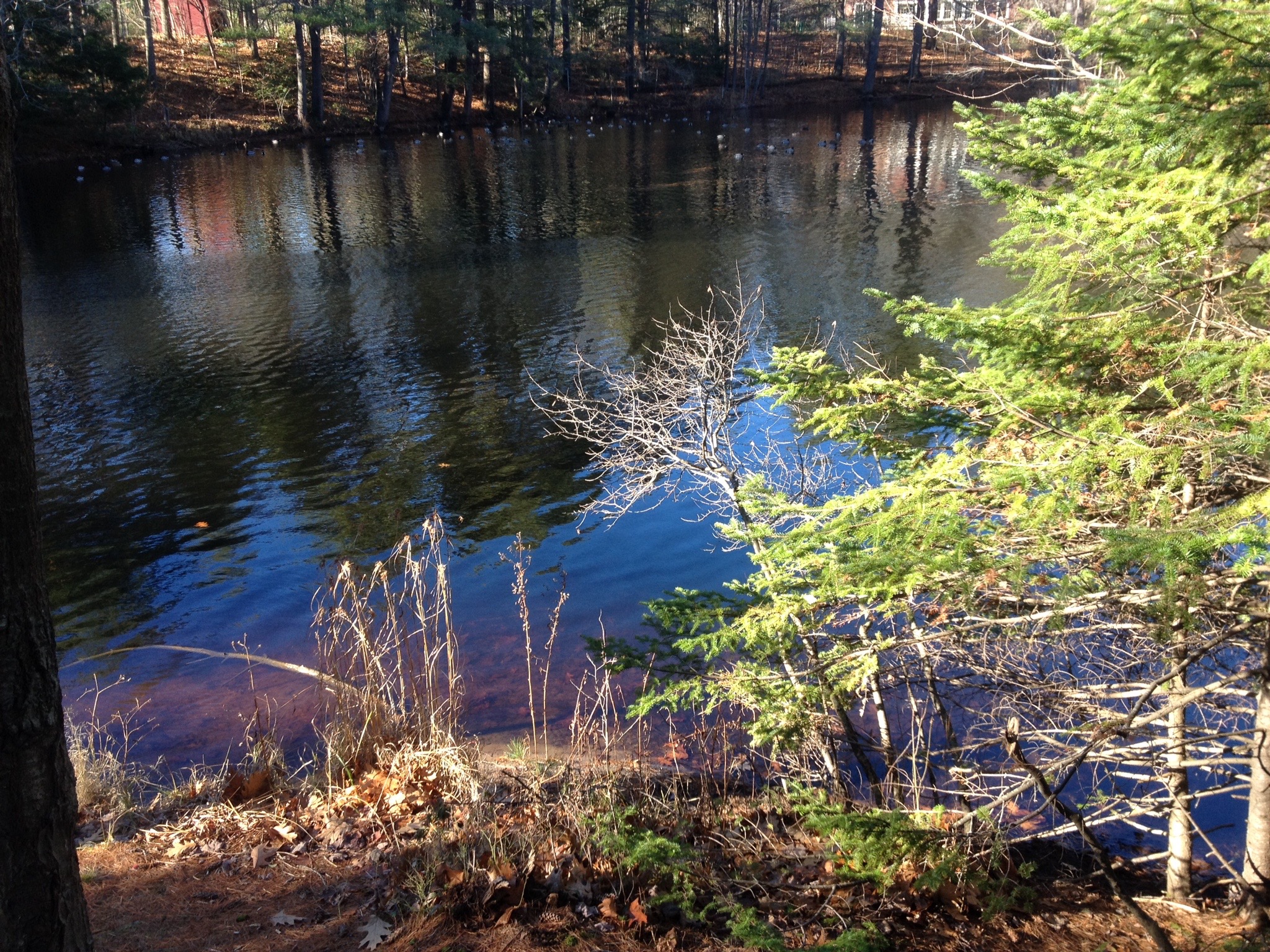
As close as they let me get

At some distance, as close as they let me get

The ducks go back to mutter; they discuss my arrival and veering away, and the sound crosses the water, skips off the new ice. I thumb through the worn pages of my memory for the word that describes a gathering of ducks on water. Flock? No, that’s in flight. Is it covey? No, that’s quails, I think. Ah, I’ve heard ducks on water called a raft; yes, I think so. The other word available turns out to be a “paddling.” Descriptive yes, but does “raft” or “paddling” convey what I hear, which could be the sound of so many Hucks and Jims talking as they float? Not really.

What then to call this talky raft?

Here are two possibilities: colloquacky; or maybe quackoquy. Or perhaps you will summon and share a better word.

All part of the fun of walking without aim – you can make the world up as you go.
Nosing Out

This is a very beautiful November day, — a cool but clear, crystalline air, through which even the white pines with their silvery sheen are an affecting sight. It is a day to behold and ramble over the hard (stiffening) and withered surface of the tawny earth. Thoreau, Journal 11/22/60

I awoke today to the first froth of snow rimming the yard. It was gone in the time it took to drink my coffee. But it serves as announcement. Still, the season shifts a little more slowly on the nearby ocean, and not long ago I was on it in search of slowed motion. Being near the ocean as the year ebbs (or floods) gives you access to two seasons, the foot-stepping one of the land and the slow follower of the water.

For the most part, the water-season’s over. Boats are shrink-wrapped and tucked away in storage; only the wind-flung leaves animate the waves as they reach for the shore; and all the osprey and eagle nests that sowed the air with birds are empty. Still, on a day when the winds stay away, and after the slanting sun warms the air a little, I sometimes rack my boat on the car’s roof and go to the sea.

To be clear, as the waters cool, I am wary. The ocean buoys are flirting with 50, and even in the calm bays the temps aren’t much higher. A bath in that sort of water can quickly become a one-way plunge. But I have a drysuit, which makes me feel a little like an astronaut – sans the helmet and Houston – and I’m not about to embark on a “test-piece” of paddling toward some extreme, so some float-time seems okay.

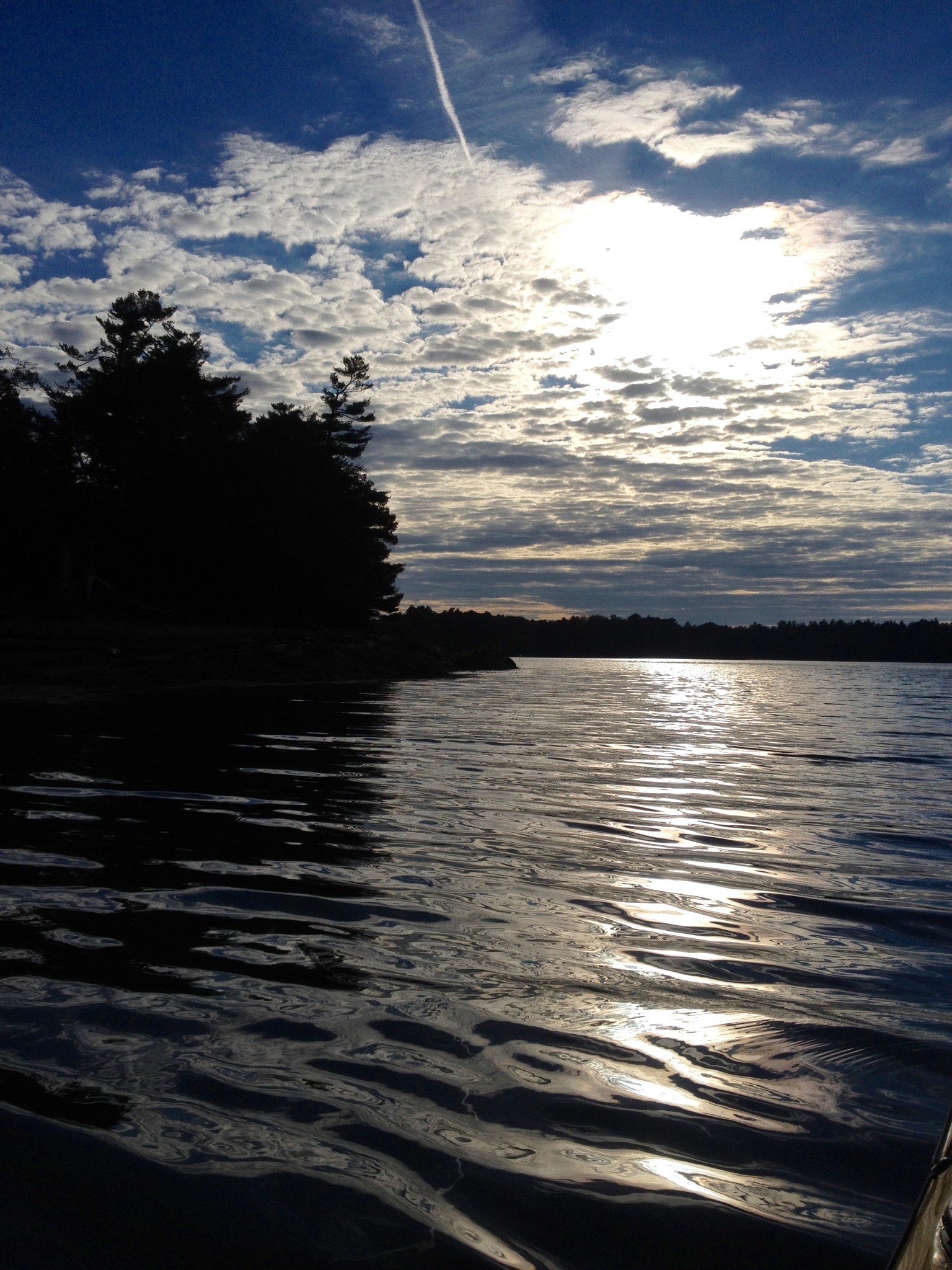
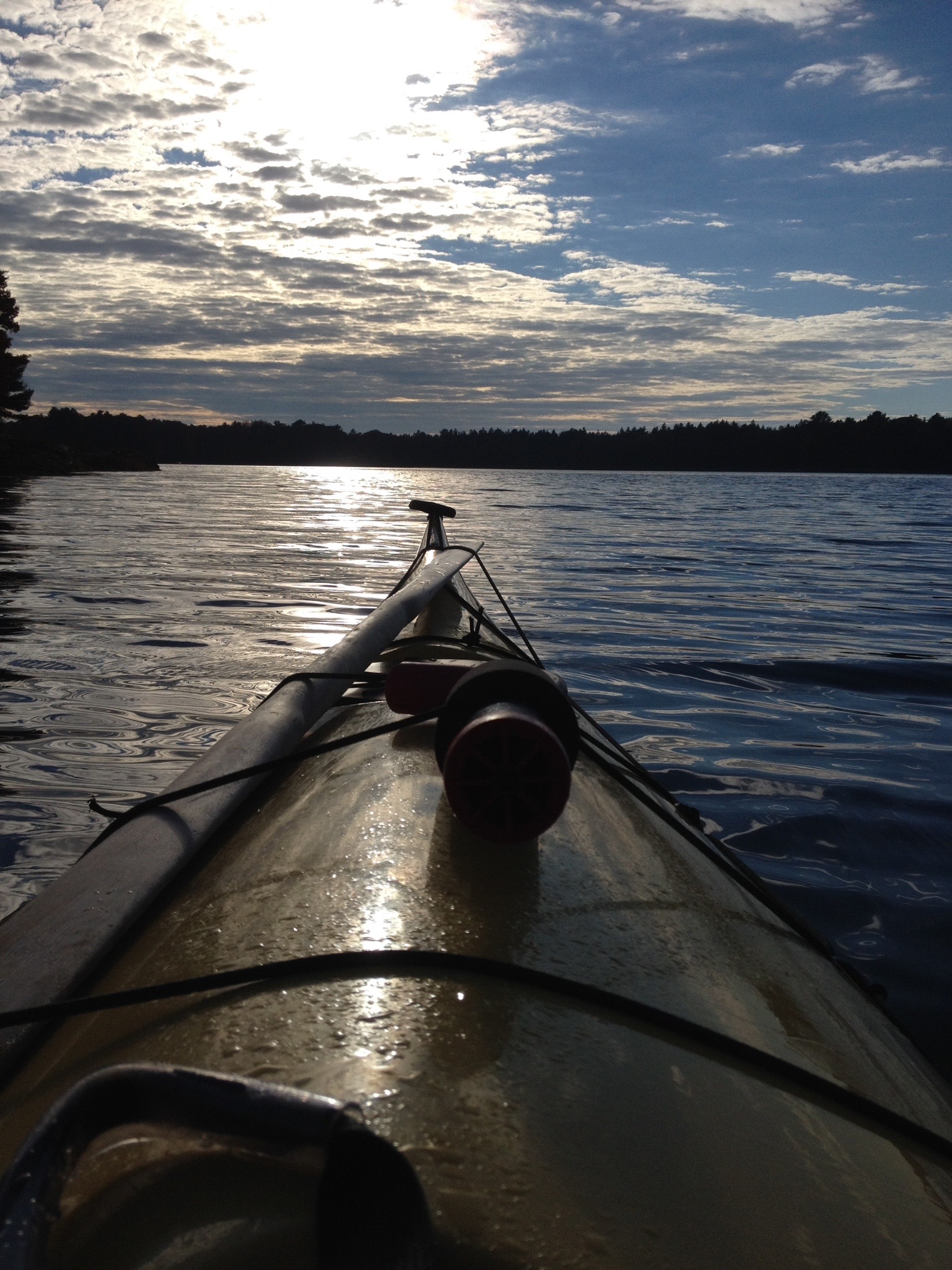
On this day, even in the afternoon, the sea-world seems to have exhaled and dropped into a nap. What ripples there are on the waters emphasize their calm and the tranquil sky above. Paddling on such a surface has the feel of sliding across polished glass, and I begin my circuit of little islands by making the day’s long letter – the V of passage.

The V that makes the V of passage

The V that makes the V of passage

As the point of this V I aim at little Scrag Island, and its northern headland, a cliff that looks like a big ship’s prow. There, I drift for bit, watching the silent rock, admiring how the fifty-foot pines somehow find holds that keep them upright and growing an annual foot or so. The absence of any “quick-life,” – birds, boats, us – keeps me at this scene where pine clasps rock; I feel no hurry. When I do paddle on, the shore sliding by on my left, it is simply for the pleasure of this easy sliding.

Island pines holding on, rising

Island pines holding on, rising

There is, I think, no large message from this day, other than its glimpse into the longer spans of time where tree and rock simply persist. But there is the expanse of water and sky, the stretch of vision that seems, as I float, back on time’s tide.

Though you are finger-cold toward night, and you cast a stone on your first ice, and see the unmelted crystals under every bank, it is glorious November weather, and only the November fruits are out. Thoreau, Journal, 11/22/60

Today is one of those fruits.

Under Leaf – Looking Closely

By Corinne H. Smith

Nature will bear the closest inspection; she invites us to lay our eye level with the smallest leaf, and take an insect view of its plain. ~ Thoreau, “Natural History of Massachusetts”

It’s still leaf-raking season out here in the suburbs. Every two weeks, the township truck comes through and inhales all of the leafy street-side hills we have carefully assembled. It’s magic. When we come home from the day’s work, the leaves are gone. The neighborhood is neat and clean again. Our bounty is on its way to the next county, where it will become compost. And yet: when you look at what’s still hanging in our trees, you know that this is a cycle that will need to be repeated. Over and over again.

I am a classic procrastinator. So I spent one recent chilly Sunday outside with my trusty hand-held rake, scraping furiously at the lawn to give up its colorful, curling, crumbling bits. No whiny, fossil-fuel-gobbling blower for me. No whirling dervishes of tornadic leaves. The Monday truck visit loomed large on the calendar, and I needed to put in some sweat equity. I couldn’t even SEE the grass, for all of the leaves — oak, sweet gum, Japanese maple, and several unknown others. And these were only from the trees in my own yard. Yellow litter from some sizable sugar maples rushed in from other spots up the street.

I worked around the football game broadcasts of the day. (I do have my priorities, after all.) And I sacrificed most of a late afternoon game to get back to the more-demanding task outside. Rake, rake, rake. Build those piles. As soon as the sun dropped below the horizon line, though, the air got downright arctic. I had to pull up my jacket zipper. Soon I had to turn on the outside lights to see what I was doing. I can tell you that there’s something quite tactile and sensory in the act of raking leaves in the dark.

The day's leaf-work awaits the truck.

The day’s leaf-work awaits the truck.

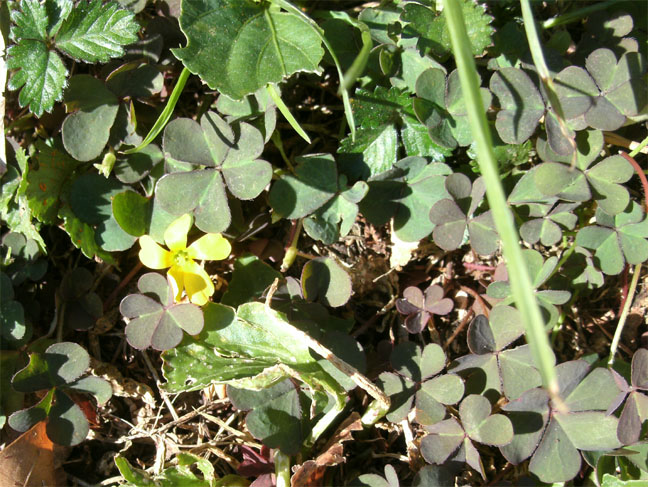
But before the darkness descended, I made a new discovery. Naturally as you rake, you pay close attention to the ground in front of you. Your goal is to see the grass, the ground, or the sidewalk again. You watch for these familiar sights. Well, as I was cleaning off one corner of the front yard, I was pleased to see it becoming all green again. Except that it wasn’t entirely green. Suddenly I saw several little yellow flowers that I had never seen before. In November?

A new flower - oxalis creeper

A new flower – oxalis creeper

This part of the lawn is made up mostly of violets, clover, and wild strawberries. I’m used to seeing little purple flowers, white flowers, and tiny red berries here in the spring and summer. This yellow one was something new. I dropped the rake and knelt down to take a closer look. I hardly took an “insect view” of the plain. I’d say it was more like one of a rabbit or a groundhog. But I got close enough to know that this plant was new to me. It had clover-like leaves, but not a clover-like flower. And it was vine-like, in its own tiny way. I pulled out a sample, took it inside, and put it in water to keep it fresh. Then I came back to the raking — now, with a fresh eye for what could be hiding beneath the leaves.

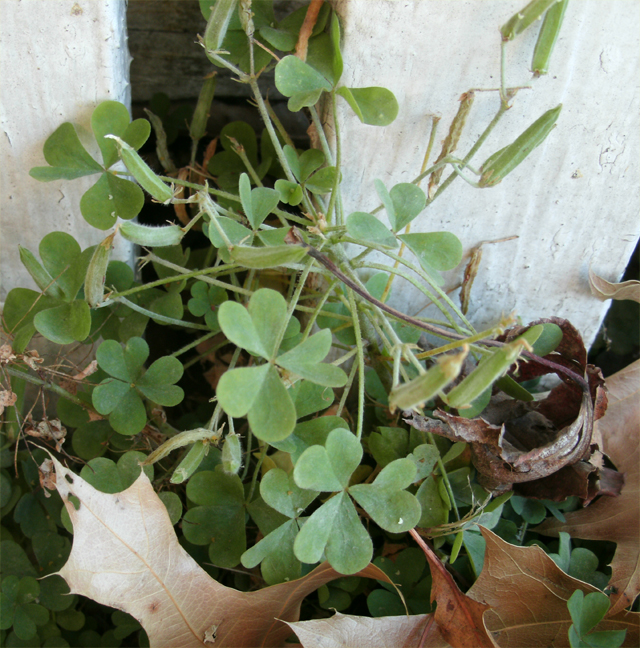
Later, as I watched the Sunday evening football game on TV – because again, I do have my priorities – I brought out all of my nature guidebooks. I wanted to identify this new yellow flower. But my favorite books let me down. All of them pointed instead to yellow wood sorrel, known as oxalis. I knew this plant. It had brighter and flatter green leaves, and it grew in a clump. It was even edible. No, I knew this new one was different.

The usual wood sorrel, without flower at this time of year

The usual wood sorrel, without flower at this time of year

Finally I picked up a guidebook I rarely use. I turned to the oxalis page, almost in futility. I hoped a picture nearby would match my sample. And there it was: CREEPING wood sorrel! “A creeping plant with smaller flowers and leaves than the preceding. … Usually found as a weed around greenhouses.” Well, mine grew next to the driveway. I’m glad to meet you and know you, creeping wood sorrel. I won’t soon forget you.

This week a brisk wind blew through the neighborhood, and once again I must rake in time to meet the Monday township truck. I wonder what new discovery I’ll make in this go-round? Surely, I’ll be giving the uncovered ground “the closest inspection.”