
Category Archives: Nature

Summer Reading – Walden’s Shore

In Search of Bedrock at Walden

Part of summer’s joy lies in its liberal stretches of reading time. And so the gift of a book often offers immediate rather than delayed pleasure. The other day I received such a gift: Robert Thorson’s Walden’s Shore is a detailed examination of Thoreau and 19th-century geo-science. Thorson is a geology professor at University of Connecticut, and he brings an earth scientist’s deep knowledge of what we walk upon to the work of watching and walking with Henry Thoreau throughout his lifetime.
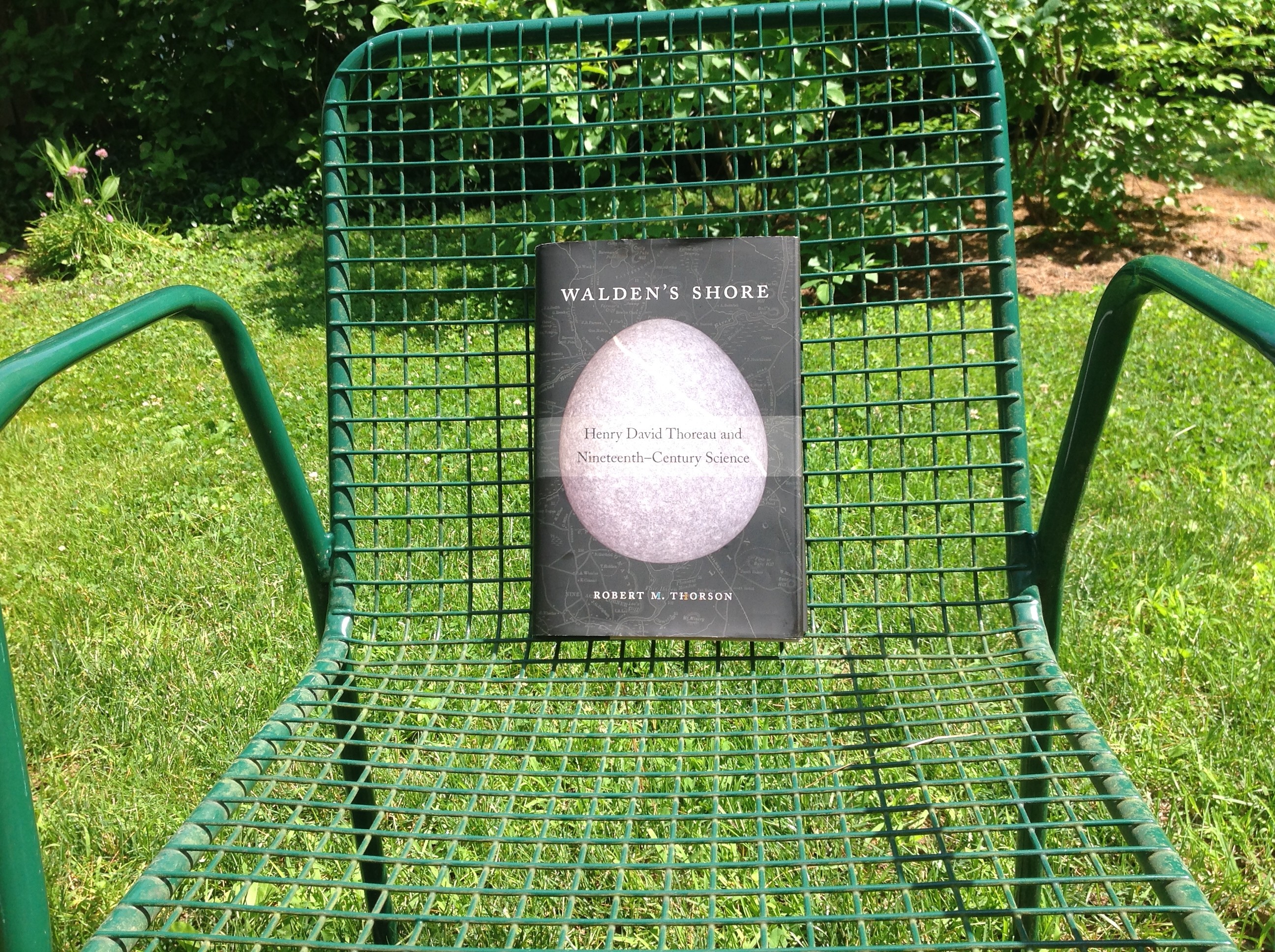
photo

Noted Thoreau scholar, Jeffrey Cramer, offers a book blurb saying, “Walden’s Shore has no predecessor in the field of Thoreau studies. It is a welcome addition and needed reassessment of an iconic figure.” I’ve found this true. Part of the difficulty of reading Thoreau lies in his transcendence of time – he speaks across ages with insights that lift him from the context of his own time, and a reader can end up looking up to him in a way that leaves that reader ungrounded. There is irony in this of course, because Thoreau’s vision is rooted in his ability to stay very much on the ground, to see in fact into it and take the measure of whatever moves on and through his days in Concord.

Thorson’s gift is also to see beyond the immediate and into what’s often called “deep time” and the shaping of the world we walk. We learn how the surface features at and around Walden tell stories remarkably similar to those intuited by Thoreau during his intense examination of those features. And, from Thorson’s particular reading of Thoreau’s journals, we see a tracery of Thoreau’s deepening tendency toward scientific measurement and thinking as he writes Walden. Thorson keeps track of “every entry where Thoreau seemed to be mensurating or thinking spatially beyond what would have been expected of a competent naturalist of his day.” Before 11/23/50, Thorson finds 
no cases; from that date forward to the close of the Walden period on 4/27/54,” Thorson counts 62 cases. This reading makes a nice summary of Thoreau’s evolving scientific mind.

“Let us settle ourselves, and work and wedge our feet downward through the mud and slush of opinion, and prejudice, and tradition, and delusion, and appearance, that alluvion which covers the globe…till we come to a hard bottom and rocks in place, which we can call reality,” Thoreau writes in Walden. And Thorson then endeavors to show his readers just where that bedrock bottom is and how Thoreau, ever prescient, apprehended it, well before modern sensing and imaging devices confirmed many of his views.

Thorson also sums up scientific thinking before and up to Thoreau’s writing of Walden, and limns Thoreau’s place in the scientific ferment of his day, when that era’s creationists first felt the swelling power of Darwin’s theories. This is useful, necessary context for a deeper appreciation of Thoreau’s work and intelligence. But, if that were all Walden’s Shore offered I would have stalled in mid book.

For me, a reader (and sometimes writer) of stories, Walden’s Shore’s gifts and appeal are deepened by the interlacing of imagined narratives throughout the book. Just when geologic theory threatens to deaden or swamp my mind, Thorson cuts to narrative – there, then, is Thoreau out walking and recording and opining about what he sees. Here then is the living character in real time, and the drift of continents and clash of tectonics becomes – as it is in our lives – backdrop for our fascination with people.

As Thorson writes in his introduction, “This book is heavily biased toward presenting Thoreau as a competent, pioneering geoscientist. With few exceptions, I emphasize what he got right and overlook what he got wrong or didn’t notice. Mine is not a fair and balanced treatment.” Yes…and because this is at root a narrative of human exploration that seems just fine.

Added note: Thorson writes with clear sentences and an understanding of narrative’s lures and power. That may sound like usual praise; it is not.
Raptors and Riparians

by Ashton Nichols

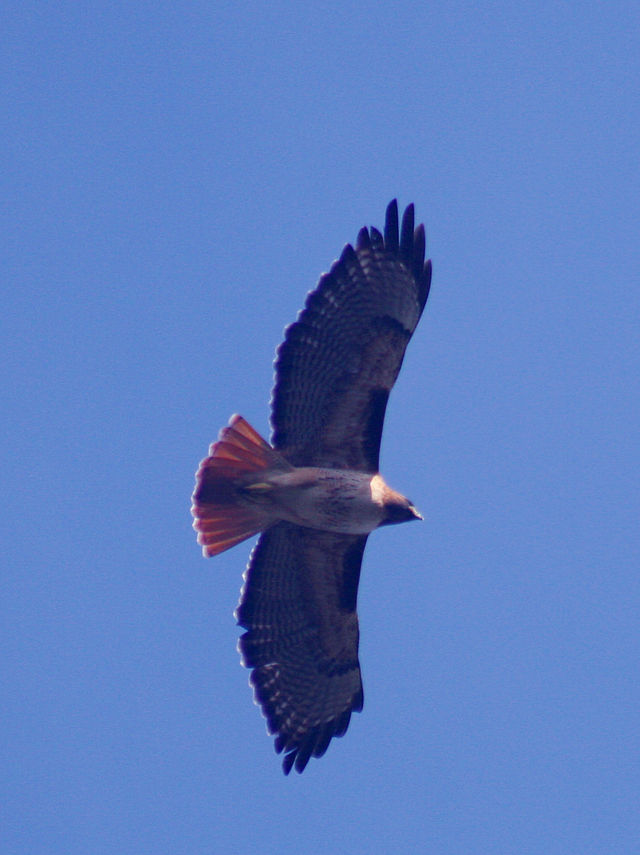
In addition to songbirds, our Creekside is also a realm of raptors; that is to say, it is busy with that expansive group of avian species that include the hawks, and the eagles, and the owls. “Raptor” derives from a Latin word rapere, which means–as you might imagine–to seize forcefully. This morning it was just two red-tailed hawks circling high above the farm fields near us, squawking a call that is known to all of those who remember the television show Northern Exposure: “Awwkkee, aawwkkee!” they cry, as gangs of crows circle around them in small flocks, working hard to chase them away. But the red-tailed hawks often win. Today it seems like a draw, as the crows disperse and scatter into the tall trees off toward the western horizon, and the red-tails sail away into the distance in the direction of North Mountain. With this dramatic encounter of hawks and crows, I thought I was done with my bird-watching for the day, but I was not very prophetic on this blue-skied dawn.

Red-tail: Unharried on High. photo by Brocken

Red-tail: Unharried on High.
photo: http://en.wikipedia.org/wiki/Redtail_hawk#mediaviewer/File:Red-tailed_hawk_in_flight.jpg

Hawks like these aggressive hunters are here almost every day. Usually it is red-tails like this pair, but sometimes it is Cooper’s hawks or sharp-shins, kestrels (not really much larger than large songbirds) or broad-wings. These hawks in their kettles all gather here because the hunting is so good: field mice and moles, voles and even big rats, all drawn by the hundreds of acres of seeded farm-fields around us, by the stacks of grain and corn in the barns, and by the smaller birds that hawks are also willing to eat. I have seen a peregrine falcon take a sparrow right out of the sky in front of me, in a flash of feathers that looked like an explosion of bird-life.

There are also cats on the farm here, as you might well expect: barn cats in their low dozens: tigers and tortoise-shells, an orange-and-white that is one of my favorites, and even a jet black bit of bad luck, but I like her a lot. Yet even all of these felines cannot keep the microtis (the word that means “small-eared” when it refers to little furry mammals) that surround us at bay. There cannot be too many cats for the hawks; there cannot be too many cats for the rats. Here at Creekside we witness the delicate balance of nature: hawks and cats, mice and rats, and even thousands upon thousands of spring-peeper frogs, but more about them and their role anon.

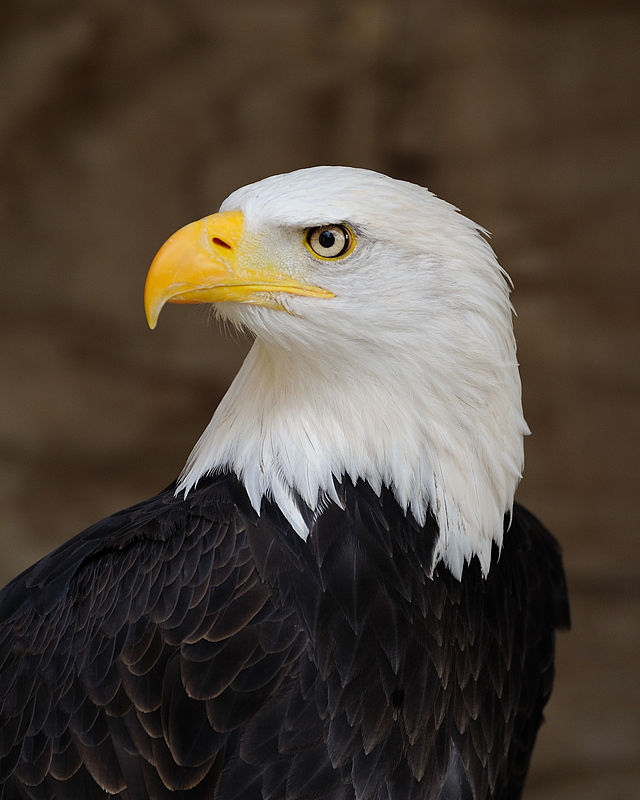
We also have bald eagles at Creekside this spring and early summer, at least two often-seen juvenile birds that we have been watching closely for almost six months now. We have watched them as they have grown and matured, as they soar from one wide farm-field to the other, and then as they sail away down toward the wide-open creek bed, and especially as they change their wide-winged plumage from brown-and-white splotches to the beautifully characteristic white head and tail. Bald eagles are born with almost as many white feathers as brown ones scattered throughout their wide body and wings and then, as they grow, the brown number increases, and the white one shrinks to just their heads and tails. In the male, as all good Americans know, this white ends up only covering the head and the sparkling white tail. The adult female, however, unlike most other bird species, looks almost exactly like the adult male, but she is a little bit larger all over: her wingspan is wider, she weighs a bit more, her beautifully curved bill is a bit longer, and so are the sharp rear talons on her wildly lizard-looking legs.

Photo by Lloyd MacKenzie

Photo by Lloyd MacKenzie

Several years ago, there was a registered bald eagle’s nest about five miles to the northwest of us along our same winding creek. A registered nest has watchers from the Audubon Society, and other official birding groups, who regularly report on the condition of the nest, the number of eagle’s eggs, and just how the young develop as they hatch and then mature. But these two juveniles that we have been watching this year are clearly from much closer by; the nest from which they fledged must be just down the hill from us or along the wide ox-bow that winds across and along the creek to our immediate west. These two birds fly close enough to us sometimes so that we can see their curved beaks and reptilian talons. They roost in tall pine trees nearby and the locust trees just behind the house, and then they swoop down and soar across the nearby fields and creek in search of prey. Once, at least once, we saw one of these magnificent birds with that very same prey in its talons, captured and spiked right through with razor sharp claws, a small rodent or other immature mammal, dead now and soaring off across the wide fields toward the mountain ridge above us, another kill, another capture, another protein feast for this fine national bird that we call America’s.

Finally, our owls are the last group of raptors here with us at Creekside. We have never seen one, at least we have not seen one yet, but we often hear them in numbers at night, calling from deep down in the Conodoguinet creek bed. Most often it is the barred owl, with its characteristic, “Who cooks for you all; who cooks for you?” and then sometimes, when we get lucky, we hear the noble great horned owl, with a more stately and solemn, “Whooo, whooo, whoo, whoo! Whoo, whoo, whoo, whooo!”

Often Heard, Seldom Seen - the Spring Peeper. Photo by Zach Welty

Often Heard, Seldom Seen – the Spring Peeper.
Photo by Zach Welty

Some nights these owl calls even drown out the chorus of spring peeper frogs, or these two choruses–avian and reptilian–vie for supremacy, first the frogs taking over, “Kee, ke, ke, kee, keek–Kee, kee, ke, kee,” and then the owls, especially that booming great horned sound, “Whoo, whoo, whoo, whoo; whoo, whoo, whoo, whoo!” We drift off to sleep with these sounds in our heads: the huge owls off in the distance and then these tiny frogs, thousands of them not much bigger than the size of your thumbnail–just two hundred to three hundred yards away–peeping loudly: “peeeep, peeep, peep-peep, peeeep,” and we are lulled into unconsciousness by these booming repeated raptor calls followed by these delicate riparian replies.

Solstice Dance

Solstice – In The Long Light of the Journals

The light woke me before five this morning. Often, these days, it’s the birds, whose singing begins with a single fluted call just after four; that call garners response. Then, the avian neighborhood joins in. But today, appropriately, it was the light, which seemed intent on my living the fullness of this “longest” day of the year. I got up, brewed some coffee and went to a morning chair to read.

Through these days in 1855, Henry Thoreau was also making the most of the long light, spending hours out and about, and, for the most part, recording only the nests he observed in short journal entries. These days form a skein of regeneration: as the light peaks the whole world seems to be rising and chirping from its many cupped circles. Young birds break from their eggs, squall for food, fledge finally, and Henry, as he walked, must always have been looking up. A whole sky alight suggested as much.

But one day, the 18th, on his way to or from The Hemlocks, Henry catches motion on the ground. First one, then another, painted tortoise appears: “I saw a painted tortoise just beginning its hole; then another a dozen rods from the river on the bare barren field near some pitch pines…I stooped down over it, and, to my surprise, after a slight pause it proceeded in its work, directly under and within eighteen inches of my face.” For long minutes Henry stays still in this “constrained position,” watching, as the turtle digs her hole and lays five “wet, flesh-colored” eggs. His description is typically precise, satisfying, and now, this reader thinks, it’s time to rise from this cramping crouch and move on. Perhaps to the next local miracle.

From Henry's Point of View

From Henry’s Point of View

Henry, however, stays; I stay too. And I am rewarded with a recovered favorite image, a dance of completion that seems just right for the days of maximum light:

After these ten minutes or more, it without pause or turning began to scrape the moist earth into the whole with its hind legs, and, when it had half filled it, it carefully pressed it down with the edges of its hind feet, dancing on them alternately, for some time, as on its knees, tilting from side to side, pressing by the whole weight of the rear of its shell…The thoroughness with which the covering was done was remarkable. It persevered in drawing in and dancing on the dry surface which had never been disturbed long after you thought it had done its duty, but it never moved its forefeet, nor once looked round, nor saw the eggs it had laid.

Painted Turtle Laying Eggs

I put the journal down. I have seen such dancing, for me snapping turtles crawled up from a nearby bog. Now the image is fresh again, a dance of the solstice lit by the long day of Henry Thoreau’s writing.