Category Archives: Nature

September Morn at Walden

By Corinne H. Smith

patricewalden1


I come to Walden twice a year
To saunter ‘round the pond.
We gather at the replica
And set off after dawn.

It’s crisp and quiet on this day
When we begin our walk.
I tell my fellow colleagues
Just to listen and not talk.

We tiptoe as the clock would,
With the water to our right,
And share the place with fisherfolk
And swimmers glistening bright.

The Sun may be a morning star;
But its pale brother Moon
Still hangs above the railroad tracks:
It fades away too soon.

The air is chilly, that’s for sure.
I keep my hands tucked in.
A mist swirls on the water;
I can feel it nip my skin.

A few bold blue jays cackle
From the trees above our heads.
Then nuthatches and chickadees
Dart in and chirp instead.

But something’s missing from the scene:
A motion and a sound.
No chipmunks squeal across our path:
They’ve all stayed underground.

When I lead walks, they often
Chase each other near my feet.
The trail has fallen silent now;
The hike seems incomplete.

We make it to the house site
And we think of friend Thoreau.
If he were here, he’d no doubt
Tell us what we need to know.

And then we keep on going
With the sun strong in our eyes.
The bathers are just showing up
With blankets and supplies.

Companions tell me that they spied
Some chipmunks later on.
But they were few; and quick enough,
They scurried and were gone.

Are they driven by the cool air?
Do they sense the morning mist?
Will they have enough for winter?
Will they chatter and persist?

I wonder what you do, chips.
Are you snuggled, safe and dry?
Enjoy your hibernation, then.
I’ll see you next July.
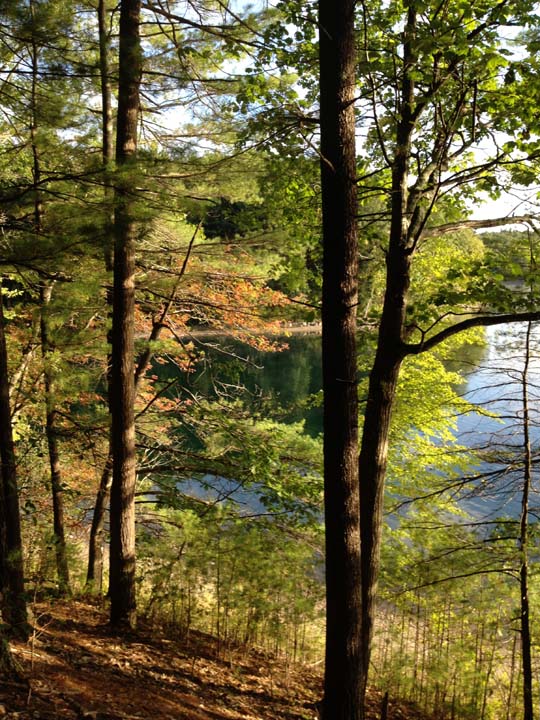
patricewalden2


Photographs are courtesy of Patrice Todisco, Executive Director, Freedom’s Way National Heritage Area.

Trees for the Forest

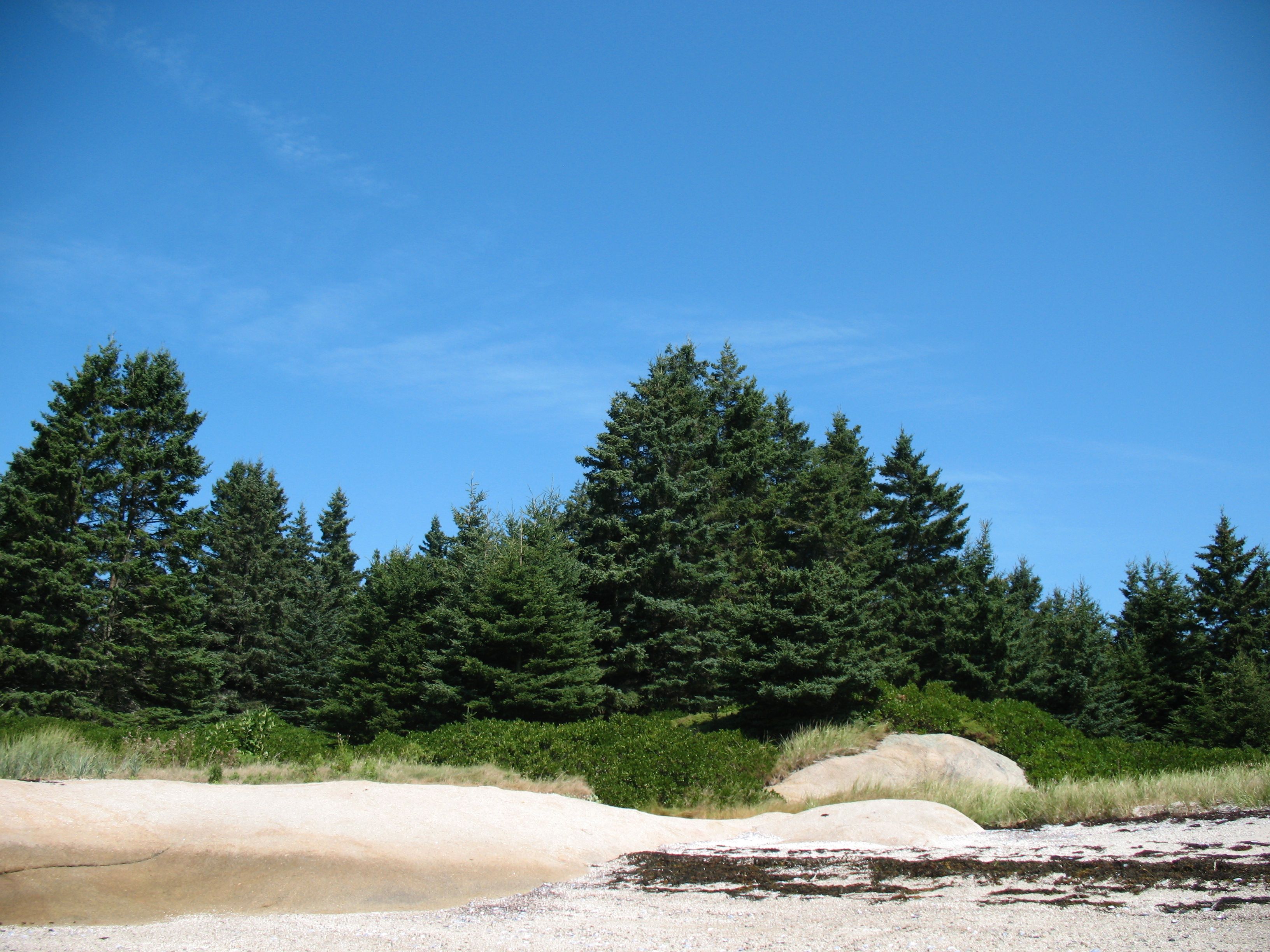
I’ve spent much of my summer nearly past amid the trees; I became more mindful of this during a recent paddle on wide open waters near Maine’s Isle au Haut (pronounced locally, Isle a Ho). Most of the islands in this area are dense with forest, mostly spruce, birch and few white pines, and, when I pulled in for a rest stop on Wreck Island, I stepped from under a wide ocean sky into a close, lichen-papered room of dark woods. Pale green bearded-moss filtering the light hung from the trees; my eyes had to jump open a number of f-stops to see. A thin trail wound off to the right, and, for a minute, I watched it expectantly. Wreck Island is, however, now inhabited only by deer and assorted smaller animals, and so I was really peering down a trail and waiting for the past to arrive.

Spruce-capped Islands

Spruce-capped Islands

That past, in the late 1700s and throughout the 1800s, saw very different islands, first claimed and then inhabited by a mix of farmers and fishermen and soon shorn of their trees, which went for fields, buildings, boats, heat and, as the 1800s wore on, pulp. Photos from the 1880s are recognizable only in the shapes of the islands. Such shearing of woodlands was, of course, familiar to Henry Thoreau in Concord also – that long-farmed landscape was cut close, which undoubtedly helped Thoreau treasure those patches of swamp and woodland left untouched. But to find deep woods, Thoreau had to travel to interior Maine.

As I paddled amid the islands, I thought about the microcosm of regeneration each represents. All but a few have full heads of forest-hair, and the interiors of those forested islands have reverted to the timeless suggestion and mystery of woodlands. On one tiny island (Potato), the heart-shaped hoof prints of deer pointed to who lived there now. The regreening of New England has been much noted (over 80% of our region is now forested), and, as the trees and forest thicken annually, woody anomalies keep reappearing too – a mountain lion in Connecticut (DNA sampling said he’d migrated from the Dakotas), a moose on Rte 128, bears in backyard trees. Now, ironically, the most shorn of landscapes can be found in the vast clear cuts of Maine’s interior, where only narrow “beauty strips” of trees separate those who paddle the rivers from the dazed, cut-over square miles of former woods.

New Trees above the cove at Wreck Island

New Trees above the cove at Wreck Island

Thoreau liked to count the rings of trees and learn the outlines of their stories during the good years and the hard. Counting the trees of this summer outlines a story of regeneration that Henry Thoreau would have nodded at and liked.

September Days

I know the feeling.

The days of this September week have acted on me as they may have acted on Henry in 1855. His journal covers the month’s first 12 days in under a page, ending with two haiku-like entries (I have reshaped them to suggest the form, and yes, the syllable-count stricture is relaxed):

Sept. 11 loudly the
cricket mole creaks by mid-afternoon
muskrat houses begun

Sept. 12 a few
clams freshly eaten some
grapes ripe.

Perhaps the slanting light and the etched clarity of each branch and leaf kept Henry from more usual, detailed writing; perhaps he felt summoned outside, even as the year began to contract. Surely, it’s felt that way for me. Summer’s expansive and eternal mornings have been replaced by sharp, cool air and the sense that something stirs to my north. Every minute outside seems precious and won; the clear air has said, Look and see.

And I have been rewarded:

Bluest sky tall spruce
a single perch for survey
two bald eagles vie

Pebbles crunch underfoot
laughter peals from the white birch
pileated woodpecker

Sea to horizon
ripples shot with sun flight
all day to paddle