Author Archives: Sandy Stott

All of the Crayons in the Box

Editor’s Note: Corinne Smith, author of Westward I Go Free: Tracing Thoreau’s Last Journey, will be speaking at the Acton Memorial Library, on Thursday, May 15th at 7:00 p.m.

By Corinne H. Smith

“How encouraging to perceive again that faint tinge of green, spreading amid the russet on earth’s cheeks! I revive with Nature; her victory is mine. This is my jewelry.” ~ Thoreau’s journal, April 3, 1856

“Green is essentially VIVID, or the color of life, and it is therefore most brilliant when a plant is moist or most alive. A plant is said to be green in opposition to being withered and dead. The word, according to Webster, is from the Saxon GRENE, to grow, and hence is the color of herbage when growing.” ~ Thoreau’s journal, April 2, 1855

When I was a child, I loved crayons and coloring books. I liked to fill the blank spaces with the colors of my own choosing. I was never too daring, though. I stuck to the palette of the world as I understood it. I never ended up with purple skies or purple people. (Even though that was then my favorite color.) I always used the crayon marked GREEN for grass, for leaves, and for the tops of the trees. After all, that’s what we were taught. The sky is blue, the grass is green. So that’s what we saw. It came down to the basics. At that young age, I conformed to them.

Soon, I advanced beyond the primary colors and got the double-box set of 24 crayons. Now I had additional greens to consider, like OLIVE GREEN and BLUE GREEN. Neither one of these looked very much like green to me. Had someone made a mistake on the labels? And why did I now have both YELLOW GREEN and GREEN YELLOW? How could the order of the words make such a difference when I applied these colors to the page? How would I ever remember which one I liked better? I began to keep my favorites on the right-hand side of the container so that I would never pick up the “wrong” one by mistake.

But getting older meant eventually advancing to the big box. 64 crayons – Alas! Suddenly I had too many choices. What was with all of these greens? In addition to the previous ones from the smaller collection, I now had FOREST GREEN and PINE GREEN as options. My young suburban mind didn’t grasp the nuances of these two, either. Didn’t pine trees grow in forests? How could these colors be different? The one that confused me the most was the crayon labeled SPRING GREEN. It wasn’t really a green, and it wasn’t really a yellow. It was neither YELLOW GREEN nor GREEN YELLOW. Evidently someone at the crayon factory thought that it represented a color found in the natural world during the season of Spring. This is silly, I thought, as I slid the crayon into the left-hand side of the box. I’d never seen that color in our neighborhood in Spring.

Well, now I do.
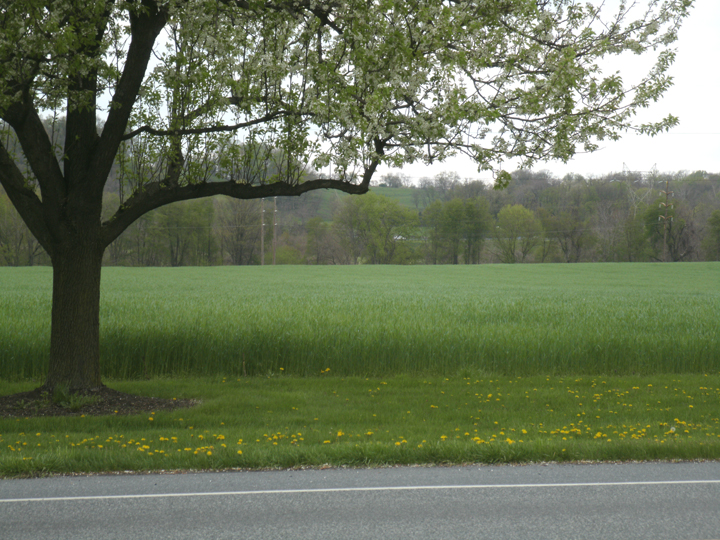
 

The many greens of Spring

The many greens of Spring

As an adult, I’ve grown to notice all of the variations on the green theme that emerge in front of us as winter winds down. Now I love it. Now I find it fascinating. The willows start first, soon after the groundhog pops out of his den to scrutinize his shadow. They seem to turn that GREEN YELLOW hue before the green intensifies. Other trees begin with tiny leaflets that are SPRING GREEN or YELLOW GREEN before they deepen in color. But each tree is different. Each field or each lawn is different. You can look across the countryside today and see more greens than you ever thought were possible.

“To be awake is to be alive,” Henry Thoreau said. Sometimes we see the finer details only as we get older, I guess. We realize that the sky is rarely entirely blue, and that even the most manicured lawn is made up of a variety of greens. And in the wider landscape that is Spring-ing up around us, Dame Nature is using all of the colors in the box, and then some. Fifty years later, SPRING GREEN now makes sense to me. Who knew that you could learn so much from a fist-full of crayons?

Who knew that a single color could have so many cousins?

crayons

How I Missed the Anniversary…of Thoreau’s Death…Again

May 6th. You’d think it would be embossed in my mind – all these years of reading and teaching Thoreau, and yet, it slipped by again.

On the evening of this slippage, while I supervised an impatient study hall, I wondered to myself: why is that?

Here’s what I answered: it sounds simple, hokey, even, but for me, Henry Thoreau lives on. It would be a cliche to point to Walden and other works and say, “see, all around the world people read these words and then look up and change; all around the world people read and develop or renew their faith in I.” True…but trite to write.

And I’ve been reading through his spring journal of 1855, even as I live my spring of 2014. We have shared hawks and peepers and redwing blackbirds, woodland meanderings. All good, but…

Here then is a more personal truth: years of living with Henry Thoreau’s writing have given me new eyes. Every day when I walk out the door, I look up, I scan the peripheries of each world I step into – yesterday the robin nesting in the dwarf pine was facing east as she sat atop her two blue eggs; today, she’s facing south. The copper beech in the yard is kicking finally last year’s dun leaves from a hold that endured quite a winter. The parking lot maple prepares a riot of seeds…so much faith.

It all begins…again.

Little Feats

Note: no quotations from Henry Thoreau in this post, but I like to think a similar spirit suffused his mountains.

The other day, while small-stepping along the trails that lead to and from Walden, I got to thinking about footwork. A lifetime of trails has kept me reasonably adept at the juggling cadence needed for New England trails and their studding of rocks and roots, often disguised by leaf litter. But it was a sharp downhill that triggered this running meditation.

Not long ago, I’d heard from a younger friend who runs mountain trails. I’d asked for a report about a loop I like, and I had gotten back a detailed account of a daylight-long ramble. At its close he wrote, “the last five miles go by pretty quickly with a bomber descent off Flume and a flat mile out to the road.” ‘Bomber descent,’ I thought as I short-stepped down the sharp, forty-foot drop off an esker; ‘no way no way no way no no way…’ – this one-syllable no-mantra set up with my stepping.

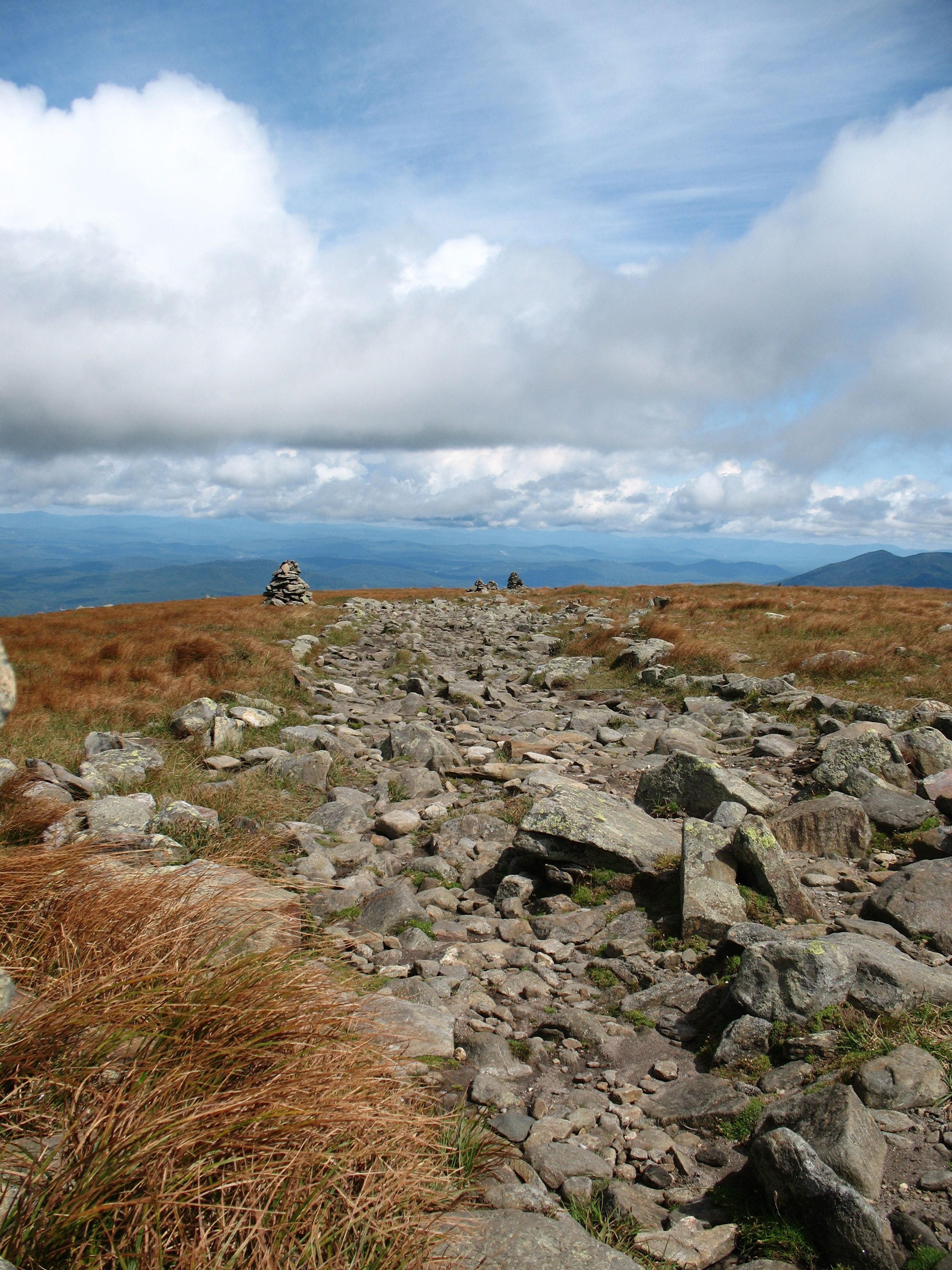
All of New England’s mountains genuflect to their northern shaper, the glaciers, gone to water for now, but likely to cycle back at some point. The upended, frost-split rock is their residue, and everyone who visits our uplands must contend with its odd angles.

As boy turned loose for the first time from parental supervision, I began to stride and run through the White Mountains. I was seventeen; I was in a hurry. Beyond each summit was another, and that was where I wanted to be.

Rock-strewn Way

Rock-strewn Way

Memory’s scrapbook holds images from a summer day moving north along the ridge that joins Mt. Washington to Mt. Jefferson; I am with a 17-year-old friend who is new to these hills and their jumbled trails; I am his trail-tutor. “Look,” I say, eyeing the half-mile descent of Mt. Clay’s flank, “it’s more fun to run this.” I don’t think so,” he replies, and he starts down in a stolid fashion. “At least take my pack,” I say, and he returns, shoulders it (only a day pack) and turns downhill again. I watch him grow steadily smaller.

The amperage loose in my system has me edgy, which is another way to say sharp. I see my first five steps and figure the rest will appear. They do. I land on various edges, listen to the hollow clunk of my boots and odd knocking stones, and when I can’t find my next step immediately, I do what my mountain-running counselor taught me at fourteen – I “go up.”

“Going up,” jumping higher when you see no landing, may sound counterintuitive, but it works. In those few airborne seconds, you find your next step, even if it is a thin edge of stone; and then you quick-step on. This is rock-dancing, and in that era of life that was my way.

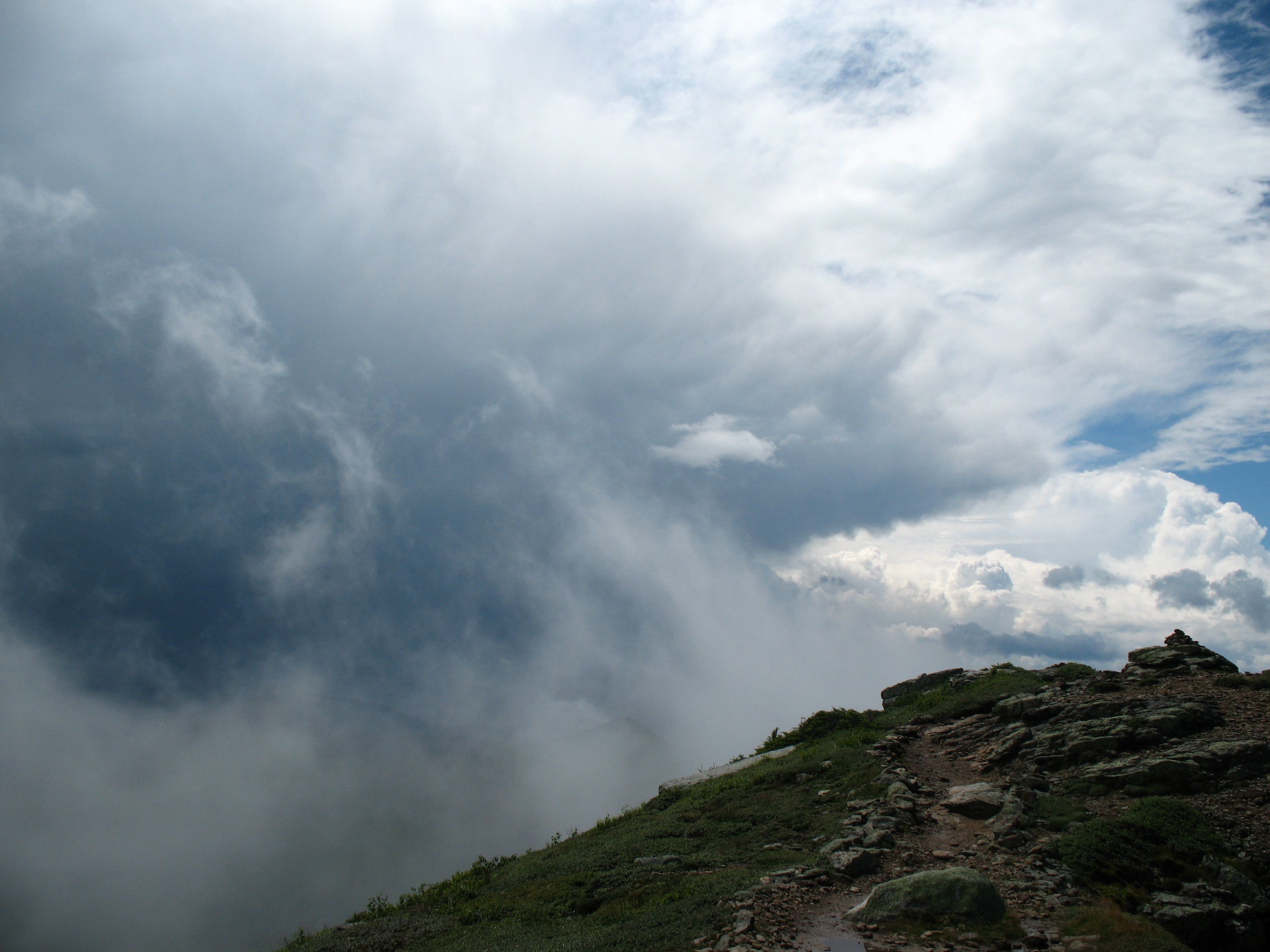
Up There - Franconia Ridge

Up There – Franconia Ridge

That memory leads to appreciation for the ways our walking changes over time. And so, even as I walk and shuffle the same trails as my younger friend and my younger self, I leave the bombing to them and dance now in short steps. They are my little feats.

Post note: surely, when you consider the ground Henry Thoreau covered on his walks and in the hills, he too must have “danced” or “bombed” some of his descents.